

Improvement of fine-grained and cohesive soils 151
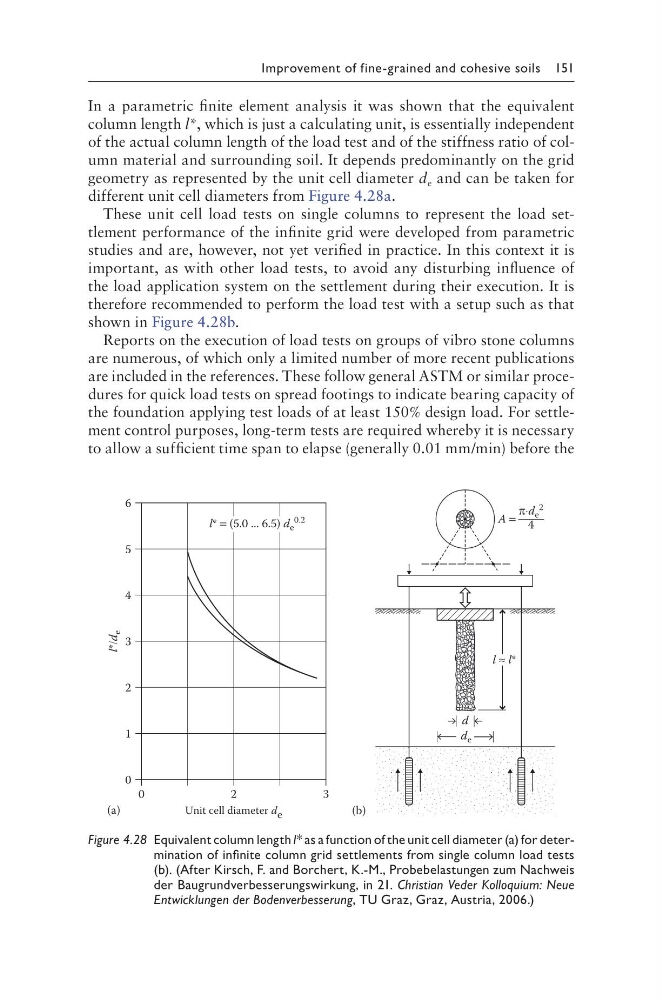
In a parametric finite element analysis it was shown that the equivalent
column length l*, which is just a calculating unit, is essentially independent
of the actual column length of the load test and of the stiffness ratio of column material and surrounding soil. It depends predominantly on the grid
geometry as represented by the unit cell diameter d e and can be taken for
different unit cell diameters from Figure 4.28a.
These unit cell load tests on single columns to represent the load settlement performance of the infinite grid were developed from parametric
studies and are, however, not yet verified in practice. In this context it is
important, as with other load tests, to avoid any disturbing influence of
the load application system on the settlement during their execution. It is
therefore recommended to perform the load test with a setup such as that
shown in Figure 4.28b.
Reports on the execution of load tests on groups of vibro stone columns
are numerous, of which only a limited number of more recent publications
are included in the references. These follow general ASTM or similar procedures for quick load tests on spread footings to indicate bearing capacity of
the foundation applying test loads of at least 150% design load. For settlement control purposes, long-term tests are required whereby it is necessary
to allow a sufficient time span to elapse (generally 0.01 mm/min) before the
l ≈ l*
d
A = 4
π⋅d e
2
3
0
2
0
6
5
4
3
2
1
Unit cell diameter d e
l* = (5.0 ... 6.5) d e
0.2
l*/d
e
(a)
(b)
d e
Figure 4.28 Equivalent column length l* as a function of the unit cell diameter (a) for determination of infinite column grid settlements from single column load tests
(b). (After Kirsch, F. and Borchert, K.-M., Probebelastungen zum Nachweis
der Baugrundverbesserungswirkung, in 21. Christian Veder Kolloquium: Neue
Entwicklungen der Bodenverbesserung, TU Graz, Graz, Austria, 2006.)
In a parametric finite element analysis it was shown that the equivalent
column length l*, which is just a calculating unit, is essentially independent
of the actual column length of the load test and of the stiffness ratio of column material and surrounding soil. It depends predominantly on the grid
geometry as represented by the unit cell diameter d e and can be taken for
different unit cell diameters from Figure 4.28a.
These unit cell load tests on single columns to represent the load settlement performance of the infinite grid were developed from parametric
studies and are, however, not yet verified in practice. In this context it is
important, as with other load tests, to avoid any disturbing influence of
the load application system on the settlement during their execution. It is
therefore recommended to perform the load test with a setup such as that
shown in Figure 4.28b.
Reports on the execution of load tests on groups of vibro stone columns
are numerous, of which only a limited number of more recent publications
are included in the references. These follow general ASTM or similar procedures for quick load tests on spread footings to indicate bearing capacity of
the foundation applying test loads of at least 150% design load. For settlement control purposes, long-term tests are required whereby it is necessary
to allow a sufficient time span to elapse (generally 0.01 mm/min) before the
l ≈ l*
d
A = 4
π⋅d e
2
3
0
2
0
6
5
4
3
2
1
Unit cell diameter d e
l* = (5.0 ... 6.5) d e
0.2
l*/d
e
(a)
(b)
d e
Figure 4.28 Equivalent column length l* as a function of the unit cell diameter (a) for determination of infinite column grid settlements from single column load tests
(b). (After Kirsch, F. and Borchert, K.-M., Probebelastungen zum Nachweis
der Baugrundverbesserungswirkung, in 21. Christian Veder Kolloquium: Neue
Entwicklungen der Bodenverbesserung, TU Graz, Graz, Austria, 2006.)