

Improvement of fine-grained and cohesive soils 147
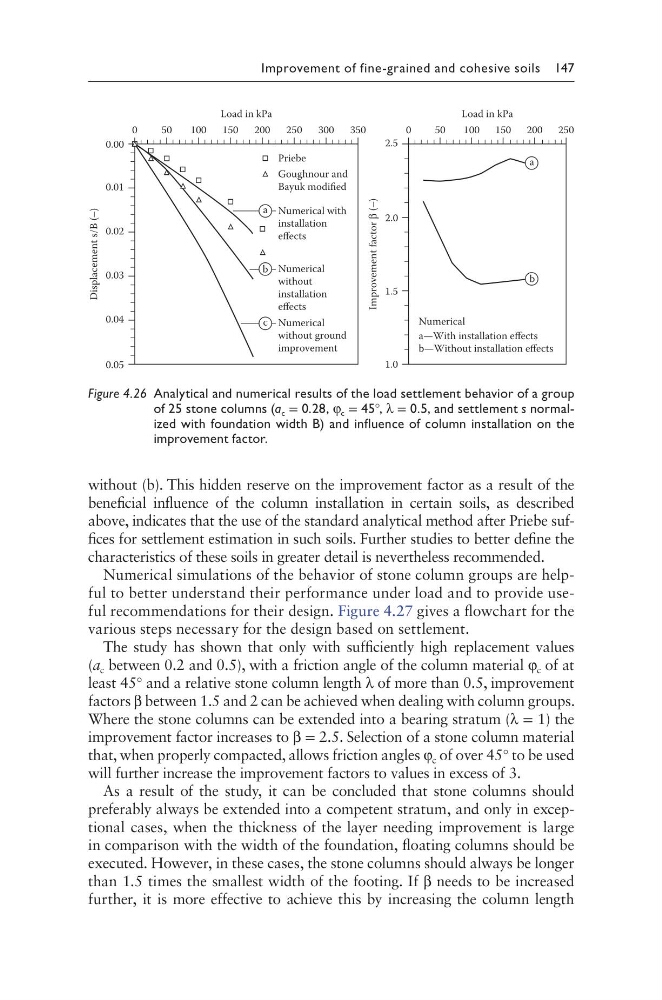
without (b). This hidden reserve on the improvement factor as a result of the
beneficial influence of the column installation in certain soils, as described
above, indicates that the use of the standard analytical method after Priebe suffices for settlement estimation in such soils. Further studies to better define the
characteristics of these soils in greater detail is nevertheless recommended.
Numerical simulations of the behavior of stone column groups are helpful to better understand their performance under load and to provide useful recommendations for their design. Figure 4.27 gives a flowchart for the
various steps necessary for the design based on settlement.
The study has shown that only with sufficiently high replacement values
(a c between 0.2 and 0.5), with a friction angle of the column material φ c of at
least 45° and a relative stone column length λ of more than 0.5, improvement
factors β between 1.5 and 2 can be achieved when dealing with column groups.
Where the stone columns can be extended into a bearing stratum (λ = 1) the
improvement factor increases to β = 2.5. Selection of a stone column material
that, when properly compacted, allows friction angles φ c of over 45° to be used
will further increase the improvement factors to values in excess of 3.
As a result of the study, it can be concluded that stone columns should
preferably always be extended into a competent stratum, and only in exceptional cases, when the thickness of the layer needing improvement is large
in comparison with the width of the foundation, floating columns should be
executed. However, in these cases, the stone columns should always be longer
than 1.5 times the smallest width of the footing. If β needs to be increased
further, it is more effective to achieve this by increasing the column length
0
5 0
100
150
200
250
300
350
0.02
0.03
0.05
0.01
0.04
0.00
2.0
1.0
1.5
2.5
Priebe
Numerical with
installation
effects
a—With installation effects
b—Without installation effects
Numerical
without
installation
effects
Numerical
without ground
improvement
Goughnour and
Bayuk modified
a
c
b
a
b
Load in kPa
0
5 0
100 150 200 250
Load in kPa
Displacement s/B (−)
Improvement factor β
(−)
Numerical
Figure 4.26 Analytical and numerical results of the load settlement behavior of a group
of 25 stone columns (a c = 0.28, φ c = 45°, λ = 0.5, and settlement s normalized with foundation width B) and influence of column installation on the
improvement factor.
without (b). This hidden reserve on the improvement factor as a result of the
beneficial influence of the column installation in certain soils, as described
above, indicates that the use of the standard analytical method after Priebe suffices for settlement estimation in such soils. Further studies to better define the
characteristics of these soils in greater detail is nevertheless recommended.
Numerical simulations of the behavior of stone column groups are helpful to better understand their performance under load and to provide useful recommendations for their design. Figure 4.27 gives a flowchart for the
various steps necessary for the design based on settlement.
The study has shown that only with sufficiently high replacement values
(a c between 0.2 and 0.5), with a friction angle of the column material φ c of at
least 45° and a relative stone column length λ of more than 0.5, improvement
factors β between 1.5 and 2 can be achieved when dealing with column groups.
Where the stone columns can be extended into a bearing stratum (λ = 1) the
improvement factor increases to β = 2.5. Selection of a stone column material
that, when properly compacted, allows friction angles φ c of over 45° to be used
will further increase the improvement factors to values in excess of 3.
As a result of the study, it can be concluded that stone columns should
preferably always be extended into a competent stratum, and only in exceptional cases, when the thickness of the layer needing improvement is large
in comparison with the width of the foundation, floating columns should be
executed. However, in these cases, the stone columns should always be longer
than 1.5 times the smallest width of the footing. If β needs to be increased
further, it is more effective to achieve this by increasing the column length
0
5 0
100
150
200
250
300
350
0.02
0.03
0.05
0.01
0.04
0.00
2.0
1.0
1.5
2.5
Priebe
Numerical with
installation
effects
a—With installation effects
b—Without installation effects
Numerical
without
installation
effects
Numerical
without ground
improvement
Goughnour and
Bayuk modified
a
c
b
a
b
Load in kPa
0
5 0
100 150 200 250
Load in kPa
Displacement s/B (−)
Improvement factor β
(−)
Numerical
Figure 4.26 Analytical and numerical results of the load settlement behavior of a group
of 25 stone columns (a c = 0.28, φ c = 45°, λ = 0.5, and settlement s normalized with foundation width B) and influence of column installation on the
improvement factor.