

Improvement of fine-grained and cohesive soils 145
measured at normal pressures of over 200 kN/m 2 . Herle et al. (2007) have
also noted that conventionally used friction angle values of only 40° appear
too conservative when designing vibro replacement stone columns.
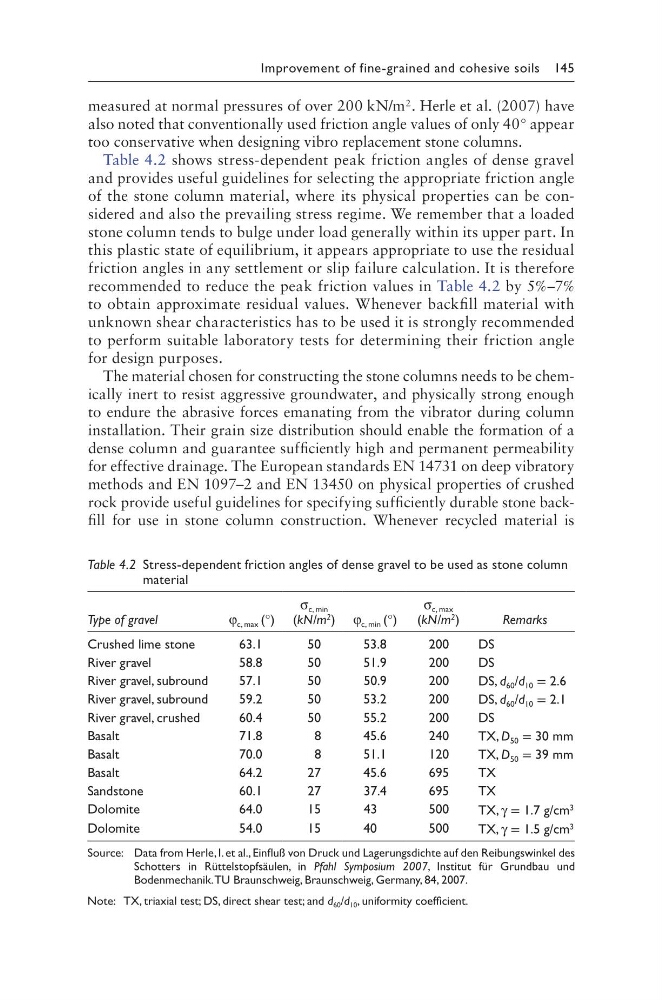
Table 4.2 shows stress-dependent peak friction angles of dense gravel
and provides useful guidelines for selecting the appropriate friction angle
of the stone column material, where its physical properties can be considered and also the prevailing stress regime. We remember that a loaded
stone column tends to bulge under load generally within its upper part. In
this plastic state of equilibrium, it appears appropriate to use the residual
friction angles in any settlement or slip failure calculation. It is therefore
recommended to reduce the peak friction values in Table 4.2 by 5%–7%
to obtain approximate residual values. Whenever backfill material with
unknown shear characteristics has to be used it is strongly recommended
to perform suitable laboratory tests for determining their friction angle
for design purposes.
The material chosen for constructing the stone columns needs to be chemically inert to resist aggressive groundwater, and physically strong enough
to endure the abrasive forces emanating from the vibrator during column
installation. Their grain size distribution should enable the formation of a
dense column and guarantee sufficiently high and permanent permeability
for effective drainage. The European standards EN 14731 on deep vibratory
methods and EN 1097–2 and EN 13450 on physical properties of crushed
rock provide useful guidelines for specifying sufficiently durable stone backfill for use in stone column construction. Whenever recycled material is
Table 4.2 Stress-dependent friction angles of dense gravel to be used as stone column
material
Type of gravel
φ c, max (°)
σ c, min
(kN/m 2 ) φ c, min (°)
σ c, max
(kN/m 2 )
Remarks
Crushed lime stone
63.1
50
53.8
200
DS
River gravel
58.8
50
51.9
200
DS
River gravel, subround
57.1
50
50.9
200
DS, d 60 /d 10 = 2.6
River gravel, subround
59.2
50
53.2
200
DS, d 60 /d 10 = 2.1
River gravel, crushed
60.4
50
55.2
200
DS
Basalt
71.8
8
45.6
240
TX, D 50 = 30 mm
Basalt
70.0
8
51.1
120
TX, D 50 = 39 mm
Basalt
64.2
27
45.6
695
TX
Sandstone
60.1
27
37.4
695
TX
Dolomite
64.0
15
43
500
TX, γ = 1.7 g/cm 3
Dolomite
54.0
15
40
500
TX, γ = 1.5 g/cm 3
Source: Data from Herle, I. et al., Einfluß von Druck und Lagerungsdichte auf den Reibungswinkel des
Schotters in Rüttelstopfsäulen, in Pfahl Symposium 2007, Institut für Grundbau und
Bodenmechanik. TU Braunschweig, Braunschweig, Germany, 84, 2007.
Note: TX, triaxial test; DS, direct shear test; and d 60 /d 10 , uniformity coefficient.
measured at normal pressures of over 200 kN/m 2 . Herle et al. (2007) have
also noted that conventionally used friction angle values of only 40° appear
too conservative when designing vibro replacement stone columns.
Table 4.2 shows stress-dependent peak friction angles of dense gravel
and provides useful guidelines for selecting the appropriate friction angle
of the stone column material, where its physical properties can be considered and also the prevailing stress regime. We remember that a loaded
stone column tends to bulge under load generally within its upper part. In
this plastic state of equilibrium, it appears appropriate to use the residual
friction angles in any settlement or slip failure calculation. It is therefore
recommended to reduce the peak friction values in Table 4.2 by 5%–7%
to obtain approximate residual values. Whenever backfill material with
unknown shear characteristics has to be used it is strongly recommended
to perform suitable laboratory tests for determining their friction angle
for design purposes.
The material chosen for constructing the stone columns needs to be chemically inert to resist aggressive groundwater, and physically strong enough
to endure the abrasive forces emanating from the vibrator during column
installation. Their grain size distribution should enable the formation of a
dense column and guarantee sufficiently high and permanent permeability
for effective drainage. The European standards EN 14731 on deep vibratory
methods and EN 1097–2 and EN 13450 on physical properties of crushed
rock provide useful guidelines for specifying sufficiently durable stone backfill for use in stone column construction. Whenever recycled material is
Table 4.2 Stress-dependent friction angles of dense gravel to be used as stone column
material
Type of gravel
φ c, max (°)
σ c, min
(kN/m 2 ) φ c, min (°)
σ c, max
(kN/m 2 )
Remarks
Crushed lime stone
63.1
50
53.8
200
DS
River gravel
58.8
50
51.9
200
DS
River gravel, subround
57.1
50
50.9
200
DS, d 60 /d 10 = 2.6
River gravel, subround
59.2
50
53.2
200
DS, d 60 /d 10 = 2.1
River gravel, crushed
60.4
50
55.2
200
DS
Basalt
71.8
8
45.6
240
TX, D 50 = 30 mm
Basalt
70.0
8
51.1
120
TX, D 50 = 39 mm
Basalt
64.2
27
45.6
695
TX
Sandstone
60.1
27
37.4
695
TX
Dolomite
64.0
15
43
500
TX, γ = 1.7 g/cm 3
Dolomite
54.0
15
40
500
TX, γ = 1.5 g/cm 3
Source: Data from Herle, I. et al., Einfluß von Druck und Lagerungsdichte auf den Reibungswinkel des
Schotters in Rüttelstopfsäulen, in Pfahl Symposium 2007, Institut für Grundbau und
Bodenmechanik. TU Braunschweig, Braunschweig, Germany, 84, 2007.
Note: TX, triaxial test; DS, direct shear test; and d 60 /d 10 , uniformity coefficient.