

Improvement of fine-grained and cohesive soils 137
prevailing hydraulic gradient. It appears from a recent study of this question that these hydraulic gradients, measured in practice, are too small to
cause material transport into the stone columns (Boley, 2007).
In water-bearing nonplastic silts that generally behave like granular soils,
the choice of method (dry or wet) and column material deserves more careful
consideration. Modern dry bottom feed systems allow the use of well-graded
gravel and even sand as column material to avoid any transport of fines into
the columns as a result of seepage flow. However, this choice would result in
a distinct reduction of the friction angle of the column material.
In water-bearing fine-grained soils under load, that are improved by stone
columns, pore water moves toward columns and drainage layers above or
below. The curved flow paths can be divided into vertical and radial components, and the seepage flow rules adopted accordingly. Equation 4.34
describes the degree of consolidation U in the stone column-reinforced
layer as the combined effect of the vertical consolidation U v and the radial
consolidation U r .
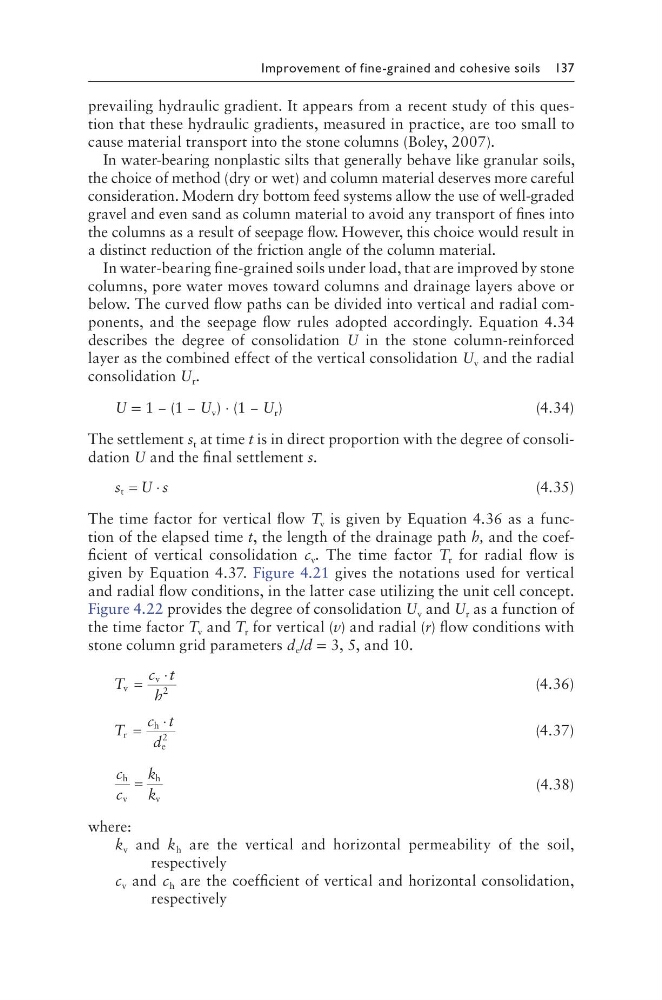
U = 1 − (1 − U v ) · (1 − U r )
(4.34)
The settlement s t at time t is in direct proportion with the degree of consolidation U and the final settlement s.
s U s
t = ⋅
(4.35)
The time factor for vertical flow T v is given by Equation 4.36 as a function of the elapsed time t, the length of the drainage path h, and the coefficient of vertical consolidation c v . The time factor T r for radial flow is
given by Equation 4.37. Figure 4.21 gives the notations used for vertical
and radial flow conditions, in the latter case utilizing the unit cell concept.
Figure 4.22 provides the degree of consolidation U v and U r as a function of
the time factor T v and T r for vertical (v) and radial (r) flow conditions with
stone column grid parameters d e /d = 3, 5, and 10.
T
c
h
v
v
2
=
⋅ t
(4.36)
T
c t
r
h
e
=
⋅
d
2
(4.37)
c
c
k
k
h
v
h
v
=
(4.38)
where:
k v and k h are the vertical and horizontal permeability of the soil,
respectively
c v and c h are the coefficient of vertical and horizontal consolidation,
respectively
prevailing hydraulic gradient. It appears from a recent study of this question that these hydraulic gradients, measured in practice, are too small to
cause material transport into the stone columns (Boley, 2007).
In water-bearing nonplastic silts that generally behave like granular soils,
the choice of method (dry or wet) and column material deserves more careful
consideration. Modern dry bottom feed systems allow the use of well-graded
gravel and even sand as column material to avoid any transport of fines into
the columns as a result of seepage flow. However, this choice would result in
a distinct reduction of the friction angle of the column material.
In water-bearing fine-grained soils under load, that are improved by stone
columns, pore water moves toward columns and drainage layers above or
below. The curved flow paths can be divided into vertical and radial components, and the seepage flow rules adopted accordingly. Equation 4.34
describes the degree of consolidation U in the stone column-reinforced
layer as the combined effect of the vertical consolidation U v and the radial
consolidation U r .
U = 1 − (1 − U v ) · (1 − U r )
(4.34)
The settlement s t at time t is in direct proportion with the degree of consolidation U and the final settlement s.
s U s
t = ⋅
(4.35)
The time factor for vertical flow T v is given by Equation 4.36 as a function of the elapsed time t, the length of the drainage path h, and the coefficient of vertical consolidation c v . The time factor T r for radial flow is
given by Equation 4.37. Figure 4.21 gives the notations used for vertical
and radial flow conditions, in the latter case utilizing the unit cell concept.
Figure 4.22 provides the degree of consolidation U v and U r as a function of
the time factor T v and T r for vertical (v) and radial (r) flow conditions with
stone column grid parameters d e /d = 3, 5, and 10.
T
c
h
v
v
2
=
⋅ t
(4.36)
T
c t
r
h
e
=
⋅
d
2
(4.37)
c
c
k
k
h
v
h
v
=
(4.38)
where:
k v and k h are the vertical and horizontal permeability of the soil,
respectively
c v and c h are the coefficient of vertical and horizontal consolidation,
respectively