

Improvement of fine-grained and cohesive soils 119
σ σ
σ
s
c
s
1
1
1
= ⋅ + − ⋅
= ⋅
( (
) )
n
a
n
(4.7)
with
n
n
a
s
c
= + − ⋅
1
1
1
( (
) )
(4.8)
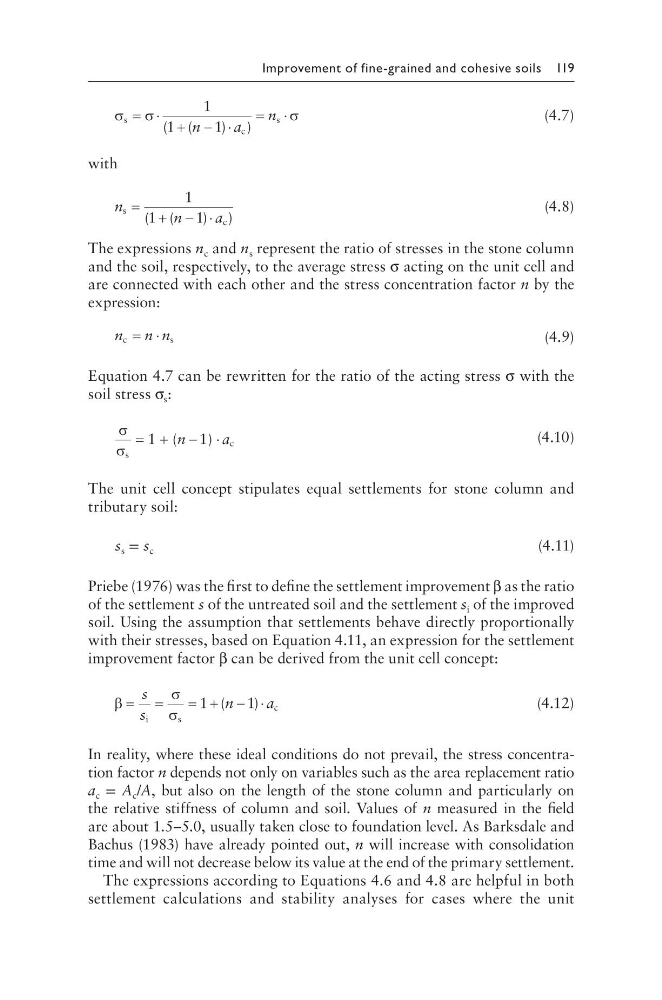
The expressions n c and n s represent the ratio of stresses in the stone column
and the soil, respectively, to the average stress σ acting on the unit cell and
are connected with each other and the stress concentration factor n by the
expression:
n n n
c
s
= ⋅
(4.9)
Equation 4.7 can be rewritten for the ratio of the acting stress σ with the
soil stress σ s :
σ
σ s
c
1 ( 1)
= + n
a
− ⋅
(4.10)
The unit cell concept stipulates equal settlements for stone column and
tributary soil:
s s = s c
(4.11)
Priebe (1976) was the first to define the settlement improvement β as the ratio
of the settlement s of the untreated soil and the settlement s i of the improved
soil. Using the assumption that settlements behave directly proportionally
with their stresses, based on Equation 4.11, an expression for the settlement
improvement factor β can be derived from the unit cell concept:
β
σ
σ
= =
= + − ⋅
s
s
n
a
i
s
c
1
1
(
)
(4.12)
In reality, where these ideal conditions do not prevail, the stress concentration factor n depends not only on variables such as the area replacement ratio
a c = A c /A, but also on the length of the stone column and particularly on
the relative stiffness of column and soil. Values of n measured in the field
are about 1.5–5.0, usually taken close to foundation level. As Barksdale and
Bachus (1983) have already pointed out, n will increase with consolidation
time and will not decrease below its value at the end of the primary settlement.
The expressions according to Equations 4.6 and 4.8 are helpful in both
settlement calculations and stability analyses for cases where the unit
σ σ
σ
s
c
s
1
1
1
= ⋅ + − ⋅
= ⋅
( (
) )
n
a
n
(4.7)
with
n
n
a
s
c
= + − ⋅
1
1
1
( (
) )
(4.8)
The expressions n c and n s represent the ratio of stresses in the stone column
and the soil, respectively, to the average stress σ acting on the unit cell and
are connected with each other and the stress concentration factor n by the
expression:
n n n
c
s
= ⋅
(4.9)
Equation 4.7 can be rewritten for the ratio of the acting stress σ with the
soil stress σ s :
σ
σ s
c
1 ( 1)
= + n
a
− ⋅
(4.10)
The unit cell concept stipulates equal settlements for stone column and
tributary soil:
s s = s c
(4.11)
Priebe (1976) was the first to define the settlement improvement β as the ratio
of the settlement s of the untreated soil and the settlement s i of the improved
soil. Using the assumption that settlements behave directly proportionally
with their stresses, based on Equation 4.11, an expression for the settlement
improvement factor β can be derived from the unit cell concept:
β
σ
σ
= =
= + − ⋅
s
s
n
a
i
s
c
1
1
(
)
(4.12)
In reality, where these ideal conditions do not prevail, the stress concentration factor n depends not only on variables such as the area replacement ratio
a c = A c /A, but also on the length of the stone column and particularly on
the relative stiffness of column and soil. Values of n measured in the field
are about 1.5–5.0, usually taken close to foundation level. As Barksdale and
Bachus (1983) have already pointed out, n will increase with consolidation
time and will not decrease below its value at the end of the primary settlement.
The expressions according to Equations 4.6 and 4.8 are helpful in both
settlement calculations and stability analyses for cases where the unit