

96 Ground improvement by deep vibratory methods
is 12.5 ft (3.8 m) below ground surface. A factor of safety of 1.1 was used in
the liquefaction analysis and its settlement calculation. The stated procedures
were developed as a function of the penetration resistance. Results of the calculations at location of pre-CPT and post-CPT are plotted in Figure 3.47.
As shown, the stone column treatment significantly increased the cone tip
resistance. However, the increase of the tip resistance caused the soil behavior
type index I c to decrease when compared with pretreatment values.
Since the posttreatment I c value decreases, the fines content calculated from
post-CPT seems lower than the pre-CPT, therefore causing higher posttreatment liquefaction-induced settlement based on the Tokimatsu–Seed procedure.
Obviously, the vibro stone column treatment cannot reduce the soil’s fines
content. To correct the fines content calculation error, the calculation was
modified, maintaining a similar fines content as the pre-CPT data (shown
in Figure 3.48) and the liquefaction-induced settlement was calculated
SP dense
CL/ML
med.stiff
SM,SC med.
dense with
CL lenses
SP/GP very dense
to cemented
∅ 3′ primary
stone columns
∅ 3′ secondary
stone columns
25′
10′
13′
5′
5′
5′
5′
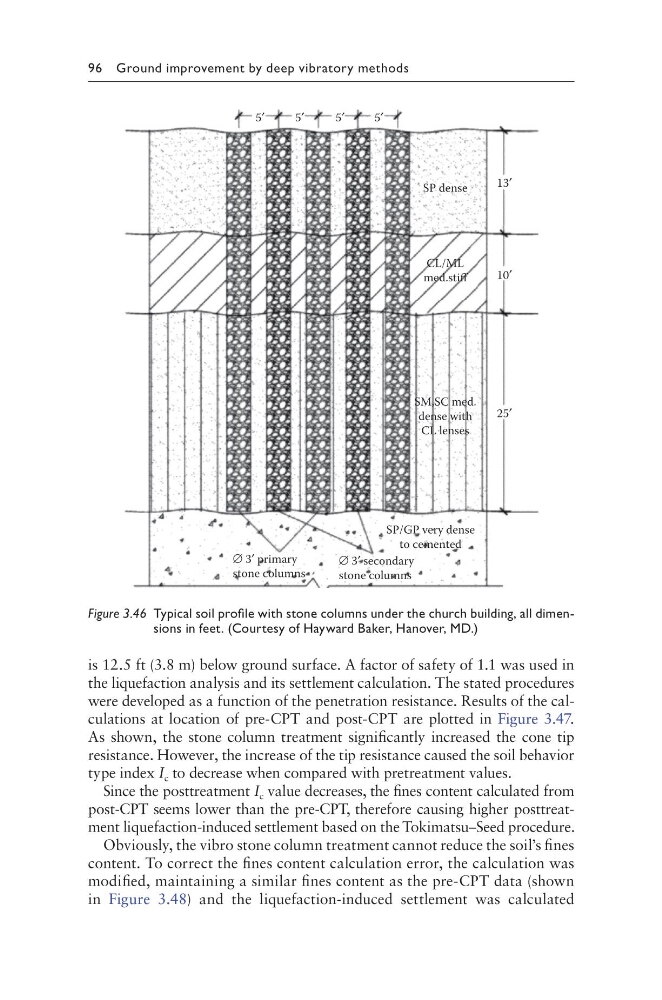
Figure 3.46 Typical soil profile with stone columns under the church building, all dimensions in feet. (Courtesy of Hayward Baker, Hanover, MD.)
is 12.5 ft (3.8 m) below ground surface. A factor of safety of 1.1 was used in
the liquefaction analysis and its settlement calculation. The stated procedures
were developed as a function of the penetration resistance. Results of the calculations at location of pre-CPT and post-CPT are plotted in Figure 3.47.
As shown, the stone column treatment significantly increased the cone tip
resistance. However, the increase of the tip resistance caused the soil behavior
type index I c to decrease when compared with pretreatment values.
Since the posttreatment I c value decreases, the fines content calculated from
post-CPT seems lower than the pre-CPT, therefore causing higher posttreatment liquefaction-induced settlement based on the Tokimatsu–Seed procedure.
Obviously, the vibro stone column treatment cannot reduce the soil’s fines
content. To correct the fines content calculation error, the calculation was
modified, maintaining a similar fines content as the pre-CPT data (shown
in Figure 3.48) and the liquefaction-induced settlement was calculated
SP dense
CL/ML
med.stiff
SM,SC med.
dense with
CL lenses
SP/GP very dense
to cemented
∅ 3′ primary
stone columns
∅ 3′ secondary
stone columns
25′
10′
13′
5′
5′
5′
5′
Figure 3.46 Typical soil profile with stone columns under the church building, all dimensions in feet. (Courtesy of Hayward Baker, Hanover, MD.)