

82 Ground improvement by deep vibratory methods
which the ground is unsuitable, and that quicker compaction is achieved
with lower numbers.
Very steep grain size distribution curves, with D 60 /D 10 below 2, are a
strong indicator that vibro compaction may only be marginally possible if
not inhibited completely. A compaction test in the laboratory, or a field trial,
will determine the suitability of such soils when no local experience exists.
The above approaches provide reasonable guidelines, but permeability
plays an important role in speed and effectiveness of vibro compaction.
With decreasing permeability below k = 10 −5 m/s, compaction is increasingly inhibited, while very high permeability in excess of 10 −2 m/s may slow
penetration of the vibrator as a result of the loss of water. In this instance,
where jetting water is normally of limited use, more powerful machines
operating at higher frequencies, in excess of 50 Hz, are more suited and
are capable of penetrating even highly permeable gravel and cobble. In this
category are applications where brick demolition rubble is regularly compacted dry in regenerating derelict industrial city centers in the North of
England to at least the depth of the former basements.
Where shallow treatment depths below 1.5 m are concerned, standard surface compaction methods such as vibratory roller compaction or heavy tamping tend to be more economical. This is especially so since the upper 1.0 m of
0
1
2
3
1
10
50
5
Friction ratio, R f (%)
M
a r g i n a l l y
N
o t c o m
p a c t a b l e
Compactable
Compactable
Penetration resistance (MPa)
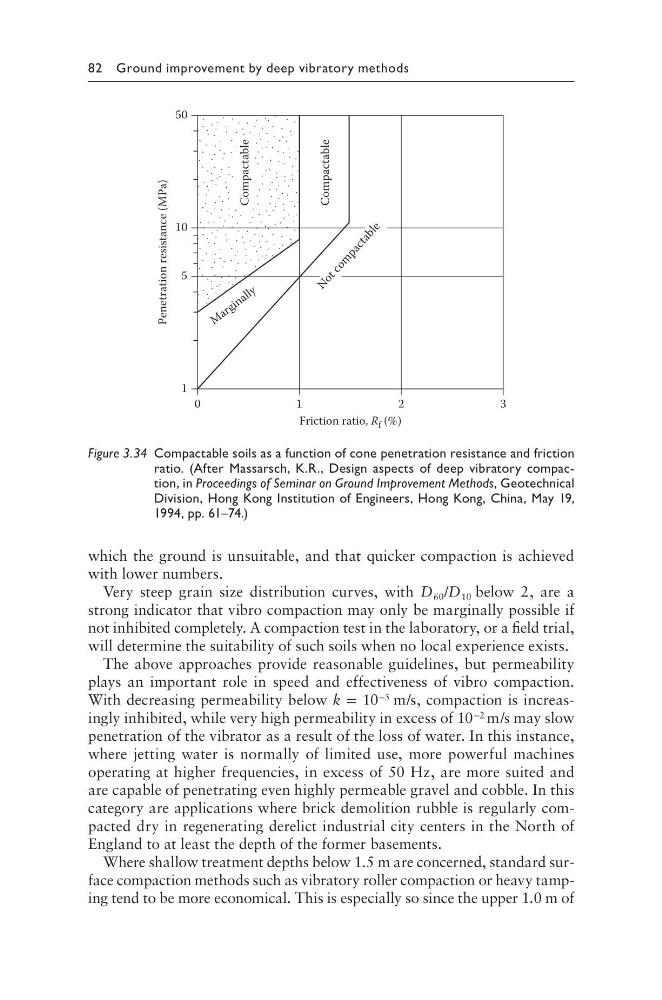
Figure 3.34 Compactable soils as a function of cone penetration resistance and friction
ratio. (After Massarsch, K.R., Design aspects of deep vibratory compaction, in Proceedings of Seminar on Ground Improvement Methods, Geotechnical
Division, Hong Kong Institution of Engineers, Hong Kong, China, May 19,
1994, pp. 61–74.)
which the ground is unsuitable, and that quicker compaction is achieved
with lower numbers.
Very steep grain size distribution curves, with D 60 /D 10 below 2, are a
strong indicator that vibro compaction may only be marginally possible if
not inhibited completely. A compaction test in the laboratory, or a field trial,
will determine the suitability of such soils when no local experience exists.
The above approaches provide reasonable guidelines, but permeability
plays an important role in speed and effectiveness of vibro compaction.
With decreasing permeability below k = 10 −5 m/s, compaction is increasingly inhibited, while very high permeability in excess of 10 −2 m/s may slow
penetration of the vibrator as a result of the loss of water. In this instance,
where jetting water is normally of limited use, more powerful machines
operating at higher frequencies, in excess of 50 Hz, are more suited and
are capable of penetrating even highly permeable gravel and cobble. In this
category are applications where brick demolition rubble is regularly compacted dry in regenerating derelict industrial city centers in the North of
England to at least the depth of the former basements.
Where shallow treatment depths below 1.5 m are concerned, standard surface compaction methods such as vibratory roller compaction or heavy tamping tend to be more economical. This is especially so since the upper 1.0 m of
0
1
2
3
1
10
50
5
Friction ratio, R f (%)
M
a r g i n a l l y
N
o t c o m
p a c t a b l e
Compactable
Compactable
Penetration resistance (MPa)
Figure 3.34 Compactable soils as a function of cone penetration resistance and friction
ratio. (After Massarsch, K.R., Design aspects of deep vibratory compaction, in Proceedings of Seminar on Ground Improvement Methods, Geotechnical
Division, Hong Kong Institution of Engineers, Hong Kong, China, May 19,
1994, pp. 61–74.)