

91
recent times. This species often develops high percentages of empty seeds
(Azpilicueta et al. 2010).
The distribution range of N. obliqua extends between 33° and 41° S both west
(Chile) and east (Argentina) of the Andes Mountains, along the Pacific Coastal
Range, and in the Longitudinal Valley between the Coastal Range and the Andes,
covering more than 1.2 million hectares (Araya and Oyarzún 2000). A marked
human impact can be observed in the west side of the Andes (Chile) (Donoso 1993),
while naturally fragmented forests characterise the eastern distribution (Argentina)
(Gallo et al. 2000). In Argentina, this species occupies ca. 33,800 ha along a heterogeneous environmental landscape, from 36° 49′ S to 40° 11′ S at five lake basins
(Lácar, Quillén, Ñorquinco, Moquehue and Epulauquen) and a river margin
(Aluminé river) (Azpilicueta et al. 2016a; Sabatier et al. 2011; Fig. 4.2). The northernmost population of N. obliqua in Argentina (Epulauquen) conforms a particular
forest growing at high altitude (1500–1700 m asl) and geographically isolated.
More than 220 km separate this population from the nearest con-specific forests in
Argentina (Fig. 4.2), ~ 100 km is the distance to the closest Chilean population, on
the western side of the Andes. Trees at these fragmented forests show particularities
at biochemical, molecular, morphological and architectural levels that make them
different from con-specific populations. Based on pollen records (Villagrán 1991)
and molecular tools (Azpilicueta et al. 2014), some studies suggested that this population could have originated as an introgression from the western side of the Andean
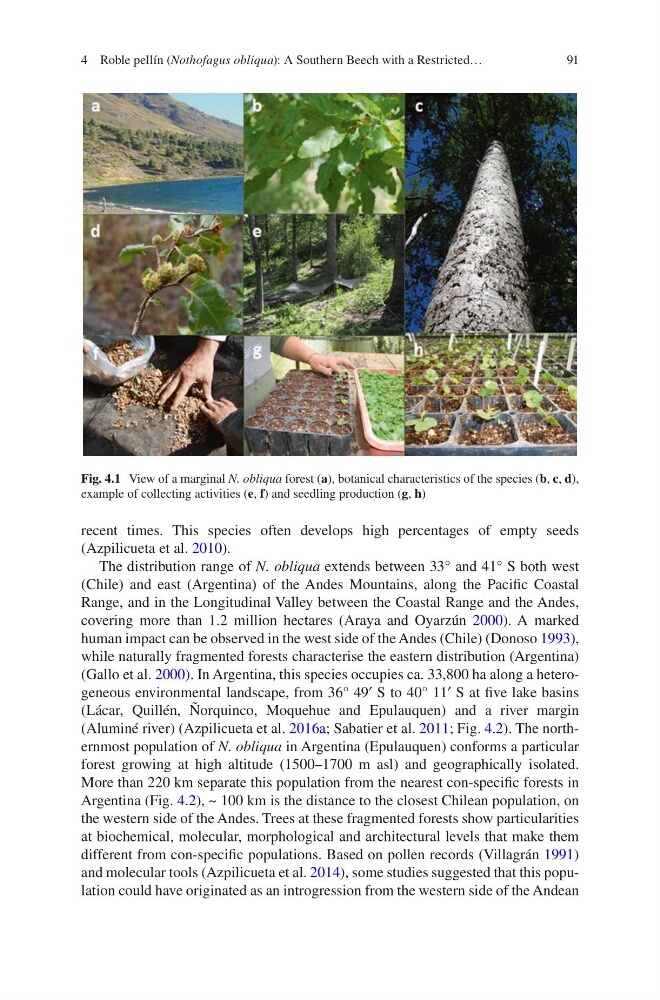
Fig. 4.1 View of a marginal N. obliqua forest (a), botanical characteristics of the species (b, c, d),
example of collecting activities (e, f) and seedling production (g, h)
4 Roble pellín (Nothofagus obliqua): A Southern Beech with a Restricted…
recent times. This species often develops high percentages of empty seeds
(Azpilicueta et al. 2010).
The distribution range of N. obliqua extends between 33° and 41° S both west
(Chile) and east (Argentina) of the Andes Mountains, along the Pacific Coastal
Range, and in the Longitudinal Valley between the Coastal Range and the Andes,
covering more than 1.2 million hectares (Araya and Oyarzún 2000). A marked
human impact can be observed in the west side of the Andes (Chile) (Donoso 1993),
while naturally fragmented forests characterise the eastern distribution (Argentina)
(Gallo et al. 2000). In Argentina, this species occupies ca. 33,800 ha along a heterogeneous environmental landscape, from 36° 49′ S to 40° 11′ S at five lake basins
(Lácar, Quillén, Ñorquinco, Moquehue and Epulauquen) and a river margin
(Aluminé river) (Azpilicueta et al. 2016a; Sabatier et al. 2011; Fig. 4.2). The northernmost population of N. obliqua in Argentina (Epulauquen) conforms a particular
forest growing at high altitude (1500–1700 m asl) and geographically isolated.
More than 220 km separate this population from the nearest con-specific forests in
Argentina (Fig. 4.2), ~ 100 km is the distance to the closest Chilean population, on
the western side of the Andes. Trees at these fragmented forests show particularities
at biochemical, molecular, morphological and architectural levels that make them
different from con-specific populations. Based on pollen records (Villagrán 1991)
and molecular tools (Azpilicueta et al. 2014), some studies suggested that this population could have originated as an introgression from the western side of the Andean
Fig. 4.1 View of a marginal N. obliqua forest (a), botanical characteristics of the species (b, c, d),
example of collecting activities (e, f) and seedling production (g, h)
4 Roble pellín (Nothofagus obliqua): A Southern Beech with a Restricted…