

69
3.4.2 Other Soil Fungi Associated with Raulí
and Its Ectomycorrhizas
Increasing our knowledge about microbial community structure and composition is
important for improving our conceptual and projective understanding of soilecosystem processes, functions and management. In this context, soil fungi have a
prominent importance due to their abundance and the significance of the processes
they perform (i.e. decomposition, nutrient cycling, biological interactions such as
mycorrhizas). In addition, fungi are excellent bioindicators (organisms highly sensitive to environmental shifts), so it is possible to use them for monitoring ecological
changes and the effects of human activities on environmental health, including soil
quality and fertility (Rai and Varma 2011).
Afforestation with fast-growing exotic conifers has been promoted as an important economic activity in Patagonia. However, the establishment of plantations of
exotic species causes severe disturbances at ecosystem level. In a recent study
(Fernández et al. 2020), temperature gradient gel electrophoresis (TGGE, molecular
fingerprint method) was utilized for evaluating the structure and composition of
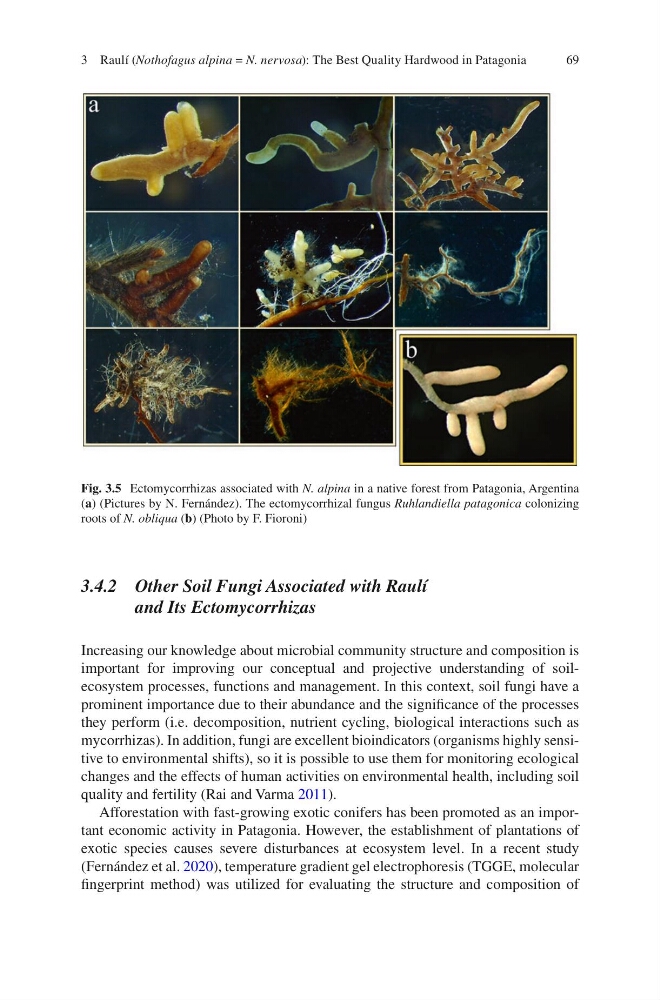
Fig. 3.5 Ectomycorrhizas associated with N. alpina in a native forest from Patagonia, Argentina
(a) (Pictures by N. Fernández). The ectomycorrhizal fungus Ruhlandiella patagonica colonizing
roots of N. obliqua (b) (Photo by F. Fioroni)
3 Raulí (Nothofagus alpina = N. nervosa): The Best Quality Hardwood in Patagonia
3.4.2 Other Soil Fungi Associated with Raulí
and Its Ectomycorrhizas
Increasing our knowledge about microbial community structure and composition is
important for improving our conceptual and projective understanding of soilecosystem processes, functions and management. In this context, soil fungi have a
prominent importance due to their abundance and the significance of the processes
they perform (i.e. decomposition, nutrient cycling, biological interactions such as
mycorrhizas). In addition, fungi are excellent bioindicators (organisms highly sensitive to environmental shifts), so it is possible to use them for monitoring ecological
changes and the effects of human activities on environmental health, including soil
quality and fertility (Rai and Varma 2011).
Afforestation with fast-growing exotic conifers has been promoted as an important economic activity in Patagonia. However, the establishment of plantations of
exotic species causes severe disturbances at ecosystem level. In a recent study
(Fernández et al. 2020), temperature gradient gel electrophoresis (TGGE, molecular
fingerprint method) was utilized for evaluating the structure and composition of
Fig. 3.5 Ectomycorrhizas associated with N. alpina in a native forest from Patagonia, Argentina
(a) (Pictures by N. Fernández). The ectomycorrhizal fungus Ruhlandiella patagonica colonizing
roots of N. obliqua (b) (Photo by F. Fioroni)
3 Raulí (Nothofagus alpina = N. nervosa): The Best Quality Hardwood in Patagonia