

65
temperature (Chuine and Cour 1999; Howe et al. 2003), being the most accurate
predictor for bud burst the thermal time in the late winter or the spring months
(cumulative degree days; Bertin 2008).
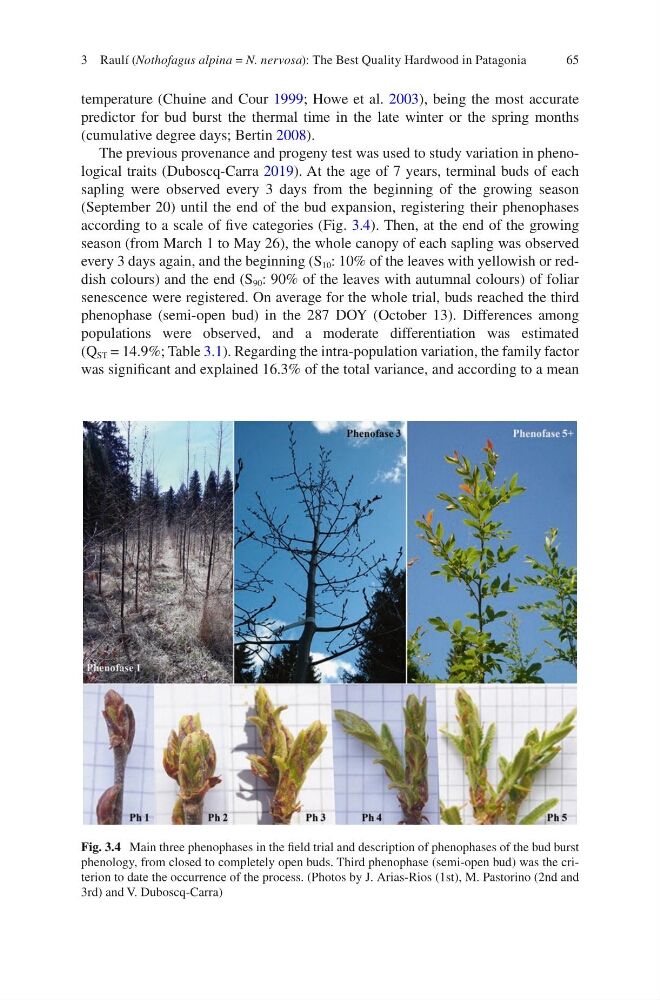
The previous provenance and progeny test was used to study variation in phenological traits (Duboscq-Carra 2019). At the age of 7 years, terminal buds of each
sapling were observed every 3 days from the beginning of the growing season
(September 20) until the end of the bud expansion, registering their phenophases
according to a scale of five categories (Fig. 3.4). Then, at the end of the growing
season (from March 1 to May 26), the whole canopy of each sapling was observed
every 3 days again, and the beginning (S 10 : 10% of the leaves with yellowish or reddish colours) and the end (S 90 : 90% of the leaves with autumnal colours) of foliar
senescence were registered. On average for the whole trial, buds reached the third
phenophase (semi-open bud) in the 287 DOY (October 13). Differences among
populations were observed, and a moderate differentiation was estimated
(Q ST = 14.9%; Table 3.1). Regarding the intra-population variation, the family factor
was significant and explained 16.3% of the total variance, and according to a mean
Fig. 3.4 Main three phenophases in the field trial and description of phenophases of the bud burst
phenology, from closed to completely open buds. Third phenophase (semi-open bud) was the criterion to date the occurrence of the process. (Photos by J. Arias-Rios (1st), M. Pastorino (2nd and
3rd) and V. Duboscq-Carra)
3 Raulí (Nothofagus alpina = N. nervosa): The Best Quality Hardwood in Patagonia
temperature (Chuine and Cour 1999; Howe et al. 2003), being the most accurate
predictor for bud burst the thermal time in the late winter or the spring months
(cumulative degree days; Bertin 2008).
The previous provenance and progeny test was used to study variation in phenological traits (Duboscq-Carra 2019). At the age of 7 years, terminal buds of each
sapling were observed every 3 days from the beginning of the growing season
(September 20) until the end of the bud expansion, registering their phenophases
according to a scale of five categories (Fig. 3.4). Then, at the end of the growing
season (from March 1 to May 26), the whole canopy of each sapling was observed
every 3 days again, and the beginning (S 10 : 10% of the leaves with yellowish or reddish colours) and the end (S 90 : 90% of the leaves with autumnal colours) of foliar
senescence were registered. On average for the whole trial, buds reached the third
phenophase (semi-open bud) in the 287 DOY (October 13). Differences among
populations were observed, and a moderate differentiation was estimated
(Q ST = 14.9%; Table 3.1). Regarding the intra-population variation, the family factor
was significant and explained 16.3% of the total variance, and according to a mean
Fig. 3.4 Main three phenophases in the field trial and description of phenophases of the bud burst
phenology, from closed to completely open buds. Third phenophase (semi-open bud) was the criterion to date the occurrence of the process. (Photos by J. Arias-Rios (1st), M. Pastorino (2nd and
3rd) and V. Duboscq-Carra)
3 Raulí (Nothofagus alpina = N. nervosa): The Best Quality Hardwood in Patagonia