

58
the south because of its greater oceanity and smaller land masses (Markgraf et al.
1995). Accordingly, several ice-free areas remained (Markgraf et al. 1995), probably even during pre-Pleistocene glaciations, constituting ancient and/or recent refugia for vegetation, some of which became the centre of expansion of the biota after
the ice retreated (e.g. Marchelli et al. 1998, 2010; Premoli et al. 2002; Marchelli and
Gallo 2006; Azpilicueta et al. 2009).
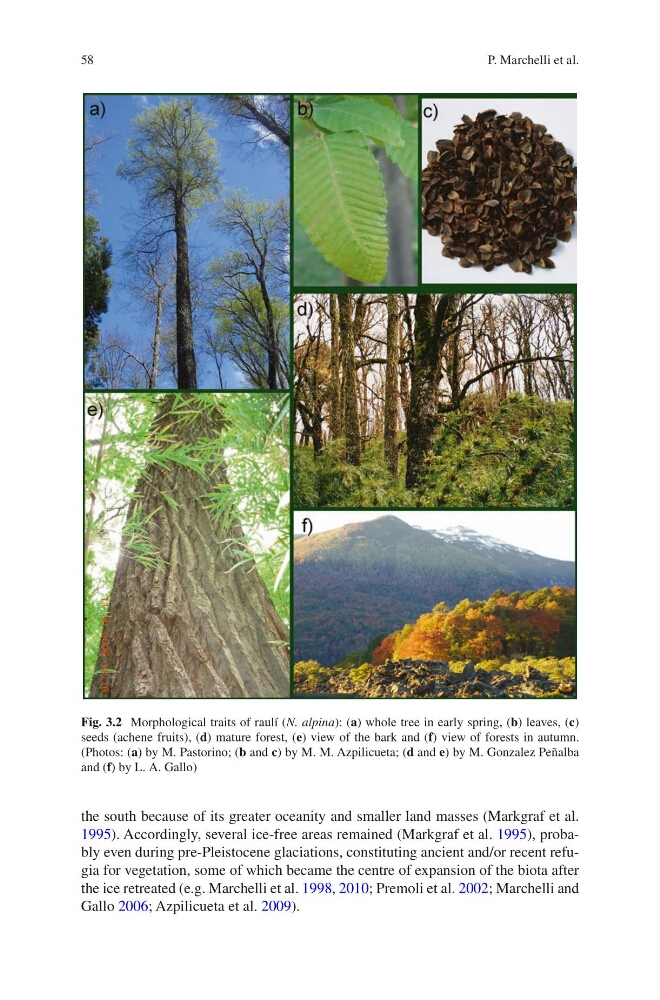
Fig. 3.2 Morphological traits of raulí (N. alpina): (a) whole tree in early spring, (b) leaves, (c)
seeds (achene fruits), (d) mature forest, (e) view of the bark and (f) view of forests in autumn.
(Photos: (a) by M. Pastorino; (b and c) by M. M. Azpilicueta; (d and e) by M. Gonzalez Peñalba
and (f) by L. A. Gallo)
P. Marchelli et al.
the south because of its greater oceanity and smaller land masses (Markgraf et al.
1995). Accordingly, several ice-free areas remained (Markgraf et al. 1995), probably even during pre-Pleistocene glaciations, constituting ancient and/or recent refugia for vegetation, some of which became the centre of expansion of the biota after
the ice retreated (e.g. Marchelli et al. 1998, 2010; Premoli et al. 2002; Marchelli and
Gallo 2006; Azpilicueta et al. 2009).
Fig. 3.2 Morphological traits of raulí (N. alpina): (a) whole tree in early spring, (b) leaves, (c)
seeds (achene fruits), (d) mature forest, (e) view of the bark and (f) view of forests in autumn.
(Photos: (a) by M. Pastorino; (b and c) by M. M. Azpilicueta; (d and e) by M. Gonzalez Peñalba
and (f) by L. A. Gallo)
P. Marchelli et al.