

47
domestication. Despite the fact that its seeds are recalcitrant, the production of
plants in the nursery is simple, and its survival in the field plantation is high.
The other species is Salix humboldtiana, which although it has a continental
distribution, and in Argentina it crosses various ecosystems, it is in the marginal
populations of the Patagonian steppe that its conservation acquires a greater value.
To avoid the extinction of these populations, an active restoration strategy becomes
necessary, that is, to domesticate the species. Its vegetative propagation by rooting
of cuttings has been shown to be not only feasible but very simple.
Fig. 2.6 Examples of postfire restauration activities. (a) Planting of Araucaria araucana seedlings in 2009 and 2010, at Lake Tromen. (b and c) Restauration at Otto Mountain (Bariloche) in
2018 and 2019, with seedlings of Austrocedrus chilensis (b) and Nothofagus dombeyi (c). (d)
Austrocedrus chilensis young tree of 15 years of age planted 3 years after a fire in Catedral
Mountain (Bariloche). (Photos: a taken from Río Negro newspaper, 5-06-2009; b–d by
M. Pastorino)
2 Temperate Subantarctic Forests: A Huge Natural Laboratory
domestication. Despite the fact that its seeds are recalcitrant, the production of
plants in the nursery is simple, and its survival in the field plantation is high.
The other species is Salix humboldtiana, which although it has a continental
distribution, and in Argentina it crosses various ecosystems, it is in the marginal
populations of the Patagonian steppe that its conservation acquires a greater value.
To avoid the extinction of these populations, an active restoration strategy becomes
necessary, that is, to domesticate the species. Its vegetative propagation by rooting
of cuttings has been shown to be not only feasible but very simple.
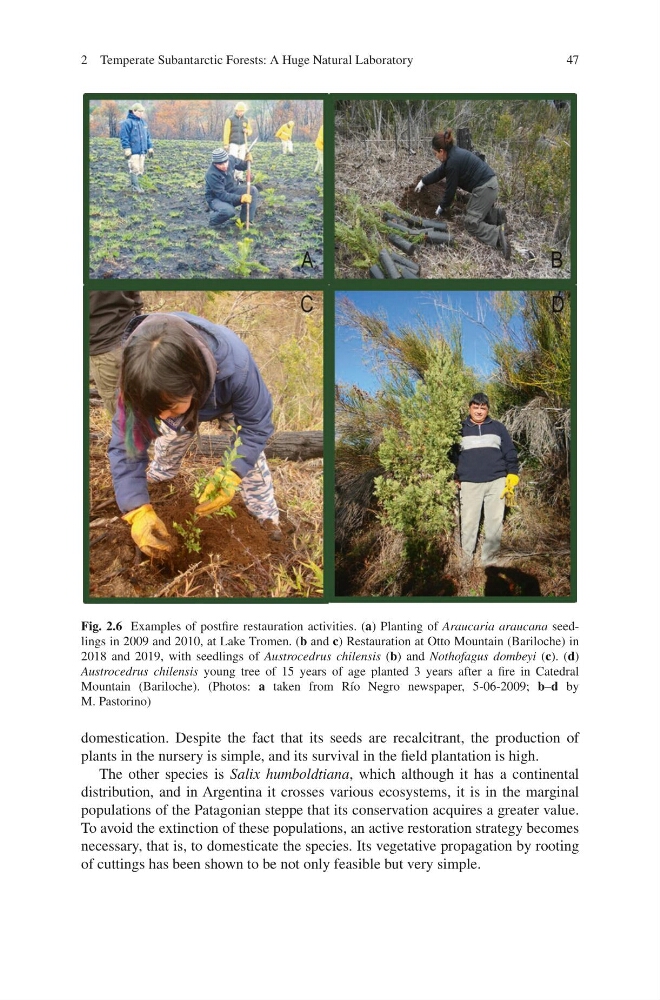
Fig. 2.6 Examples of postfire restauration activities. (a) Planting of Araucaria araucana seedlings in 2009 and 2010, at Lake Tromen. (b and c) Restauration at Otto Mountain (Bariloche) in
2018 and 2019, with seedlings of Austrocedrus chilensis (b) and Nothofagus dombeyi (c). (d)
Austrocedrus chilensis young tree of 15 years of age planted 3 years after a fire in Catedral
Mountain (Bariloche). (Photos: a taken from Río Negro newspaper, 5-06-2009; b–d by
M. Pastorino)
2 Temperate Subantarctic Forests: A Huge Natural Laboratory