

499
tion Ligustrum lucidum in the Yungas (Aragón and Groom 2003; Ayup et al. 2014)
and in the Chaco (Gavier-Pizarro et al. 2012), Morus alba in the Yungas (ZamoraRivera 2002), Melia azedarach in the Espinal (Micou 2003), Hovenia dulcis in the
Alto Paraná Rainforest (Lazzarin et al. 2015), and Pseudotsuga menziesii in
Patagonian Andean forests (Orellana and Raffaele 2010; Sarasola et al. 2006). For a
regional example of mitigation, we can mention the case of Araucaria araucana
assisted migration program recently initiated in Chile (Ipinza et al. 2019) and
already described in Chap. 7. The hindered natural propagation of Araucaria angustifolia in the northeast of Argentina has also been addressed, in Chap. 15. It is presumably related to climate change, and the movement of the species toward
temperate climates, such as that of the Province of Buenos Aires, has been suggested to overcome that restriction.
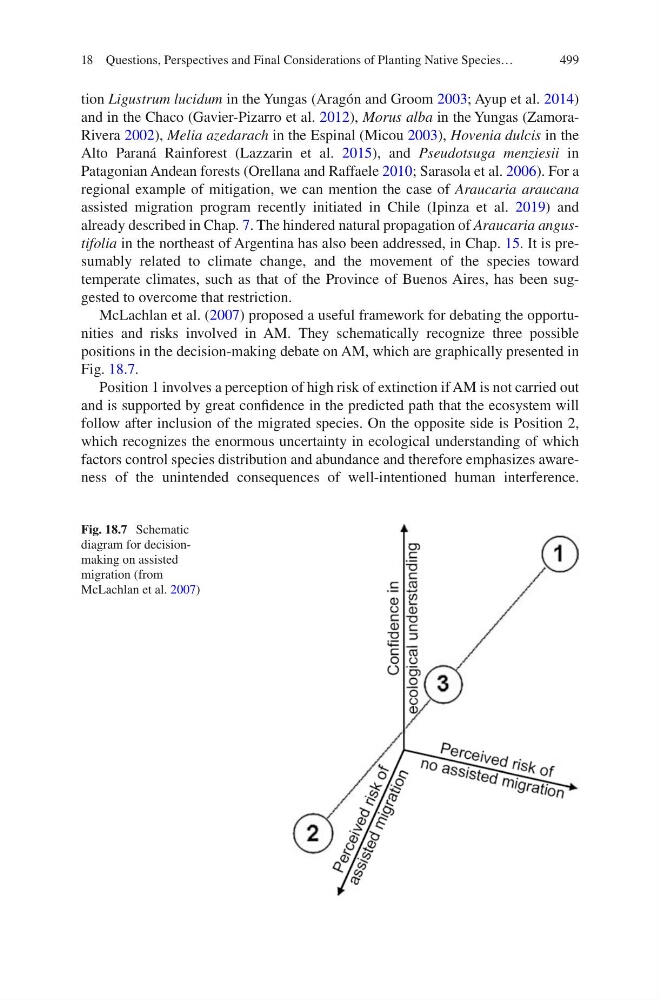
McLachlan et al. (2007) proposed a useful framework for debating the opportunities and risks involved in AM. They schematically recognize three possible
positions in the decision-making debate on AM, which are graphically presented in
Fig. 18.7.
Position 1 involves a perception of high risk of extinction if AM is not carried out
and is supported by great confidence in the predicted path that the ecosystem will
follow after inclusion of the migrated species. On the opposite side is Position 2,
which recognizes the enormous uncertainty in ecological understanding of which
factors control species distribution and abundance and therefore emphasizes awareness of the unintended consequences of well-intentioned human interference.
Fig. 18.7 Schematic
diagram for decisionmaking on assisted
migration (from
McLachlan et al. 2007)
18 Questions, Perspectives and Final Considerations of Planting Native Species…
tion Ligustrum lucidum in the Yungas (Aragón and Groom 2003; Ayup et al. 2014)
and in the Chaco (Gavier-Pizarro et al. 2012), Morus alba in the Yungas (ZamoraRivera 2002), Melia azedarach in the Espinal (Micou 2003), Hovenia dulcis in the
Alto Paraná Rainforest (Lazzarin et al. 2015), and Pseudotsuga menziesii in
Patagonian Andean forests (Orellana and Raffaele 2010; Sarasola et al. 2006). For a
regional example of mitigation, we can mention the case of Araucaria araucana
assisted migration program recently initiated in Chile (Ipinza et al. 2019) and
already described in Chap. 7. The hindered natural propagation of Araucaria angustifolia in the northeast of Argentina has also been addressed, in Chap. 15. It is presumably related to climate change, and the movement of the species toward
temperate climates, such as that of the Province of Buenos Aires, has been suggested to overcome that restriction.
McLachlan et al. (2007) proposed a useful framework for debating the opportunities and risks involved in AM. They schematically recognize three possible
positions in the decision-making debate on AM, which are graphically presented in
Fig. 18.7.
Position 1 involves a perception of high risk of extinction if AM is not carried out
and is supported by great confidence in the predicted path that the ecosystem will
follow after inclusion of the migrated species. On the opposite side is Position 2,
which recognizes the enormous uncertainty in ecological understanding of which
factors control species distribution and abundance and therefore emphasizes awareness of the unintended consequences of well-intentioned human interference.
Fig. 18.7 Schematic
diagram for decisionmaking on assisted
migration (from
McLachlan et al. 2007)
18 Questions, Perspectives and Final Considerations of Planting Native Species…