

466
demonstrating that discriminant markers can be developed efficiently by mining
functional annotation of transcriptome sequences (El Mujtar et al. 2017a). In this
sense, the comparison between markers from unigenes of the abiotic stress category
and anonymous markers revealed a greater discriminant capacity in the functional
markers (Torales et al. 2012; El Mujtar et al. 2017a).
As stated previously in this Section, N. pumilio thrives in relatively cold environments, marking it as a potentially sensitive species to temperature increases such as
those predicted by Global Climate Change. In this context, in order to study the
overall effect of high temperatures in the physiology and gene expression of this
species, Estravis-Barcala et al. (in prep.) performed RNA-Seq in contrasting experimental conditions, consisting of two temperatures (20 and 34 °C) and two moments
of the day (dawn and dusk). Two biological replicates from independent experiments were sequenced for each combination of temperature and time of the day. The
total RNA was extracted from whole leaves following Chang et al. (1993), and
poly- A-selected mRNA libraries were prepared for sequencing in an Ion Torrent
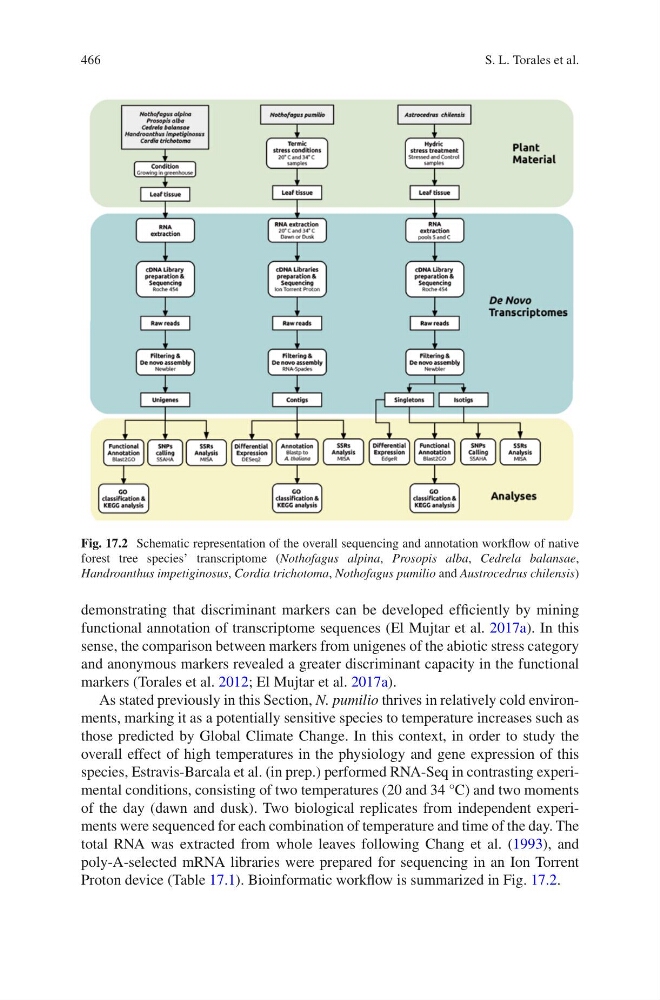
Proton device (Table 17.1). Bioinformatic workflow is summarized in Fig. 17.2.
Fig. 17.2 Schematic representation of the overall sequencing and annotation workflow of native
forest tree species’ transcriptome (Nothofagus alpina, Prosopis alba, Cedrela balansae,
Handroanthus impetiginosus, Cordia trichotoma, Nothofagus pumilio and Austrocedrus chilensis)
S. L. Torales et al.
demonstrating that discriminant markers can be developed efficiently by mining
functional annotation of transcriptome sequences (El Mujtar et al. 2017a). In this
sense, the comparison between markers from unigenes of the abiotic stress category
and anonymous markers revealed a greater discriminant capacity in the functional
markers (Torales et al. 2012; El Mujtar et al. 2017a).
As stated previously in this Section, N. pumilio thrives in relatively cold environments, marking it as a potentially sensitive species to temperature increases such as
those predicted by Global Climate Change. In this context, in order to study the
overall effect of high temperatures in the physiology and gene expression of this
species, Estravis-Barcala et al. (in prep.) performed RNA-Seq in contrasting experimental conditions, consisting of two temperatures (20 and 34 °C) and two moments
of the day (dawn and dusk). Two biological replicates from independent experiments were sequenced for each combination of temperature and time of the day. The
total RNA was extracted from whole leaves following Chang et al. (1993), and
poly- A-selected mRNA libraries were prepared for sequencing in an Ion Torrent
Proton device (Table 17.1). Bioinformatic workflow is summarized in Fig. 17.2.
Fig. 17.2 Schematic representation of the overall sequencing and annotation workflow of native
forest tree species’ transcriptome (Nothofagus alpina, Prosopis alba, Cedrela balansae,
Handroanthus impetiginosus, Cordia trichotoma, Nothofagus pumilio and Austrocedrus chilensis)
S. L. Torales et al.