

38
of the Committee of Intercultural Management in the Lanín National Park. This
Committee is an essential tool to develop the new relationship that must be based on
the mutual recognition of the rights of the parties (Carpinetti 2007). In these
20 years, the social and political experience has been strengthened. The internal
organization of the communities and the implementation of intercultural environmental education programs have been promoted (M. González Peñalba, personal
communication). However, tensions still exist with opposing views to the relative
weight that is given to the conservation of natural resources and their use, mainly
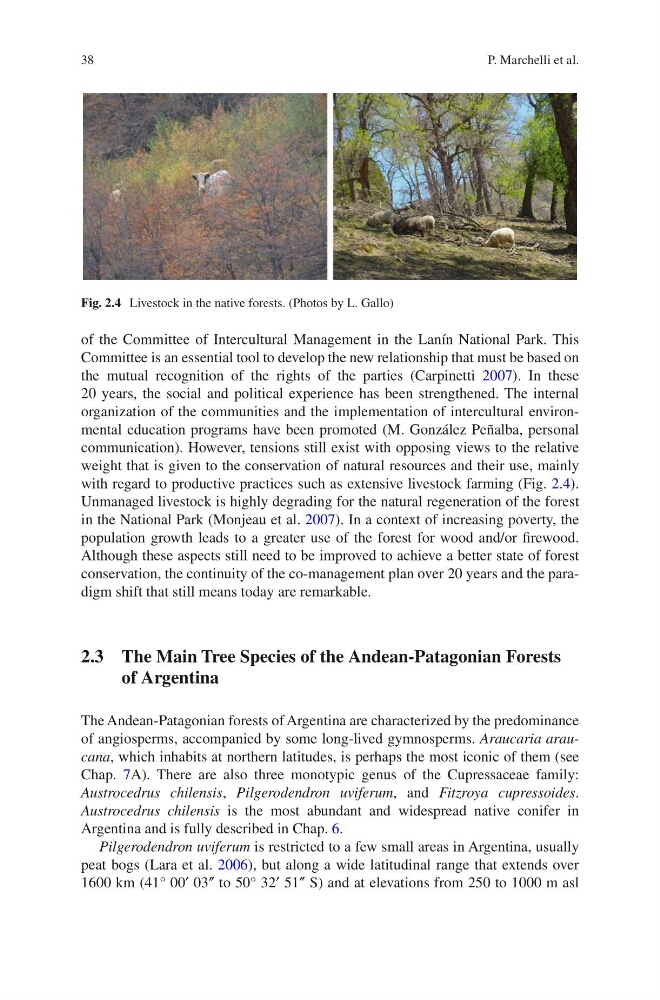
with regard to productive practices such as extensive livestock farming (Fig. 2.4).
Unmanaged livestock is highly degrading for the natural regeneration of the forest
in the National Park (Monjeau et al. 2007). In a context of increasing poverty, the
population growth leads to a greater use of the forest for wood and/or firewood.
Although these aspects still need to be improved to achieve a better state of forest
conservation, the continuity of the co-management plan over 20 years and the paradigm shift that still means today are remarkable.
2.3 The Main Tree Species of the Andean-Patagonian Forests
of Argentina
The Andean-Patagonian forests of Argentina are characterized by the predominance
of angiosperms, accompanied by some long-lived gymnosperms. Araucaria araucana, which inhabits at northern latitudes, is perhaps the most iconic of them (see
Chap. 7A). There are also three monotypic genus of the Cupressaceae family:
Austrocedrus chilensis, Pilgerodendron uviferum, and Fitzroya cupressoides.
Austrocedrus chilensis is the most abundant and widespread native conifer in
Argentina and is fully described in Chap. 6.
Pilgerodendron uviferum is restricted to a few small areas in Argentina, usually
peat bogs (Lara et al. 2006), but along a wide latitudinal range that extends over
1600 km (41° 00′ 03″ to 50° 32′ 51″ S) and at elevations from 250 to 1000 m asl
Fig. 2.4 Livestock in the native forests. (Photos by L. Gallo)
P. Marchelli et al.
of the Committee of Intercultural Management in the Lanín National Park. This
Committee is an essential tool to develop the new relationship that must be based on
the mutual recognition of the rights of the parties (Carpinetti 2007). In these
20 years, the social and political experience has been strengthened. The internal
organization of the communities and the implementation of intercultural environmental education programs have been promoted (M. González Peñalba, personal
communication). However, tensions still exist with opposing views to the relative
weight that is given to the conservation of natural resources and their use, mainly
with regard to productive practices such as extensive livestock farming (Fig. 2.4).
Unmanaged livestock is highly degrading for the natural regeneration of the forest
in the National Park (Monjeau et al. 2007). In a context of increasing poverty, the
population growth leads to a greater use of the forest for wood and/or firewood.
Although these aspects still need to be improved to achieve a better state of forest
conservation, the continuity of the co-management plan over 20 years and the paradigm shift that still means today are remarkable.
2.3 The Main Tree Species of the Andean-Patagonian Forests
of Argentina
The Andean-Patagonian forests of Argentina are characterized by the predominance
of angiosperms, accompanied by some long-lived gymnosperms. Araucaria araucana, which inhabits at northern latitudes, is perhaps the most iconic of them (see
Chap. 7A). There are also three monotypic genus of the Cupressaceae family:
Austrocedrus chilensis, Pilgerodendron uviferum, and Fitzroya cupressoides.
Austrocedrus chilensis is the most abundant and widespread native conifer in
Argentina and is fully described in Chap. 6.
Pilgerodendron uviferum is restricted to a few small areas in Argentina, usually
peat bogs (Lara et al. 2006), but along a wide latitudinal range that extends over
1600 km (41° 00′ 03″ to 50° 32′ 51″ S) and at elevations from 250 to 1000 m asl
Fig. 2.4 Livestock in the native forests. (Photos by L. Gallo)
P. Marchelli et al.