

399
productivity if certain basic rules of forestry practice are not taken into consideration, such as selection of the species, origin of the seeds, planting site, and the
forest management plan of the plantation.
With the arrival of the first settlers toward 1930 to the north of the Province of
Misiones, the cultivation of A. angustifolia began (Cozzo 1976). Its long fiber represented an opportunity for cellulose pulps production, of which Argentina is not
self-sufficient yet. Toward 1945, a still working plant of cellulose was installed in
Puerto Piray (at the side of Paraná River). It was initially feeded with A. angustifolia
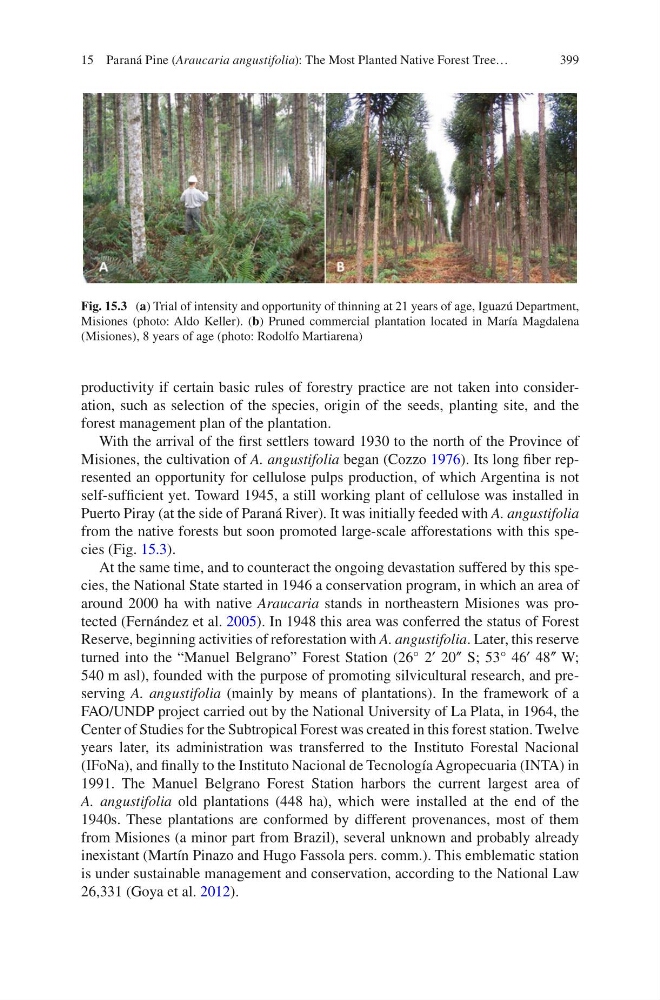
from the native forests but soon promoted large-scale afforestations with this species (Fig. 15.3).
At the same time, and to counteract the ongoing devastation suffered by this species, the National State started in 1946 a conservation program, in which an area of
around 2000 ha with native Araucaria stands in northeastern Misiones was protected (Fernández et al. 2005). In 1948 this area was conferred the status of Forest
Reserve, beginning activities of reforestation with A. angustifolia. Later, this reserve
turned into the “Manuel Belgrano” Forest Station (26° 2′ 20″ S; 53° 46′ 48″ W;
540 m asl), founded with the purpose of promoting silvicultural research, and preserving A. angustifolia (mainly by means of plantations). In the framework of a
FAO/UNDP project carried out by the National University of La Plata, in 1964, the
Center of Studies for the Subtropical Forest was created in this forest station. Twelve
years later, its administration was transferred to the Instituto Forestal Nacional
(IFoNa), and finally to the Instituto Nacional de Tecnología Agropecuaria (INTA) in
1991. The Manuel Belgrano Forest Station harbors the current largest area of
A. angustifolia old plantations (448 ha), which were installed at the end of the
1940s. These plantations are conformed by different provenances, most of them
from Misiones (a minor part from Brazil), several unknown and probably already
inexistant (Martín Pinazo and Hugo Fassola pers. comm.). This emblematic station
is under sustainable management and conservation, according to the National Law
26,331 (Goya et al. 2012).
Fig. 15.3 (a) Trial of intensity and opportunity of thinning at 21 years of age, Iguazú Department,
Misiones (photo: Aldo Keller). (b) Pruned commercial plantation located in María Magdalena
(Misiones), 8 years of age (photo: Rodolfo Martiarena)
15 Paraná Pine (Araucaria angustifolia): The Most Planted Native Forest Tree…
productivity if certain basic rules of forestry practice are not taken into consideration, such as selection of the species, origin of the seeds, planting site, and the
forest management plan of the plantation.
With the arrival of the first settlers toward 1930 to the north of the Province of
Misiones, the cultivation of A. angustifolia began (Cozzo 1976). Its long fiber represented an opportunity for cellulose pulps production, of which Argentina is not
self-sufficient yet. Toward 1945, a still working plant of cellulose was installed in
Puerto Piray (at the side of Paraná River). It was initially feeded with A. angustifolia
from the native forests but soon promoted large-scale afforestations with this species (Fig. 15.3).
At the same time, and to counteract the ongoing devastation suffered by this species, the National State started in 1946 a conservation program, in which an area of
around 2000 ha with native Araucaria stands in northeastern Misiones was protected (Fernández et al. 2005). In 1948 this area was conferred the status of Forest
Reserve, beginning activities of reforestation with A. angustifolia. Later, this reserve
turned into the “Manuel Belgrano” Forest Station (26° 2′ 20″ S; 53° 46′ 48″ W;
540 m asl), founded with the purpose of promoting silvicultural research, and preserving A. angustifolia (mainly by means of plantations). In the framework of a
FAO/UNDP project carried out by the National University of La Plata, in 1964, the
Center of Studies for the Subtropical Forest was created in this forest station. Twelve
years later, its administration was transferred to the Instituto Forestal Nacional
(IFoNa), and finally to the Instituto Nacional de Tecnología Agropecuaria (INTA) in
1991. The Manuel Belgrano Forest Station harbors the current largest area of
A. angustifolia old plantations (448 ha), which were installed at the end of the
1940s. These plantations are conformed by different provenances, most of them
from Misiones (a minor part from Brazil), several unknown and probably already
inexistant (Martín Pinazo and Hugo Fassola pers. comm.). This emblematic station
is under sustainable management and conservation, according to the National Law
26,331 (Goya et al. 2012).
Fig. 15.3 (a) Trial of intensity and opportunity of thinning at 21 years of age, Iguazú Department,
Misiones (photo: Aldo Keller). (b) Pruned commercial plantation located in María Magdalena
(Misiones), 8 years of age (photo: Rodolfo Martiarena)
15 Paraná Pine (Araucaria angustifolia): The Most Planted Native Forest Tree…