

382
RWC
FW DW TW DW
=
−
(
)
−
(
)
×
/
.
100
where FW is fresh weight, DW is dry weight, and TW is turgid weight.
The Ψ w was determined with a Schölander chamber at midday, and at the end of
the trial, total biomass production and shoot height were measured.
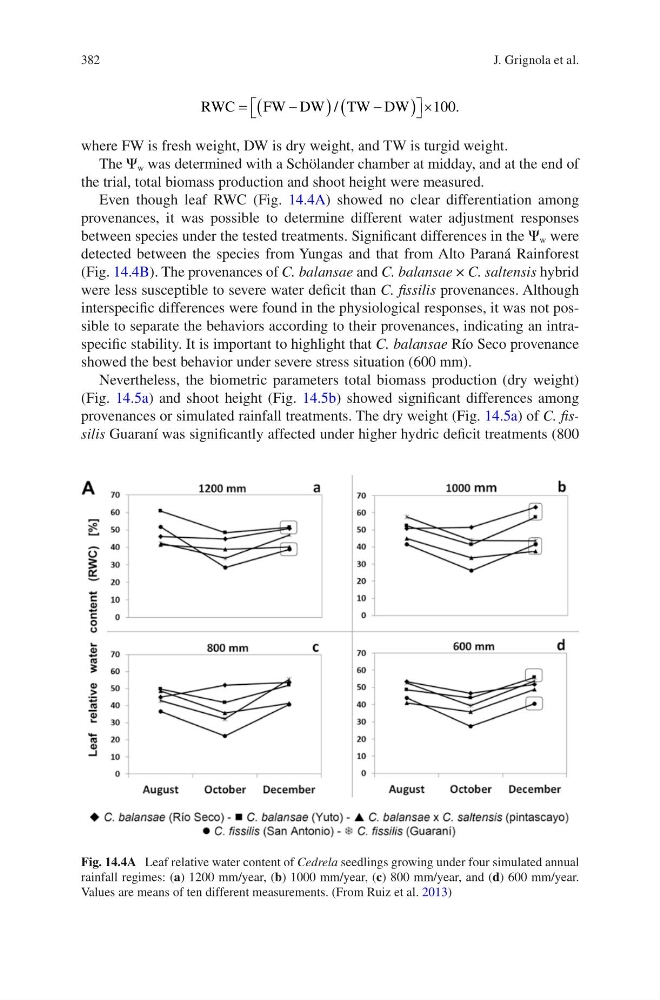
Even though leaf RWC (Fig. 14.4A) showed no clear differentiation among
provenances, it was possible to determine different water adjustment responses
between species under the tested treatments. Significant differences in the Ψ w were
detected between the species from Yungas and that from Alto Paraná Rainforest
(Fig. 14.4B). The provenances of C. balansae and C. balansae × C. saltensis hybrid
were less susceptible to severe water deficit than C. fissilis provenances. Although
interspecific differences were found in the physiological responses, it was not possible to separate the behaviors according to their provenances, indicating an intraspecific stability. It is important to highlight that C. balansae Río Seco provenance
showed the best behavior under severe stress situation (600 mm).
Nevertheless, the biometric parameters total biomass production (dry weight)
(Fig. 14.5a) and shoot height (Fig. 14.5b) showed significant differences among
provenances or simulated rainfall treatments. The dry weight (Fig. 14.5a) of C. fissilis Guaraní was significantly affected under higher hydric deficit treatments (800
Fig. 14.4A Leaf relative water content of Cedrela seedlings growing under four simulated annual
rainfall regimes: (a) 1200 mm/year, (b) 1000 mm/year, (c) 800 mm/year, and (d) 600 mm/year.
Values are means of ten different measurements. (From Ruiz et al. 2013)
J. Grignola et al.
RWC
FW DW TW DW
=
−
(
)
−
(
)
×
/
.
100
where FW is fresh weight, DW is dry weight, and TW is turgid weight.
The Ψ w was determined with a Schölander chamber at midday, and at the end of
the trial, total biomass production and shoot height were measured.
Even though leaf RWC (Fig. 14.4A) showed no clear differentiation among
provenances, it was possible to determine different water adjustment responses
between species under the tested treatments. Significant differences in the Ψ w were
detected between the species from Yungas and that from Alto Paraná Rainforest
(Fig. 14.4B). The provenances of C. balansae and C. balansae × C. saltensis hybrid
were less susceptible to severe water deficit than C. fissilis provenances. Although
interspecific differences were found in the physiological responses, it was not possible to separate the behaviors according to their provenances, indicating an intraspecific stability. It is important to highlight that C. balansae Río Seco provenance
showed the best behavior under severe stress situation (600 mm).
Nevertheless, the biometric parameters total biomass production (dry weight)
(Fig. 14.5a) and shoot height (Fig. 14.5b) showed significant differences among
provenances or simulated rainfall treatments. The dry weight (Fig. 14.5a) of C. fissilis Guaraní was significantly affected under higher hydric deficit treatments (800
Fig. 14.4A Leaf relative water content of Cedrela seedlings growing under four simulated annual
rainfall regimes: (a) 1200 mm/year, (b) 1000 mm/year, (c) 800 mm/year, and (d) 600 mm/year.
Values are means of ten different measurements. (From Ruiz et al. 2013)
J. Grignola et al.