

380
14.3 Variation in Quantitative Traits
First approaches to unravel the variation of the Cedrela genus in quantitative traits
concentrated on the species level, particularly considering physiological traits. An
assay of thermic stress tolerance was carried out with seedlings of C. fissilis and
C. saltensis (Meloni and Martínez 2011). One-month seedlings were transferred to
pots containing Hoagland nutrient solution under greenhouse with photoperiod
adjusted (12 h) and controlled temperature conditions (10 °C or 25 °C). Modulated
fluorescence emission measurements were made daily between 8:30 am and
10:30 am, and concentrations of quercitol (a cyclitol) and catechin (a phenol), two
natural compounds with likely cryoprotective action on cell membranes, were
determined (Orthen and Popp 2000).
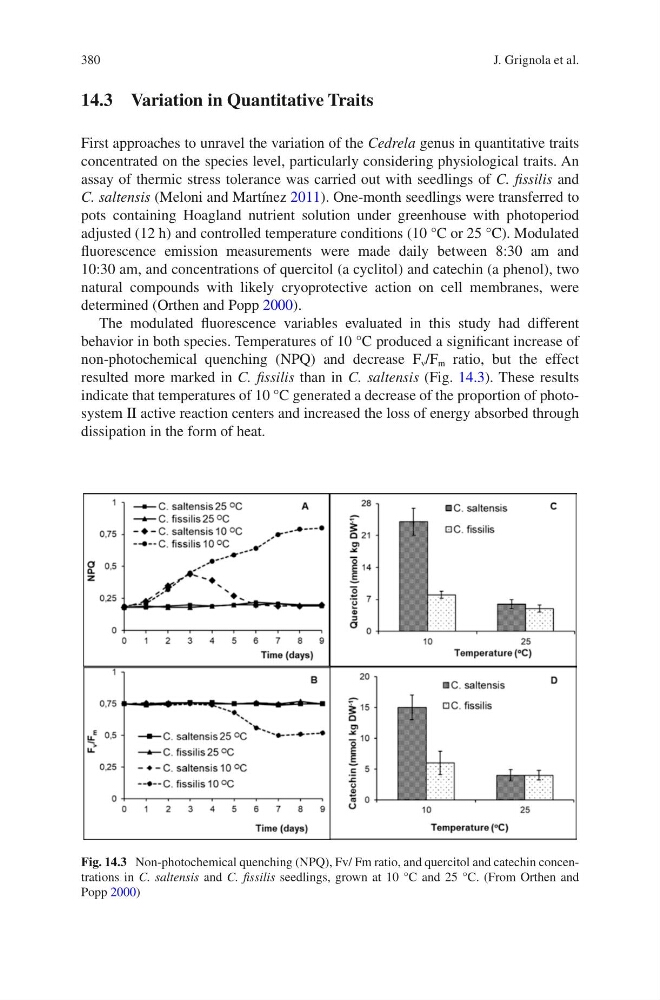
The modulated fluorescence variables evaluated in this study had different
behavior in both species. Temperatures of 10 °C produced a significant increase of
non-photochemical quenching (NPQ) and decrease F v /F m ratio, but the effect
resulted more marked in C. fissilis than in C. saltensis (Fig. 14.3). These results
indicate that temperatures of 10 °C generated a decrease of the proportion of photosystem II active reaction centers and increased the loss of energy absorbed through
dissipation in the form of heat.
Fig. 14.3 Non-photochemical quenching (NPQ), Fv/ Fm ratio, and quercitol and catechin concentrations in C. saltensis and C. fissilis seedlings, grown at 10 °C and 25 °C. (From Orthen and
Popp 2000)
J. Grignola et al.
14.3 Variation in Quantitative Traits
First approaches to unravel the variation of the Cedrela genus in quantitative traits
concentrated on the species level, particularly considering physiological traits. An
assay of thermic stress tolerance was carried out with seedlings of C. fissilis and
C. saltensis (Meloni and Martínez 2011). One-month seedlings were transferred to
pots containing Hoagland nutrient solution under greenhouse with photoperiod
adjusted (12 h) and controlled temperature conditions (10 °C or 25 °C). Modulated
fluorescence emission measurements were made daily between 8:30 am and
10:30 am, and concentrations of quercitol (a cyclitol) and catechin (a phenol), two
natural compounds with likely cryoprotective action on cell membranes, were
determined (Orthen and Popp 2000).
The modulated fluorescence variables evaluated in this study had different
behavior in both species. Temperatures of 10 °C produced a significant increase of
non-photochemical quenching (NPQ) and decrease F v /F m ratio, but the effect
resulted more marked in C. fissilis than in C. saltensis (Fig. 14.3). These results
indicate that temperatures of 10 °C generated a decrease of the proportion of photosystem II active reaction centers and increased the loss of energy absorbed through
dissipation in the form of heat.
Fig. 14.3 Non-photochemical quenching (NPQ), Fv/ Fm ratio, and quercitol and catechin concentrations in C. saltensis and C. fissilis seedlings, grown at 10 °C and 25 °C. (From Orthen and
Popp 2000)
J. Grignola et al.