

378
of 22–23 mm. The average life cycle is 5 weeks, depending on weather conditions
and food availability.
Knowing the duration of the first generation of the year of H. grandella is of
great importance to understand the population dynamics of this insect and implement strategies aimed at not allowing the exponential growth of the population over
time. Baca et al. (2013) determined in the north of the Province of Salta the temporal distribution of H. grandella attacks in C. balansae saplings. They observed the
first adult in September and the second in mid-November, although the largest adult
capture was recorded during December and January. The first attacks were observed
8 weeks after the beginning of cedar foliation. The largest number of attacks was
observed in mid-December, coinciding with the adult population peak. The first
10% of the observed attacks were concentrated in the term of 22 days (November–
December), while the remaining 90% was concentrated within 71 days (December–
February). These observations are important because there is a period of 20–30 days
since the presence of the first adults of H. grandella and the first damages.
On the other hand, Baca et al. (2013) determined that a generation of H. grandella in field conditions lasted 44 ± 8 days. These results agree with the information
obtained in laboratory conditions, where the species completed the total life cycle in
4–7 weeks (average 5 weeks), depending on the conditions and availability of food.
The knowledge of life cycle duration allows determining the appropriate control
time (Tapia 2012).
There are numerous studies regarding chemical control, mainly in Central
America. In Argentina, different evaluated insecticides have proven to be effective.
Generally, the effective products are hazardous and require numerous applications.
Tapia (2012) conducted a series of control trials with chemicals. The experiments
were carried out in commercial plantations of C. balansae, C. angustifolia, C. saltensis, and C. odorata in Salta, Jujuy, and Tucumán, with biweekly and monthly
application frequencies. The products evaluated were Imidacloprid (SC 35% at
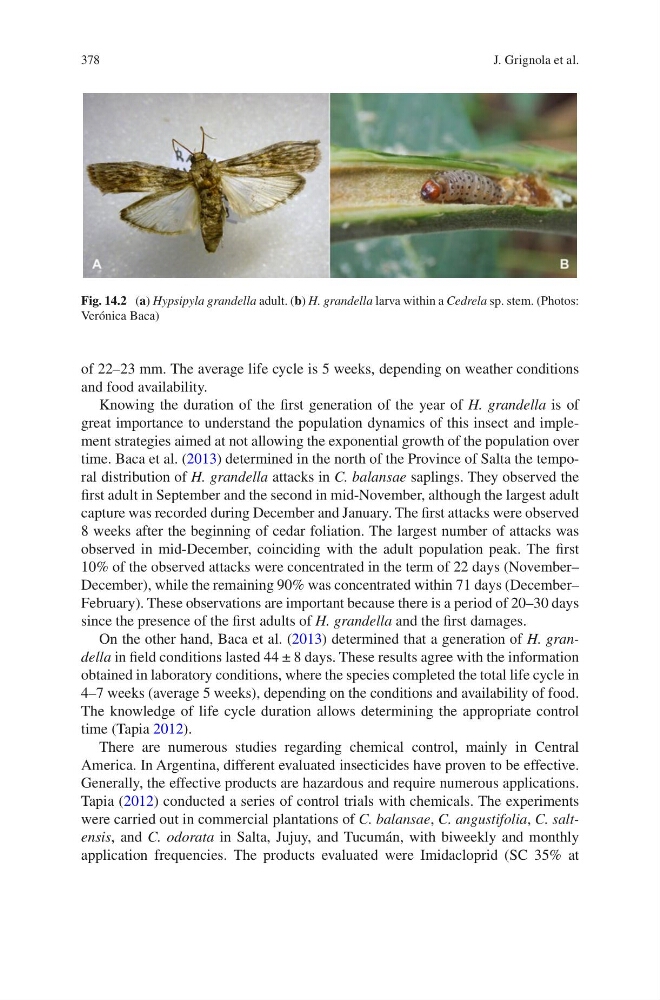
Fig. 14.2 (a) Hypsipyla grandella adult. (b) H. grandella larva within a Cedrela sp. stem. (Photos:
Verónica Baca)
J. Grignola et al.
of 22–23 mm. The average life cycle is 5 weeks, depending on weather conditions
and food availability.
Knowing the duration of the first generation of the year of H. grandella is of
great importance to understand the population dynamics of this insect and implement strategies aimed at not allowing the exponential growth of the population over
time. Baca et al. (2013) determined in the north of the Province of Salta the temporal distribution of H. grandella attacks in C. balansae saplings. They observed the
first adult in September and the second in mid-November, although the largest adult
capture was recorded during December and January. The first attacks were observed
8 weeks after the beginning of cedar foliation. The largest number of attacks was
observed in mid-December, coinciding with the adult population peak. The first
10% of the observed attacks were concentrated in the term of 22 days (November–
December), while the remaining 90% was concentrated within 71 days (December–
February). These observations are important because there is a period of 20–30 days
since the presence of the first adults of H. grandella and the first damages.
On the other hand, Baca et al. (2013) determined that a generation of H. grandella in field conditions lasted 44 ± 8 days. These results agree with the information
obtained in laboratory conditions, where the species completed the total life cycle in
4–7 weeks (average 5 weeks), depending on the conditions and availability of food.
The knowledge of life cycle duration allows determining the appropriate control
time (Tapia 2012).
There are numerous studies regarding chemical control, mainly in Central
America. In Argentina, different evaluated insecticides have proven to be effective.
Generally, the effective products are hazardous and require numerous applications.
Tapia (2012) conducted a series of control trials with chemicals. The experiments
were carried out in commercial plantations of C. balansae, C. angustifolia, C. saltensis, and C. odorata in Salta, Jujuy, and Tucumán, with biweekly and monthly
application frequencies. The products evaluated were Imidacloprid (SC 35% at
Fig. 14.2 (a) Hypsipyla grandella adult. (b) H. grandella larva within a Cedrela sp. stem. (Photos:
Verónica Baca)
J. Grignola et al.