

375
conservation value (“yellow areas”) according to Law No. 26,331. About 1.5 million hectares of “yellow areas” have been identified in the provinces of Jujuy,
Tucumán, Salta, and Misiones with suitable conditions for Cedrela sp. cultivation
under enrichment systems (Fornes 2012).
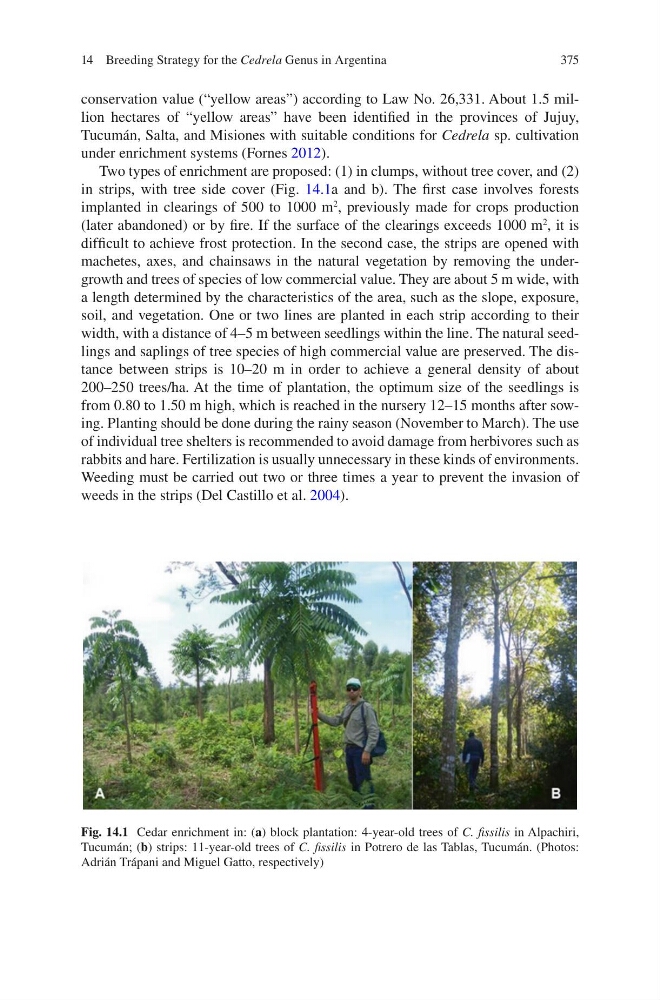
Two types of enrichment are proposed: (1) in clumps, without tree cover, and (2)
in strips, with tree side cover (Fig. 14.1a and b). The first case involves forests
implanted in clearings of 500 to 1000 m
2
, previously made for crops production
(later abandoned) or by fire. If the surface of the clearings exceeds 1000 m
2
, it is
difficult to achieve frost protection. In the second case, the strips are opened with
machetes, axes, and chainsaws in the natural vegetation by removing the undergrowth and trees of species of low commercial value. They are about 5 m wide, with
a length determined by the characteristics of the area, such as the slope, exposure,
soil, and vegetation. One or two lines are planted in each strip according to their
width, with a distance of 4–5 m between seedlings within the line. The natural seedlings and saplings of tree species of high commercial value are preserved. The distance between strips is 10–20 m in order to achieve a general density of about
200–250 trees/ha. At the time of plantation, the optimum size of the seedlings is
from 0.80 to 1.50 m high, which is reached in the nursery 12–15 months after sowing. Planting should be done during the rainy season (November to March). The use
of individual tree shelters is recommended to avoid damage from herbivores such as
rabbits and hare. Fertilization is usually unnecessary in these kinds of environments.
Weeding must be carried out two or three times a year to prevent the invasion of
weeds in the strips (Del Castillo et al. 2004).
Fig. 14.1 Cedar enrichment in: (a) block plantation: 4-year-old trees of C. fissilis in Alpachiri,
Tucumán; (b) strips: 11-year-old trees of C. fissilis in Potrero de las Tablas, Tucumán. (Photos:
Adrián Trápani and Miguel Gatto, respectively)
14 Breeding Strategy for the Cedrela Genus in Argentina
conservation value (“yellow areas”) according to Law No. 26,331. About 1.5 million hectares of “yellow areas” have been identified in the provinces of Jujuy,
Tucumán, Salta, and Misiones with suitable conditions for Cedrela sp. cultivation
under enrichment systems (Fornes 2012).
Two types of enrichment are proposed: (1) in clumps, without tree cover, and (2)
in strips, with tree side cover (Fig. 14.1a and b). The first case involves forests
implanted in clearings of 500 to 1000 m
2
, previously made for crops production
(later abandoned) or by fire. If the surface of the clearings exceeds 1000 m
2
, it is
difficult to achieve frost protection. In the second case, the strips are opened with
machetes, axes, and chainsaws in the natural vegetation by removing the undergrowth and trees of species of low commercial value. They are about 5 m wide, with
a length determined by the characteristics of the area, such as the slope, exposure,
soil, and vegetation. One or two lines are planted in each strip according to their
width, with a distance of 4–5 m between seedlings within the line. The natural seedlings and saplings of tree species of high commercial value are preserved. The distance between strips is 10–20 m in order to achieve a general density of about
200–250 trees/ha. At the time of plantation, the optimum size of the seedlings is
from 0.80 to 1.50 m high, which is reached in the nursery 12–15 months after sowing. Planting should be done during the rainy season (November to March). The use
of individual tree shelters is recommended to avoid damage from herbivores such as
rabbits and hare. Fertilization is usually unnecessary in these kinds of environments.
Weeding must be carried out two or three times a year to prevent the invasion of
weeds in the strips (Del Castillo et al. 2004).
Fig. 14.1 Cedar enrichment in: (a) block plantation: 4-year-old trees of C. fissilis in Alpachiri,
Tucumán; (b) strips: 11-year-old trees of C. fissilis in Potrero de las Tablas, Tucumán. (Photos:
Adrián Trápani and Miguel Gatto, respectively)
14 Breeding Strategy for the Cedrela Genus in Argentina