

351
history of the region (Pennington et al. 2000), northern Yungas may have been a
potential thermal refuge during glacial times for C. angustifolia in the Pleistocene,
thus expecting lower diversity in more recently colonized southern Yungas because
of genetic drift processes occurring during the species migration (Martin and
McKay 2004). Nevertheless, high genetic diversity of La Florida Provincial Park in
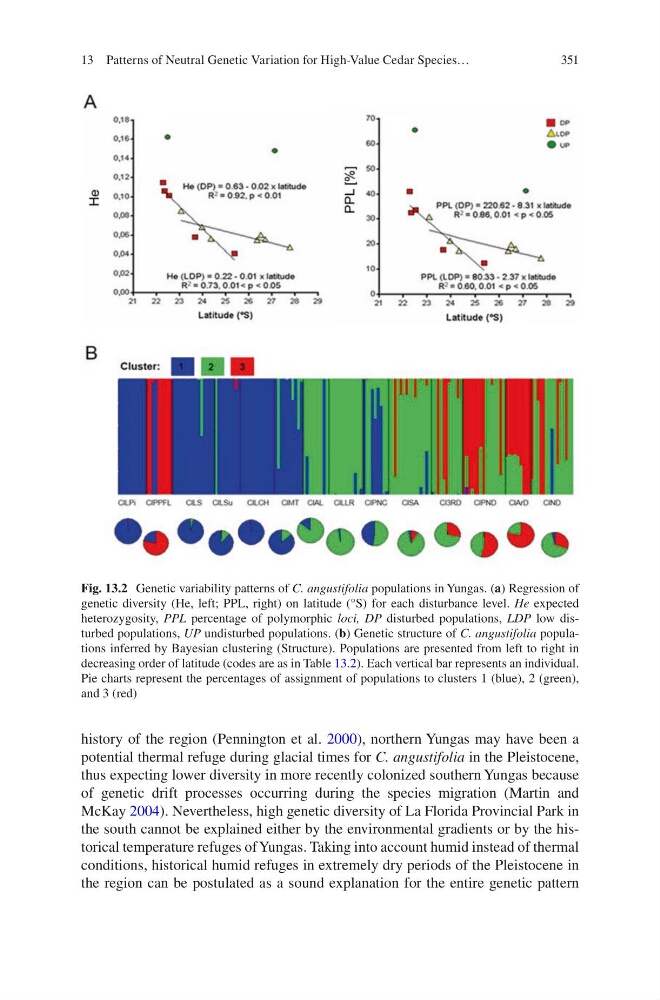
the south cannot be explained either by the environmental gradients or by the historical temperature refuges of Yungas. Taking into account humid instead of thermal
conditions, historical humid refuges in extremely dry periods of the Pleistocene in
the region can be postulated as a sound explanation for the entire genetic pattern
Fig. 13.2 Genetic variability patterns of C. angustifolia populations in Yungas. (a) Regression of
genetic diversity (He, left; PPL, right) on latitude (°S) for each disturbance level. He expected
heterozygosity, PPL percentage of polymorphic loci, DP disturbed populations, LDP low disturbed populations, UP undisturbed populations. (b) Genetic structure of C. angustifolia populations inferred by Bayesian clustering (Structure). Populations are presented from left to right in
decreasing order of latitude (codes are as in Table 13.2). Each vertical bar represents an individual.
Pie charts represent the percentages of assignment of populations to clusters 1 (blue), 2 (green),
and 3 (red)
13 Patterns of Neutral Genetic Variation for High-Value Cedar Species…
history of the region (Pennington et al. 2000), northern Yungas may have been a
potential thermal refuge during glacial times for C. angustifolia in the Pleistocene,
thus expecting lower diversity in more recently colonized southern Yungas because
of genetic drift processes occurring during the species migration (Martin and
McKay 2004). Nevertheless, high genetic diversity of La Florida Provincial Park in
the south cannot be explained either by the environmental gradients or by the historical temperature refuges of Yungas. Taking into account humid instead of thermal
conditions, historical humid refuges in extremely dry periods of the Pleistocene in
the region can be postulated as a sound explanation for the entire genetic pattern
Fig. 13.2 Genetic variability patterns of C. angustifolia populations in Yungas. (a) Regression of
genetic diversity (He, left; PPL, right) on latitude (°S) for each disturbance level. He expected
heterozygosity, PPL percentage of polymorphic loci, DP disturbed populations, LDP low disturbed populations, UP undisturbed populations. (b) Genetic structure of C. angustifolia populations inferred by Bayesian clustering (Structure). Populations are presented from left to right in
decreasing order of latitude (codes are as in Table 13.2). Each vertical bar represents an individual.
Pie charts represent the percentages of assignment of populations to clusters 1 (blue), 2 (green),
and 3 (red)
13 Patterns of Neutral Genetic Variation for High-Value Cedar Species…