

346
et al. 2009; Seghezzo et al. 2011; FAO 2016). Today, native forests remain the main
source of high-quality wood for local forestry development (Fornes et al. 2016).
In the NEA, the Alto Paraná Rainforest is invaluable as biogeographic relict and
reserve of biodiversity, due to its genetic resources and endemic species. Despite
this, the fragmentation and degradation processes, mainly caused by the patterns of
land subdivision, land use with exotic species plantations, spread of agriculture, and
unsustainable management of forest species, led to a severe reduction in the surface
occupied by forests; at current times only 6–7% of the original surface remains.
Along the twentieth century, timber species present in the remnant forest have been
overexploited, in a regional context of lack of planning and legal control (Placci
2000; Rau 2005; SAyDS 2007; Inza et al. 2018).
In both Yungas of NWA and Alto Paraná Rainforest of NEA (Fig. 13.1), Cedrela
is among the most important forest resources because of the mechanical properties
of its wood, color, veining, and easiness of work in carpentry. Consequently, it has
undergone intense processes of logging, which affected the genetic diversity and
structure of the populations (Inza et al. 2012; Soldati et al. 2013; Zelener et al. 2016).
Three endangered species of Cedrela (C. angustifolia, C. saltensis, and C. balansae) follow latitudinal and altitudinal patterns of distribution in the Yungas, with
transition zones along elevation where the species co-occur.
Cedrela angustifolia (syn = C. lilloi; Pennington and Muellner 2010) locally
called “cedro coya” is the most valuable timber species of cedar in the Yungas. It
occurs in Ecuador, Peru, Brazil, Paraguay, Bolivia, and Argentina, where it can be
found in the upper level of the MR and the TMF strata, in an altitude range of
900–2500 m above sea level (m asl), from the border with Bolivia at 22° S to 28°
15’ S, building the southernmost edge of Cedrela’s range. It is a canopy, long-lived,
and deciduous hardwood species, whose height ranges from 30 to 40 m. The populations of C. angustifolia show individuals at low density and aggregated distribution with a gap-dependent recruitment (Grau 2000; Grau et al. 2003; Zamora Petri
2006), which is consistent with the spatial distribution and regeneration patterns
described for the genus and family in the Neotropics (Mostacedo and Fredericksen
1999; Van Rheenen et al. 2004). Little is known about the species’ mating system;
however, most other Cedrela species, as well as the Meliaceae family species, are
monoecious and predominantly outcrossing, with high self-incompatibility and
small unisexual flowers pollinated by small insects (Kageyama et al. 2003; Ward
et al. 2005; Aschero 2006). Because of selective logging, the presence of individuals
with high commercial value is low, suggesting genetic erosion of the species.
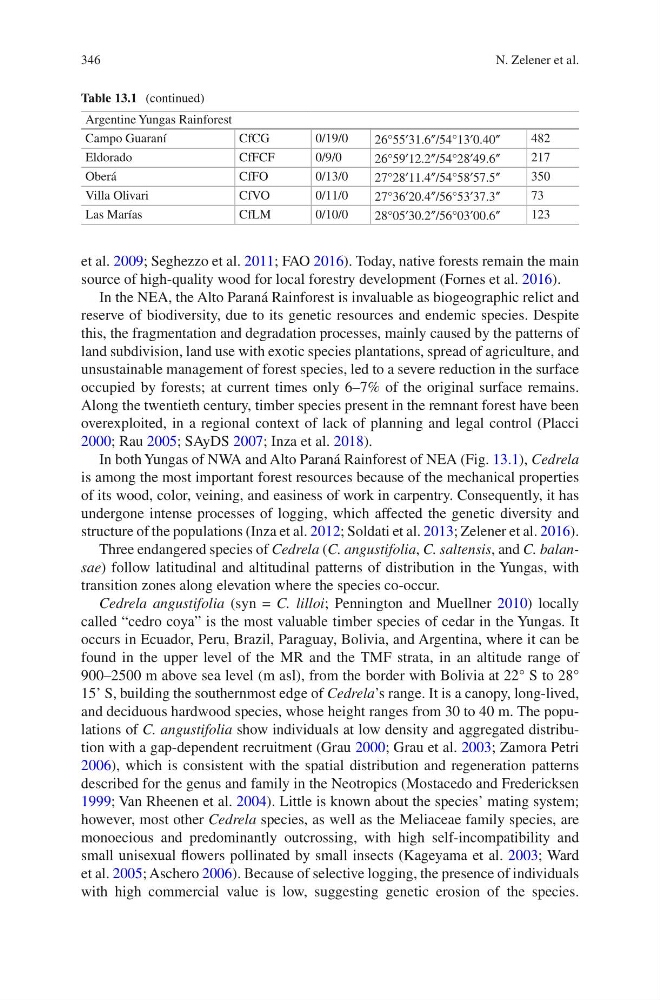
Table 13.1 (continued)
Argentine Yungas Rainforest
Campo Guaraní
CfCG
0/19/0
26°55′31.6″/54°13′0.40″
482
Eldorado
CfFCF
0/9/0
26°59′12.2″/54°28′49.6″
217
Oberá
CfFO
0/13/0
27°28′11.4″/54°58′57.5″
350
Villa Olivari
CfVO
0/11/0
27°36′20.4″/56°53′37.3″
73
Las Marías
CfLM
0/10/0
28°05′30.2″/56°03′00.6″
123
N. Zelener et al.
et al. 2009; Seghezzo et al. 2011; FAO 2016). Today, native forests remain the main
source of high-quality wood for local forestry development (Fornes et al. 2016).
In the NEA, the Alto Paraná Rainforest is invaluable as biogeographic relict and
reserve of biodiversity, due to its genetic resources and endemic species. Despite
this, the fragmentation and degradation processes, mainly caused by the patterns of
land subdivision, land use with exotic species plantations, spread of agriculture, and
unsustainable management of forest species, led to a severe reduction in the surface
occupied by forests; at current times only 6–7% of the original surface remains.
Along the twentieth century, timber species present in the remnant forest have been
overexploited, in a regional context of lack of planning and legal control (Placci
2000; Rau 2005; SAyDS 2007; Inza et al. 2018).
In both Yungas of NWA and Alto Paraná Rainforest of NEA (Fig. 13.1), Cedrela
is among the most important forest resources because of the mechanical properties
of its wood, color, veining, and easiness of work in carpentry. Consequently, it has
undergone intense processes of logging, which affected the genetic diversity and
structure of the populations (Inza et al. 2012; Soldati et al. 2013; Zelener et al. 2016).
Three endangered species of Cedrela (C. angustifolia, C. saltensis, and C. balansae) follow latitudinal and altitudinal patterns of distribution in the Yungas, with
transition zones along elevation where the species co-occur.
Cedrela angustifolia (syn = C. lilloi; Pennington and Muellner 2010) locally
called “cedro coya” is the most valuable timber species of cedar in the Yungas. It
occurs in Ecuador, Peru, Brazil, Paraguay, Bolivia, and Argentina, where it can be
found in the upper level of the MR and the TMF strata, in an altitude range of
900–2500 m above sea level (m asl), from the border with Bolivia at 22° S to 28°
15’ S, building the southernmost edge of Cedrela’s range. It is a canopy, long-lived,
and deciduous hardwood species, whose height ranges from 30 to 40 m. The populations of C. angustifolia show individuals at low density and aggregated distribution with a gap-dependent recruitment (Grau 2000; Grau et al. 2003; Zamora Petri
2006), which is consistent with the spatial distribution and regeneration patterns
described for the genus and family in the Neotropics (Mostacedo and Fredericksen
1999; Van Rheenen et al. 2004). Little is known about the species’ mating system;
however, most other Cedrela species, as well as the Meliaceae family species, are
monoecious and predominantly outcrossing, with high self-incompatibility and
small unisexual flowers pollinated by small insects (Kageyama et al. 2003; Ward
et al. 2005; Aschero 2006). Because of selective logging, the presence of individuals
with high commercial value is low, suggesting genetic erosion of the species.
Table 13.1 (continued)
Argentine Yungas Rainforest
Campo Guaraní
CfCG
0/19/0
26°55′31.6″/54°13′0.40″
482
Eldorado
CfFCF
0/9/0
26°59′12.2″/54°28′49.6″
217
Oberá
CfFO
0/13/0
27°28′11.4″/54°58′57.5″
350
Villa Olivari
CfVO
0/11/0
27°36′20.4″/56°53′37.3″
73
Las Marías
CfLM
0/10/0
28°05′30.2″/56°03′00.6″
123
N. Zelener et al.