

329
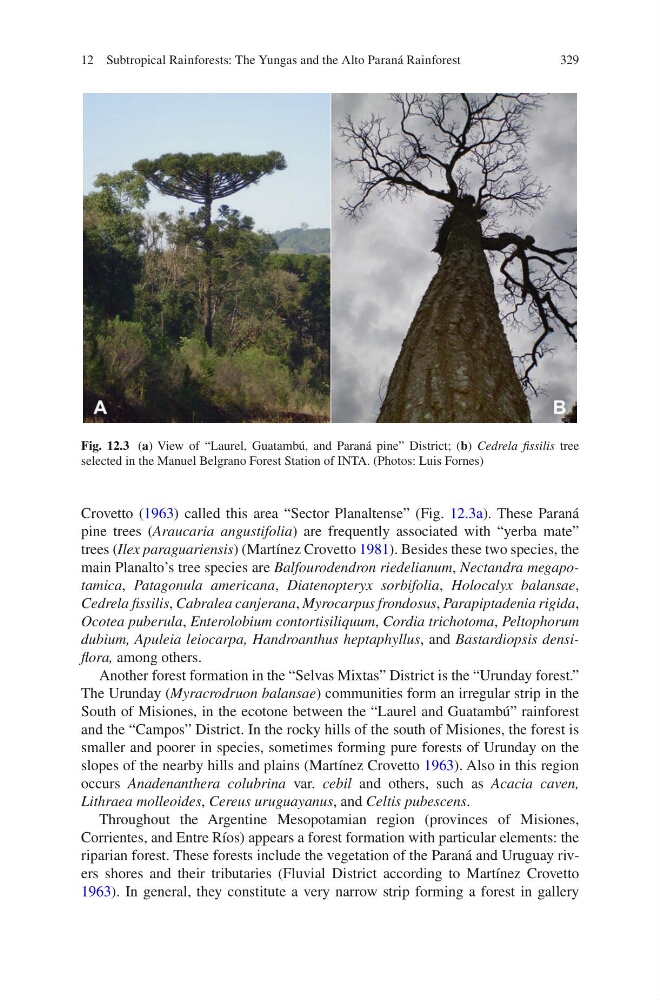
Crovetto (1963) called this area “Sector Planaltense” (Fig. 12.3a). These Paraná
pine trees (Araucaria angustifolia) are frequently associated with “yerba mate”
trees (Ilex paraguariensis) (Martínez Crovetto 1981). Besides these two species, the
main Planalto’s tree species are Balfourodendron riedelianum, Nectandra megapotamica, Patagonula americana, Diatenopteryx sorbifolia, Holocalyx balansae,
Cedrela fissilis, Cabralea canjerana, Myrocarpus frondosus, Parapiptadenia rigida,
Ocotea puberula, Enterolobium contortisiliquum, Cordia trichotoma, Peltophorum
dubium, Apuleia leiocarpa, Handroanthus heptaphyllus, and Bastardiopsis densiflora, among others.
Another forest formation in the “Selvas Mixtas” District is the “Urunday forest.”
The Urunday (Myracrodruon balansae) communities form an irregular strip in the
South of Misiones, in the ecotone between the “Laurel and Guatambú” rainforest
and the “Campos” District. In the rocky hills of the south of Misiones, the forest is
smaller and poorer in species, sometimes forming pure forests of Urunday on the
slopes of the nearby hills and plains (Martínez Crovetto 1963). Also in this region
occurs Anadenanthera colubrina var. cebil and others, such as Acacia caven,
Lithraea molleoides, Cereus uruguayanus, and Celtis pubescens.
Throughout the Argentine Mesopotamian region (provinces of Misiones,
Corrientes, and Entre Ríos) appears a forest formation with particular elements: the
riparian forest. These forests include the vegetation of the Paraná and Uruguay rivers shores and their tributaries (Fluvial District according to Martínez Crovetto
1963). In general, they constitute a very narrow strip forming a forest in gallery
Fig. 12.3 (a) View of “Laurel, Guatambú, and Paraná pine” District; (b) Cedrela fissilis tree
selected in the Manuel Belgrano Forest Station of INTA. (Photos: Luis Fornes)
12 Subtropical Rainforests: The Yungas and the Alto Paraná Rainforest
Crovetto (1963) called this area “Sector Planaltense” (Fig. 12.3a). These Paraná
pine trees (Araucaria angustifolia) are frequently associated with “yerba mate”
trees (Ilex paraguariensis) (Martínez Crovetto 1981). Besides these two species, the
main Planalto’s tree species are Balfourodendron riedelianum, Nectandra megapotamica, Patagonula americana, Diatenopteryx sorbifolia, Holocalyx balansae,
Cedrela fissilis, Cabralea canjerana, Myrocarpus frondosus, Parapiptadenia rigida,
Ocotea puberula, Enterolobium contortisiliquum, Cordia trichotoma, Peltophorum
dubium, Apuleia leiocarpa, Handroanthus heptaphyllus, and Bastardiopsis densiflora, among others.
Another forest formation in the “Selvas Mixtas” District is the “Urunday forest.”
The Urunday (Myracrodruon balansae) communities form an irregular strip in the
South of Misiones, in the ecotone between the “Laurel and Guatambú” rainforest
and the “Campos” District. In the rocky hills of the south of Misiones, the forest is
smaller and poorer in species, sometimes forming pure forests of Urunday on the
slopes of the nearby hills and plains (Martínez Crovetto 1963). Also in this region
occurs Anadenanthera colubrina var. cebil and others, such as Acacia caven,
Lithraea molleoides, Cereus uruguayanus, and Celtis pubescens.
Throughout the Argentine Mesopotamian region (provinces of Misiones,
Corrientes, and Entre Ríos) appears a forest formation with particular elements: the
riparian forest. These forests include the vegetation of the Paraná and Uruguay rivers shores and their tributaries (Fluvial District according to Martínez Crovetto
1963). In general, they constitute a very narrow strip forming a forest in gallery
Fig. 12.3 (a) View of “Laurel, Guatambú, and Paraná pine” District; (b) Cedrela fissilis tree
selected in the Manuel Belgrano Forest Station of INTA. (Photos: Luis Fornes)
12 Subtropical Rainforests: The Yungas and the Alto Paraná Rainforest