

323
number of adult trees per hectare (187), only 23.5% (44 individuals) corresponds to
species of commercial value; the remainder (149 individuals) has a DBH of less
than 30 cm, and the vast majority corresponds to species disregarded by the market.
Natural regeneration has a significant number of individuals (1320/ha), but only
6.9% corresponds to species of actual commercial value. The current state of the
environment of the Selva Pedemontana reflects the process of irrational logging
throughout the region, by which tree specimens of noble species disappeared (Del
Castillo et al. 2005).
At mid-altitudes it is found the “Selva Montana,” on the slopes of the mountains
between 900 and 1600 m asl, with annual average rainfall of 1800 mm
(1100–2300 mm). In the highest altitude is the “Bosque Montano,” between 1600
and 2300 m asl as continuous forest, with annual average rainfall of 1100 mm
(800–1400 mm). The last two altitudinal floors occupy 19,721 km
2
and represent,
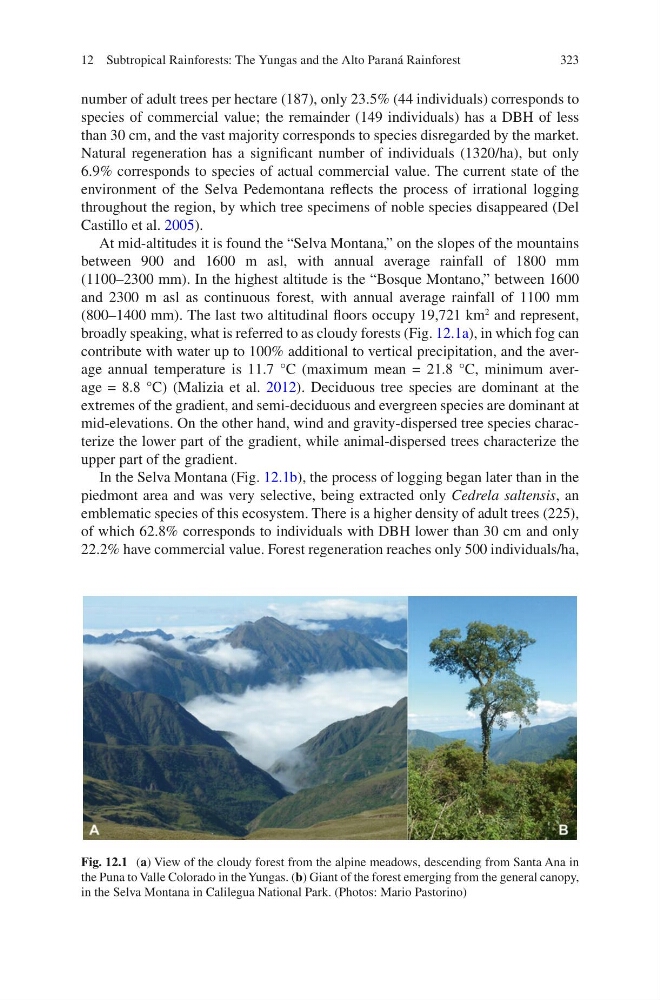
broadly speaking, what is referred to as cloudy forests (Fig. 12.1a), in which fog can
contribute with water up to 100% additional to vertical precipitation, and the average annual temperature is 11.7 °C (maximum mean = 21.8 °C, minimum average = 8.8 °C) (Malizia et al. 2012). Deciduous tree species are dominant at the
extremes of the gradient, and semi-deciduous and evergreen species are dominant at
mid-elevations. On the other hand, wind and gravity-dispersed tree species characterize the lower part of the gradient, while animal-dispersed trees characterize the
upper part of the gradient.
In the Selva Montana (Fig. 12.1b), the process of logging began later than in the
piedmont area and was very selective, being extracted only Cedrela saltensis, an
emblematic species of this ecosystem. There is a higher density of adult trees (225),
of which 62.8% corresponds to individuals with DBH lower than 30 cm and only
22.2% have commercial value. Forest regeneration reaches only 500 individuals/ha,
Fig. 12.1 (a) View of the cloudy forest from the alpine meadows, descending from Santa Ana in
the Puna to Valle Colorado in the Yungas. (b) Giant of the forest emerging from the general canopy,
in the Selva Montana in Calilegua National Park. (Photos: Mario Pastorino)
12 Subtropical Rainforests: The Yungas and the Alto Paraná Rainforest
number of adult trees per hectare (187), only 23.5% (44 individuals) corresponds to
species of commercial value; the remainder (149 individuals) has a DBH of less
than 30 cm, and the vast majority corresponds to species disregarded by the market.
Natural regeneration has a significant number of individuals (1320/ha), but only
6.9% corresponds to species of actual commercial value. The current state of the
environment of the Selva Pedemontana reflects the process of irrational logging
throughout the region, by which tree specimens of noble species disappeared (Del
Castillo et al. 2005).
At mid-altitudes it is found the “Selva Montana,” on the slopes of the mountains
between 900 and 1600 m asl, with annual average rainfall of 1800 mm
(1100–2300 mm). In the highest altitude is the “Bosque Montano,” between 1600
and 2300 m asl as continuous forest, with annual average rainfall of 1100 mm
(800–1400 mm). The last two altitudinal floors occupy 19,721 km
2
and represent,
broadly speaking, what is referred to as cloudy forests (Fig. 12.1a), in which fog can
contribute with water up to 100% additional to vertical precipitation, and the average annual temperature is 11.7 °C (maximum mean = 21.8 °C, minimum average = 8.8 °C) (Malizia et al. 2012). Deciduous tree species are dominant at the
extremes of the gradient, and semi-deciduous and evergreen species are dominant at
mid-elevations. On the other hand, wind and gravity-dispersed tree species characterize the lower part of the gradient, while animal-dispersed trees characterize the
upper part of the gradient.
In the Selva Montana (Fig. 12.1b), the process of logging began later than in the
piedmont area and was very selective, being extracted only Cedrela saltensis, an
emblematic species of this ecosystem. There is a higher density of adult trees (225),
of which 62.8% corresponds to individuals with DBH lower than 30 cm and only
22.2% have commercial value. Forest regeneration reaches only 500 individuals/ha,
Fig. 12.1 (a) View of the cloudy forest from the alpine meadows, descending from Santa Ana in
the Puna to Valle Colorado in the Yungas. (b) Giant of the forest emerging from the general canopy,
in the Selva Montana in Calilegua National Park. (Photos: Mario Pastorino)
12 Subtropical Rainforests: The Yungas and the Alto Paraná Rainforest