

301
trees of the region such as Tabebuia nodosa, Aspidosperma quebracho-blanco, and
Schinopsis lorentzii; in this type of forests, the diameter distribution of the species
is more regular, and the species density is between 25 and 38 trees/ha (Loto et al.
2018). Giménez et al. (2007) studied the wood anatomy and annual growth rings of
the species, reporting that 100 years of growth correspond to a basal diameter of
45 cm, approximately. Loto et al. (2018) registered an annual periodic increase
(period 2007–2012) of 1.14 mm/year as a mean for a total of 126 specimens.
Exploitation of G. sarmientoi has been reported in communities of Argentina
(Filipov 1994; Scarpa 2000; Martínez 2011) as well as in Bolivia and Paraguay
(Arispe and Rumiz 2002; Benítez et al. 2008; Quiroga et al. 2009); the timber is
used for home and urban construction and for handicrafts and tools; the resin is used
in medicine or as repellent (Mereles and Pérez de Molas 2008). Palo santo is
exploited at industrial level to produce charcoal, floor boards or to extract an essential oil (“guaiacol”), and it is also exported as roundwood (Jacobs 1990; SAyDS
2007; Mereles and Pérez de Molas 2008; Waller et al. 2012). The Argentinian official statistics register the production of 3282 tonne of roundwood, 821 tonne of
poles and 277 tonne of other products derived from the species wood (SGAyDS 2019).
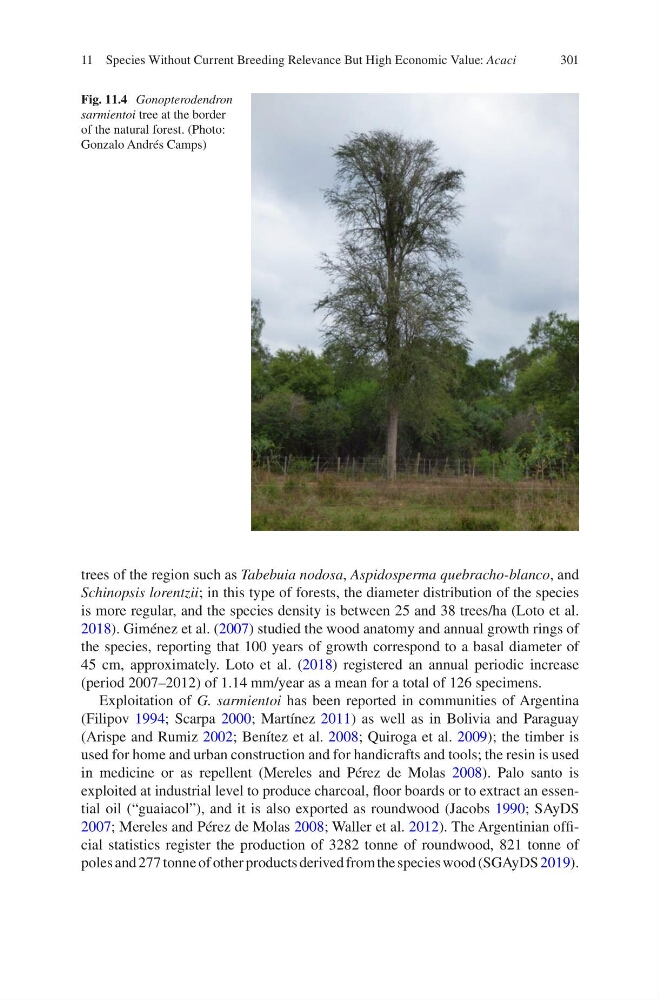
Fig. 11.4 Gonopterodendron
sarmientoi tree at the border
of the natural forest. (Photo:
Gonzalo Andrés Camps)
11 Species Without Current Breeding Relevance But High Economic Value: Acaci
trees of the region such as Tabebuia nodosa, Aspidosperma quebracho-blanco, and
Schinopsis lorentzii; in this type of forests, the diameter distribution of the species
is more regular, and the species density is between 25 and 38 trees/ha (Loto et al.
2018). Giménez et al. (2007) studied the wood anatomy and annual growth rings of
the species, reporting that 100 years of growth correspond to a basal diameter of
45 cm, approximately. Loto et al. (2018) registered an annual periodic increase
(period 2007–2012) of 1.14 mm/year as a mean for a total of 126 specimens.
Exploitation of G. sarmientoi has been reported in communities of Argentina
(Filipov 1994; Scarpa 2000; Martínez 2011) as well as in Bolivia and Paraguay
(Arispe and Rumiz 2002; Benítez et al. 2008; Quiroga et al. 2009); the timber is
used for home and urban construction and for handicrafts and tools; the resin is used
in medicine or as repellent (Mereles and Pérez de Molas 2008). Palo santo is
exploited at industrial level to produce charcoal, floor boards or to extract an essential oil (“guaiacol”), and it is also exported as roundwood (Jacobs 1990; SAyDS
2007; Mereles and Pérez de Molas 2008; Waller et al. 2012). The Argentinian official statistics register the production of 3282 tonne of roundwood, 821 tonne of
poles and 277 tonne of other products derived from the species wood (SGAyDS 2019).
Fig. 11.4 Gonopterodendron
sarmientoi tree at the border
of the natural forest. (Photo:
Gonzalo Andrés Camps)
11 Species Without Current Breeding Relevance But High Economic Value: Acaci