

286
10.5.1 Rhizobacteria for P. alba Cultivation
The symbiotic relationship between plants and rhizobacteria allows the incorporation of N 2 via biological fixation (NBF), inducing a set of systemic changes in the
plant that contributes to efficient adaptive responses. Therefore, inoculation with
rhizobacteria enhances plant survival during the development and establishment of
forest plantations, especially in limiting environmental conditions (Zamioudis and
Pieterse 2012).
In the Arid Chaco region of Argentina, the first described species with the ability
to form root nodules in P. alba was Mesorhizobium chacoense (Velázquez et al.
2001). More recently, Chávez Díaz et al. (2013) reported that rhizobacteria belonging to Mesorhizobium, Sinorhizobium (Ensifer), and Bradyrhizobium genera, isolated from environments of five P. alba populations in the Chaco region, were also
able to induce nitrogen-fixing nodules in this species. To obtain these isolates, soil
was collected from P. alba seed stands in five localities in the Chaco: San MiguelCórdoba (31° 45′ 59″ S; 65° 25′ 39″ W); Padre Lozano-Salta (23° 12′ 51″ S; 63° 50′
39″ W), Isla Cuba-Formosa (24° 17′ 31″ S; 61° 51′ 10″ W), Bolsa Palomo-Formosa
(24° 13′ 15″ S; 61° 57′ 42″ W), and Colonia Benítez-Chaco (27° 20′ S; 58° 55′ 60″
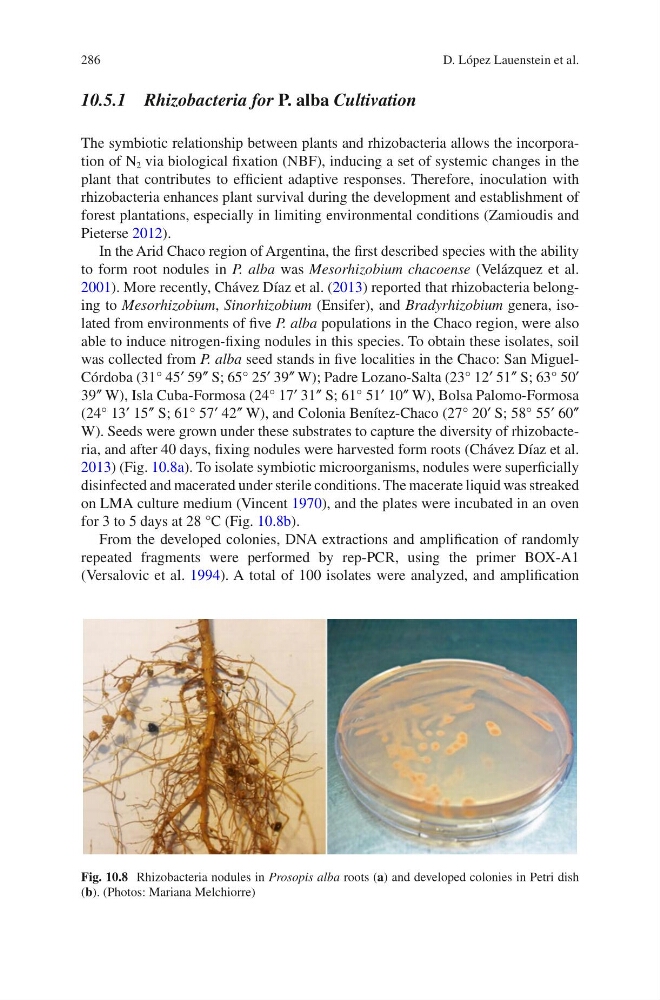
W). Seeds were grown under these substrates to capture the diversity of rhizobacteria, and after 40 days, fixing nodules were harvested form roots (Chávez Díaz et al.
2013) (Fig. 10.8a). To isolate symbiotic microorganisms, nodules were superficially
disinfected and macerated under sterile conditions. The macerate liquid was streaked
on LMA culture medium (Vincent 1970), and the plates were incubated in an oven
for 3 to 5 days at 28 °C (Fig. 10.8b).
From the developed colonies, DNA extractions and amplification of randomly
repeated fragments were performed by rep-PCR, using the primer BOX-A1
(Versalovic et al. 1994). A total of 100 isolates were analyzed, and amplification
Fig. 10.8 Rhizobacteria nodules in Prosopis alba roots (a) and developed colonies in Petri dish
(b). (Photos: Mariana Melchiorre)
D. López Lauenstein et al.
10.5.1 Rhizobacteria for P. alba Cultivation
The symbiotic relationship between plants and rhizobacteria allows the incorporation of N 2 via biological fixation (NBF), inducing a set of systemic changes in the
plant that contributes to efficient adaptive responses. Therefore, inoculation with
rhizobacteria enhances plant survival during the development and establishment of
forest plantations, especially in limiting environmental conditions (Zamioudis and
Pieterse 2012).
In the Arid Chaco region of Argentina, the first described species with the ability
to form root nodules in P. alba was Mesorhizobium chacoense (Velázquez et al.
2001). More recently, Chávez Díaz et al. (2013) reported that rhizobacteria belonging to Mesorhizobium, Sinorhizobium (Ensifer), and Bradyrhizobium genera, isolated from environments of five P. alba populations in the Chaco region, were also
able to induce nitrogen-fixing nodules in this species. To obtain these isolates, soil
was collected from P. alba seed stands in five localities in the Chaco: San MiguelCórdoba (31° 45′ 59″ S; 65° 25′ 39″ W); Padre Lozano-Salta (23° 12′ 51″ S; 63° 50′
39″ W), Isla Cuba-Formosa (24° 17′ 31″ S; 61° 51′ 10″ W), Bolsa Palomo-Formosa
(24° 13′ 15″ S; 61° 57′ 42″ W), and Colonia Benítez-Chaco (27° 20′ S; 58° 55′ 60″
W). Seeds were grown under these substrates to capture the diversity of rhizobacteria, and after 40 days, fixing nodules were harvested form roots (Chávez Díaz et al.
2013) (Fig. 10.8a). To isolate symbiotic microorganisms, nodules were superficially
disinfected and macerated under sterile conditions. The macerate liquid was streaked
on LMA culture medium (Vincent 1970), and the plates were incubated in an oven
for 3 to 5 days at 28 °C (Fig. 10.8b).
From the developed colonies, DNA extractions and amplification of randomly
repeated fragments were performed by rep-PCR, using the primer BOX-A1
(Versalovic et al. 1994). A total of 100 isolates were analyzed, and amplification
Fig. 10.8 Rhizobacteria nodules in Prosopis alba roots (a) and developed colonies in Petri dish
(b). (Photos: Mariana Melchiorre)
D. López Lauenstein et al.