

284
10.4 Vegetative Propagation: A Useful Tool for Genetic
Improvement
Agamic propagation constitutes a fundamental technique to be developed for the
P. alba breeding genetic program, since it will allow the eventual installation of
clonal seed orchards (López Lauenstein et al. 2016). In this way, ex situ conservation is also done by cloning representative samples of threatened natural populations. For these reasons, the INTA P. alba breeding program is developing asexual
propagation methodologies through different in vitro tissue culture and grafting
techniques. Also, different techniques of rejuvenation of vegetative material that
allow the multiplication of P. alba through the use of mini-stakes are being tested.
The advantage of agamic propagation in forest genetic breeding is its ability to
capture and transfer to the new individuals all the genetic potential of the mother
plant, in a short period of time since it is not necessary to wait for the production of
seeds to obtain their offspring. One of the vegetative propagation methods being
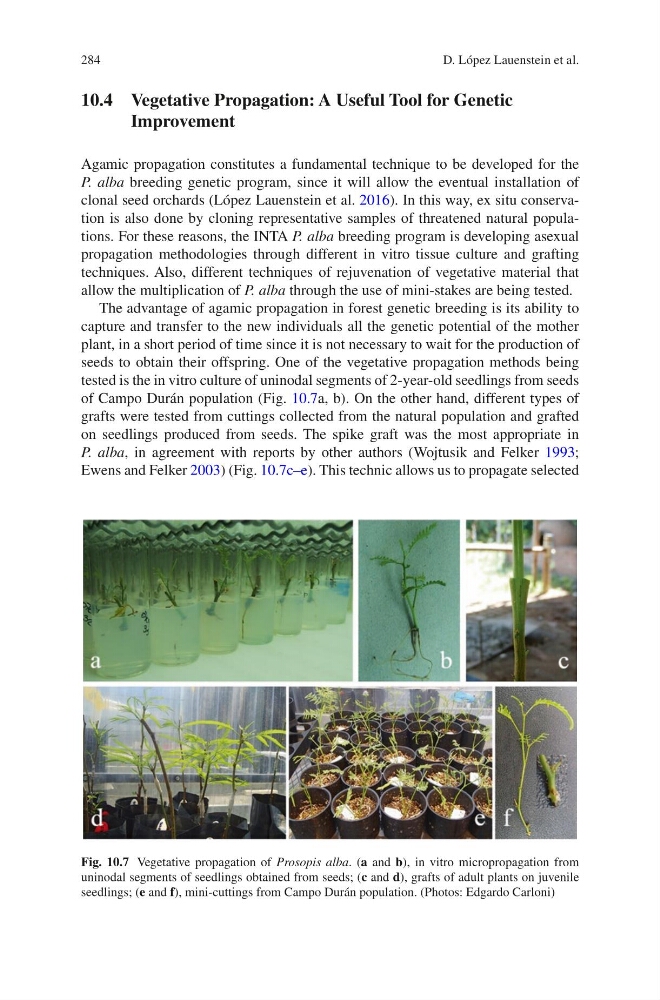
tested is the in vitro culture of uninodal segments of 2-year-old seedlings from seeds
of Campo Durán population (Fig. 10.7a, b). On the other hand, different types of
grafts were tested from cuttings collected from the natural population and grafted
on seedlings produced from seeds. The spike graft was the most appropriate in
P. alba, in agreement with reports by other authors (Wojtusik and Felker 1993;
Ewens and Felker 2003) (Fig. 10.7c–e). This technic allows us to propagate selected
Fig. 10.7 Vegetative propagation of Prosopis alba. (a and b), in vitro micropropagation from
uninodal segments of seedlings obtained from seeds; (c and d), grafts of adult plants on juvenile
seedlings; (e and f), mini-cuttings from Campo Durán population. (Photos: Edgardo Carloni)
D. López Lauenstein et al.
10.4 Vegetative Propagation: A Useful Tool for Genetic
Improvement
Agamic propagation constitutes a fundamental technique to be developed for the
P. alba breeding genetic program, since it will allow the eventual installation of
clonal seed orchards (López Lauenstein et al. 2016). In this way, ex situ conservation is also done by cloning representative samples of threatened natural populations. For these reasons, the INTA P. alba breeding program is developing asexual
propagation methodologies through different in vitro tissue culture and grafting
techniques. Also, different techniques of rejuvenation of vegetative material that
allow the multiplication of P. alba through the use of mini-stakes are being tested.
The advantage of agamic propagation in forest genetic breeding is its ability to
capture and transfer to the new individuals all the genetic potential of the mother
plant, in a short period of time since it is not necessary to wait for the production of
seeds to obtain their offspring. One of the vegetative propagation methods being
tested is the in vitro culture of uninodal segments of 2-year-old seedlings from seeds
of Campo Durán population (Fig. 10.7a, b). On the other hand, different types of
grafts were tested from cuttings collected from the natural population and grafted
on seedlings produced from seeds. The spike graft was the most appropriate in
P. alba, in agreement with reports by other authors (Wojtusik and Felker 1993;
Ewens and Felker 2003) (Fig. 10.7c–e). This technic allows us to propagate selected
Fig. 10.7 Vegetative propagation of Prosopis alba. (a and b), in vitro micropropagation from
uninodal segments of seedlings obtained from seeds; (c and d), grafts of adult plants on juvenile
seedlings; (e and f), mini-cuttings from Campo Durán population. (Photos: Edgardo Carloni)
D. López Lauenstein et al.