

258
specifically trees, are sessile organisms, and their rate of migration and generational
time are slower than changes in climate (Aitken and Whitlock 2013), local adaptation and plasticity have a more decisive impact than migration. Natural selection is
the driving force of local adaptation, and usually increases along environmental
gradients (Grivet et al. 2011; Song et al. 2016).
The observed pattern of population differentiation is the product of mutation,
migration, genetic drift, or selection (Wright 1951). While the first three are considered neutral processes, natural selection acts on certain traits and genes differently
depending on the environmental conditions, which can vary both in space and time
(Kawecki and Dieter 2004; Savolainen et al. 2013). Therefore, local adaptation
occurs when the individuals of a given environment perform better than individuals
from other places (Williams 1966).
The identification of genes under natural selection is key to understanding the
genetic basis of adaptation to different environments and also useful for practical
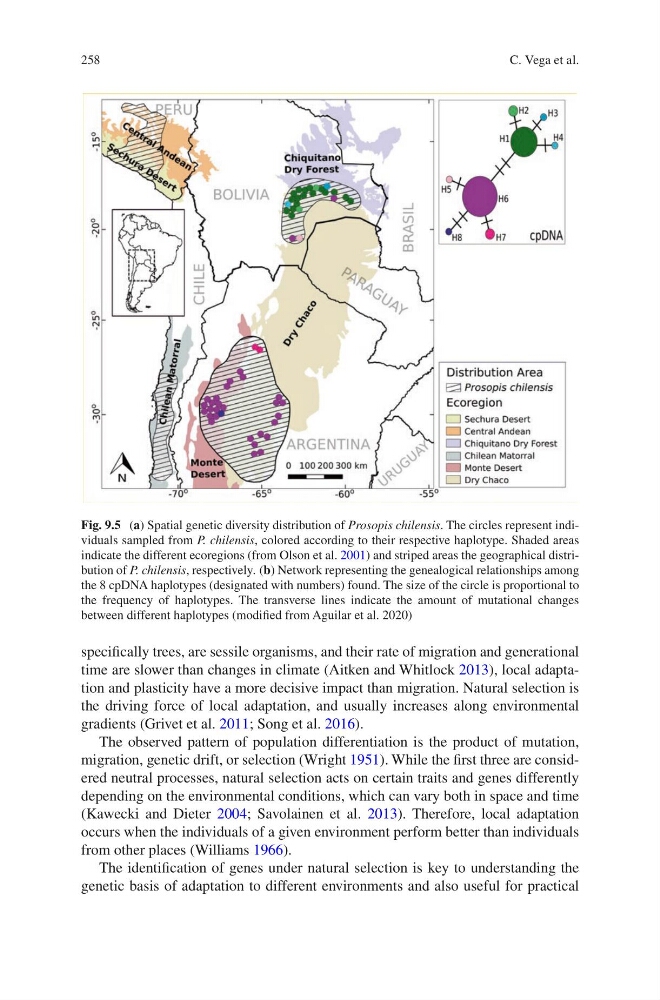
Fig. 9.5 (a) Spatial genetic diversity distribution of Prosopis chilensis. The circles represent individuals sampled from P. chilensis, colored according to their respective haplotype. Shaded areas
indicate the different ecoregions (from Olson et al. 2001) and striped areas the geographical distribution of P. chilensis, respectively. (b) Network representing the genealogical relationships among
the 8 cpDNA haplotypes (designated with numbers) found. The size of the circle is proportional to
the frequency of haplotypes. The transverse lines indicate the amount of mutational changes
between different haplotypes (modified from Aguilar et al. 2020)
C. Vega et al.
specifically trees, are sessile organisms, and their rate of migration and generational
time are slower than changes in climate (Aitken and Whitlock 2013), local adaptation and plasticity have a more decisive impact than migration. Natural selection is
the driving force of local adaptation, and usually increases along environmental
gradients (Grivet et al. 2011; Song et al. 2016).
The observed pattern of population differentiation is the product of mutation,
migration, genetic drift, or selection (Wright 1951). While the first three are considered neutral processes, natural selection acts on certain traits and genes differently
depending on the environmental conditions, which can vary both in space and time
(Kawecki and Dieter 2004; Savolainen et al. 2013). Therefore, local adaptation
occurs when the individuals of a given environment perform better than individuals
from other places (Williams 1966).
The identification of genes under natural selection is key to understanding the
genetic basis of adaptation to different environments and also useful for practical
Fig. 9.5 (a) Spatial genetic diversity distribution of Prosopis chilensis. The circles represent individuals sampled from P. chilensis, colored according to their respective haplotype. Shaded areas
indicate the different ecoregions (from Olson et al. 2001) and striped areas the geographical distribution of P. chilensis, respectively. (b) Network representing the genealogical relationships among
the 8 cpDNA haplotypes (designated with numbers) found. The size of the circle is proportional to
the frequency of haplotypes. The transverse lines indicate the amount of mutational changes
between different haplotypes (modified from Aguilar et al. 2020)
C. Vega et al.