

229
period, extracting red quebracho without following any silvicultural sustainability
criteria. In the early 1900s, it had founded 40 villages, built 400 km of railroad
tracks, and even minted its own currency. Tannin was extracted in some 30 factories
distributed throughout the north of the Province of Santa Fe. It became the first
exporter of the world of this product used in leather tannery. The exploitation of the
red quebracho affected practically its entire distribution area (Barberis et al. 2012;
Bitlloch and Sormani 2012).
Currently only two tannin factories remain. There are also restrictions for the
exploitation of the red quebrachos: only individuals with diameters greater than 45
can be harvested (Provincial Law of Chaco 2,386, Regulatory Decree 1,195/80). All
tannin production is still based on the exploitation of the native forest; there are no
commercial plantations of these species. Between 2008 and 2014, an average of
60,000 tons of tannin was produced annually, from an annual average consumption
of 250,000 m
3
of quebracho logs (MAyDS 2016). According to the estimated growth
of these species in the natural forest (about 2 m
3
/ha per year) it can be estimated that
to supply the current tannin industry the exploitation of about 125,000 ha of forest
are necessary. The exploitation of these species for the production of firewood,
charcoal, sleepers, posts, and rural buildings should be additionally considered. The
official statistics indicate some 370,000 m
3
of red quebracho sold in Argentina in
2016 (including S. balansae and S. lorentzii) for all destinations (MAyDS 2018).
Despite its environmental, productive and cultural importance, there are no publications analyzing the distribution of genetic variation, the mating system and the
relationships between genetic structures and ecophysiology in red quebracho species. These are key issues for genetic conservation and improvement. In this sense,
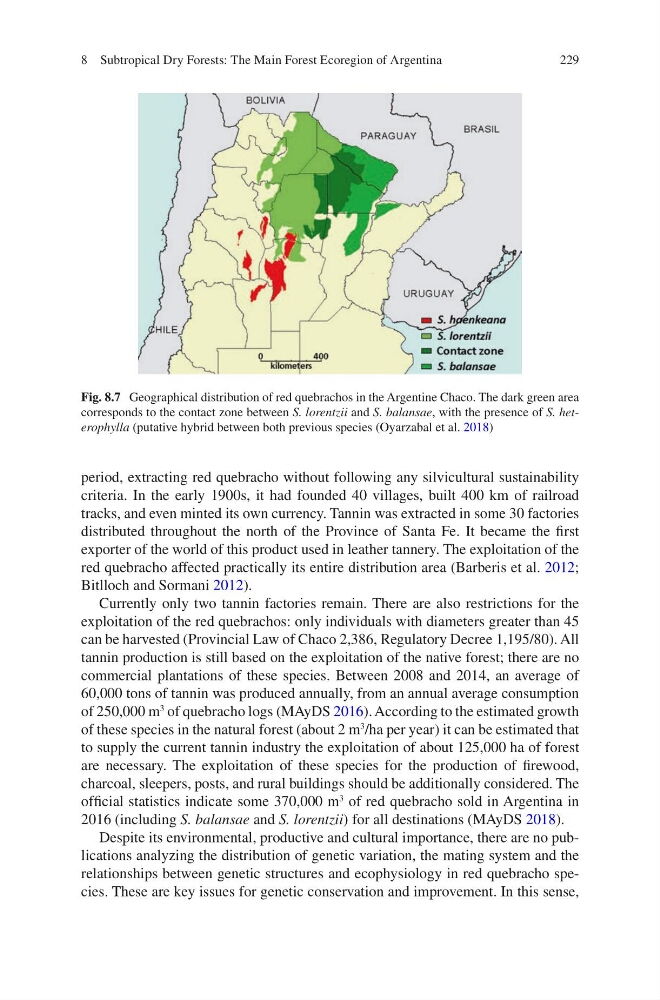
Fig. 8.7 Geographical distribution of red quebrachos in the Argentine Chaco. The dark green area
corresponds to the contact zone between S. lorentzii and S. balansae, with the presence of S. heterophylla (putative hybrid between both previous species (Oyarzabal et al. 2018)
8 Subtropical Dry Forests: The Main Forest Ecoregion of Argentina
period, extracting red quebracho without following any silvicultural sustainability
criteria. In the early 1900s, it had founded 40 villages, built 400 km of railroad
tracks, and even minted its own currency. Tannin was extracted in some 30 factories
distributed throughout the north of the Province of Santa Fe. It became the first
exporter of the world of this product used in leather tannery. The exploitation of the
red quebracho affected practically its entire distribution area (Barberis et al. 2012;
Bitlloch and Sormani 2012).
Currently only two tannin factories remain. There are also restrictions for the
exploitation of the red quebrachos: only individuals with diameters greater than 45
can be harvested (Provincial Law of Chaco 2,386, Regulatory Decree 1,195/80). All
tannin production is still based on the exploitation of the native forest; there are no
commercial plantations of these species. Between 2008 and 2014, an average of
60,000 tons of tannin was produced annually, from an annual average consumption
of 250,000 m
3
of quebracho logs (MAyDS 2016). According to the estimated growth
of these species in the natural forest (about 2 m
3
/ha per year) it can be estimated that
to supply the current tannin industry the exploitation of about 125,000 ha of forest
are necessary. The exploitation of these species for the production of firewood,
charcoal, sleepers, posts, and rural buildings should be additionally considered. The
official statistics indicate some 370,000 m
3
of red quebracho sold in Argentina in
2016 (including S. balansae and S. lorentzii) for all destinations (MAyDS 2018).
Despite its environmental, productive and cultural importance, there are no publications analyzing the distribution of genetic variation, the mating system and the
relationships between genetic structures and ecophysiology in red quebracho species. These are key issues for genetic conservation and improvement. In this sense,
Fig. 8.7 Geographical distribution of red quebrachos in the Argentine Chaco. The dark green area
corresponds to the contact zone between S. lorentzii and S. balansae, with the presence of S. heterophylla (putative hybrid between both previous species (Oyarzabal et al. 2018)
8 Subtropical Dry Forests: The Main Forest Ecoregion of Argentina