

226
8.4 Agrobusiness: The New Productive Paradigm
in the Chaco and Its Social Consequences
In the last two decades, three new social actors entered the region: (i) medium and
large agricultural entrepreneurs, (ii) real estate investors, and (iii) agricultural
investment funds. The vast majority of agricultural entrepreneurs came from the
Pampas plain (provinces of Córdoba, Santa Fe, and Buenos Aires) (González and
Román 2009), and they transferred the region’s own production model to the Chaco,
aiming to agriculturize the forest. In this way, they extracted any trace of woody
species, implemented no-till farming, applied enormous quantities of agrochemicals and fertilizers, and impose the “industrial” monoculture of soybean, eventually
accompanied by some rotation of corn, sunflower, sorghum, wheat, or cotton
(Paruelo et al. 2005; Aguiar et al. 2016). Both these agricultural entrepreneurs and
real estate investors engaged in the purchase and clearing of land, the majority of
which have already been occupied by native communities and settlers during hundreds of years (González and Román 2009; Aguiar et al. 2016). This gave rise to an
increasing social conflict that in many cases led to armed confrontations with loss
of life (Seghezzo et al. 2011). The direct effect was the expulsion of a good part of
the original rural population from vast regions (Román and González 2012), whose
destination has been mostly the poverty belts of urban centers or, to a much lesser
extent, their transformation into rural laborers.
Much of the land cleared by real estate investors and partly by agricultural entrepreneurs is leased to agricultural investment funds. These investment funds produce
exclusively on leased land, hiring technical teams, and contracting companies for
agricultural machinery and aerial spraying (also emerging players in the region).
Small, medium, and even large agricultural entrepreneurs, who produce on their
land and therefore have an interest in achieving more sustainable agriculture, are
permeable to incorporate crop rotation and possible changes in production logic. In
contrast, investment funds make decisions exclusively to maximize the return on
invested capital, with a very short-term vision. Their interests are independent of the
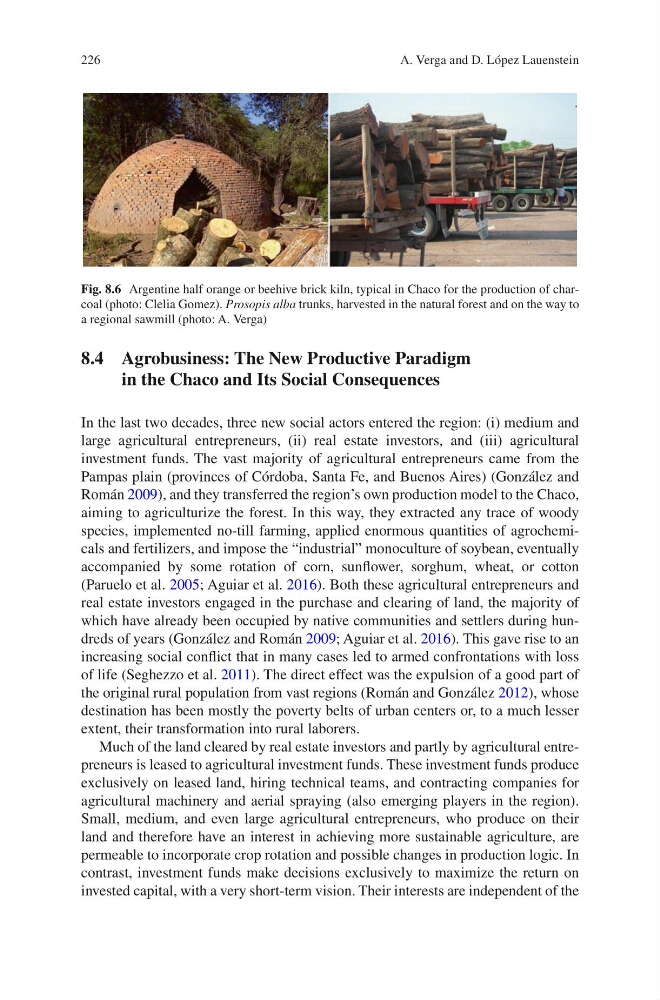
Fig. 8.6 Argentine half orange or beehive brick kiln, typical in Chaco for the production of charcoal (photo: Clelia Gomez). Prosopis alba trunks, harvested in the natural forest and on the way to
a regional sawmill (photo: A. Verga)
A. Verga and D. López Lauenstein
8.4 Agrobusiness: The New Productive Paradigm
in the Chaco and Its Social Consequences
In the last two decades, three new social actors entered the region: (i) medium and
large agricultural entrepreneurs, (ii) real estate investors, and (iii) agricultural
investment funds. The vast majority of agricultural entrepreneurs came from the
Pampas plain (provinces of Córdoba, Santa Fe, and Buenos Aires) (González and
Román 2009), and they transferred the region’s own production model to the Chaco,
aiming to agriculturize the forest. In this way, they extracted any trace of woody
species, implemented no-till farming, applied enormous quantities of agrochemicals and fertilizers, and impose the “industrial” monoculture of soybean, eventually
accompanied by some rotation of corn, sunflower, sorghum, wheat, or cotton
(Paruelo et al. 2005; Aguiar et al. 2016). Both these agricultural entrepreneurs and
real estate investors engaged in the purchase and clearing of land, the majority of
which have already been occupied by native communities and settlers during hundreds of years (González and Román 2009; Aguiar et al. 2016). This gave rise to an
increasing social conflict that in many cases led to armed confrontations with loss
of life (Seghezzo et al. 2011). The direct effect was the expulsion of a good part of
the original rural population from vast regions (Román and González 2012), whose
destination has been mostly the poverty belts of urban centers or, to a much lesser
extent, their transformation into rural laborers.
Much of the land cleared by real estate investors and partly by agricultural entrepreneurs is leased to agricultural investment funds. These investment funds produce
exclusively on leased land, hiring technical teams, and contracting companies for
agricultural machinery and aerial spraying (also emerging players in the region).
Small, medium, and even large agricultural entrepreneurs, who produce on their
land and therefore have an interest in achieving more sustainable agriculture, are
permeable to incorporate crop rotation and possible changes in production logic. In
contrast, investment funds make decisions exclusively to maximize the return on
invested capital, with a very short-term vision. Their interests are independent of the
Fig. 8.6 Argentine half orange or beehive brick kiln, typical in Chaco for the production of charcoal (photo: Clelia Gomez). Prosopis alba trunks, harvested in the natural forest and on the way to
a regional sawmill (photo: A. Verga)
A. Verga and D. López Lauenstein