

205
According to the degree and type of threat that a species can have in nature, different alternatives of rescue have been proposed. Sometimes the main long-term
threats can be attributed to genetic or evolutionary processes and mechanisms; other
times, the main cause is related to demographic factors (Carlson et al. 2014). In the
case of the Patagonian populations of the native willow, due to its very small, fragmented and isolated “populations”, the species might have a reduced ability to
evolve and an elevated extinction risk. Therefore, the three different proposed types
of rescue, demographic, genetic and evolutionary, fit very well.
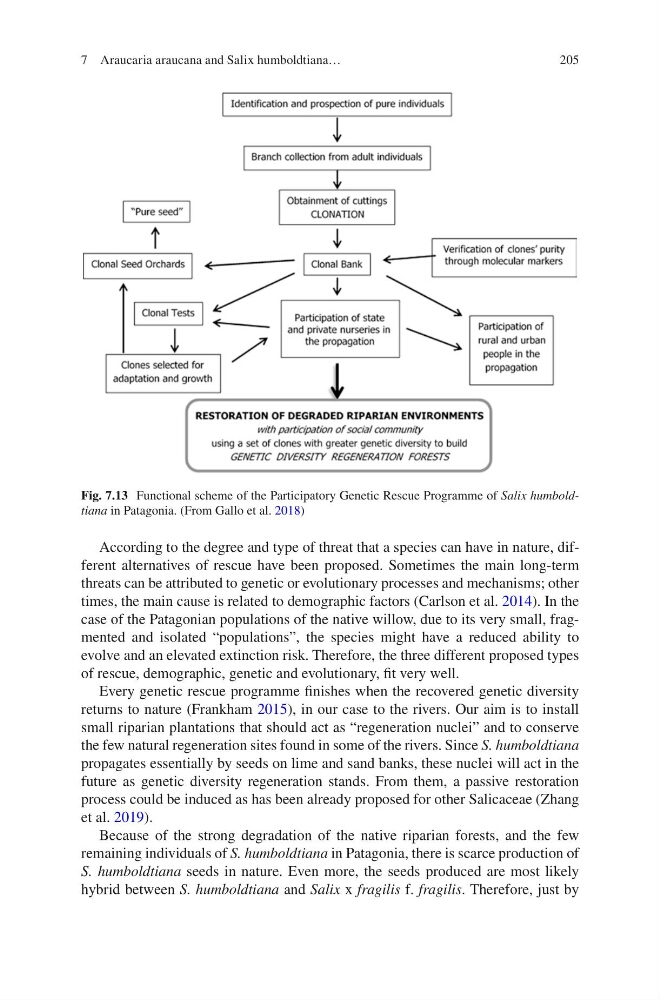
Every genetic rescue programme finishes when the recovered genetic diversity
returns to nature (Frankham 2015), in our case to the rivers. Our aim is to install
small riparian plantations that should act as “regeneration nuclei” and to conserve
the few natural regeneration sites found in some of the rivers. Since S. humboldtiana
propagates essentially by seeds on lime and sand banks, these nuclei will act in the
future as genetic diversity regeneration stands. From them, a passive restoration
process could be induced as has been already proposed for other Salicaceae (Zhang
et al. 2019).
Because of the strong degradation of the native riparian forests, and the few
remaining individuals of S. humboldtiana in Patagonia, there is scarce production of
S. humboldtiana seeds in nature. Even more, the seeds produced are most likely
hybrid between S. humboldtiana and Salix x fragilis f. fragilis. Therefore, just by
Fig. 7.13 Functional scheme of the Participatory Genetic Rescue Programme of Salix humboldtiana in Patagonia. (From Gallo et al. 2018)
7 Araucaria araucana and Salix humboldtiana…
According to the degree and type of threat that a species can have in nature, different alternatives of rescue have been proposed. Sometimes the main long-term
threats can be attributed to genetic or evolutionary processes and mechanisms; other
times, the main cause is related to demographic factors (Carlson et al. 2014). In the
case of the Patagonian populations of the native willow, due to its very small, fragmented and isolated “populations”, the species might have a reduced ability to
evolve and an elevated extinction risk. Therefore, the three different proposed types
of rescue, demographic, genetic and evolutionary, fit very well.
Every genetic rescue programme finishes when the recovered genetic diversity
returns to nature (Frankham 2015), in our case to the rivers. Our aim is to install
small riparian plantations that should act as “regeneration nuclei” and to conserve
the few natural regeneration sites found in some of the rivers. Since S. humboldtiana
propagates essentially by seeds on lime and sand banks, these nuclei will act in the
future as genetic diversity regeneration stands. From them, a passive restoration
process could be induced as has been already proposed for other Salicaceae (Zhang
et al. 2019).
Because of the strong degradation of the native riparian forests, and the few
remaining individuals of S. humboldtiana in Patagonia, there is scarce production of
S. humboldtiana seeds in nature. Even more, the seeds produced are most likely
hybrid between S. humboldtiana and Salix x fragilis f. fragilis. Therefore, just by
Fig. 7.13 Functional scheme of the Participatory Genetic Rescue Programme of Salix humboldtiana in Patagonia. (From Gallo et al. 2018)
7 Araucaria araucana and Salix humboldtiana…