

201
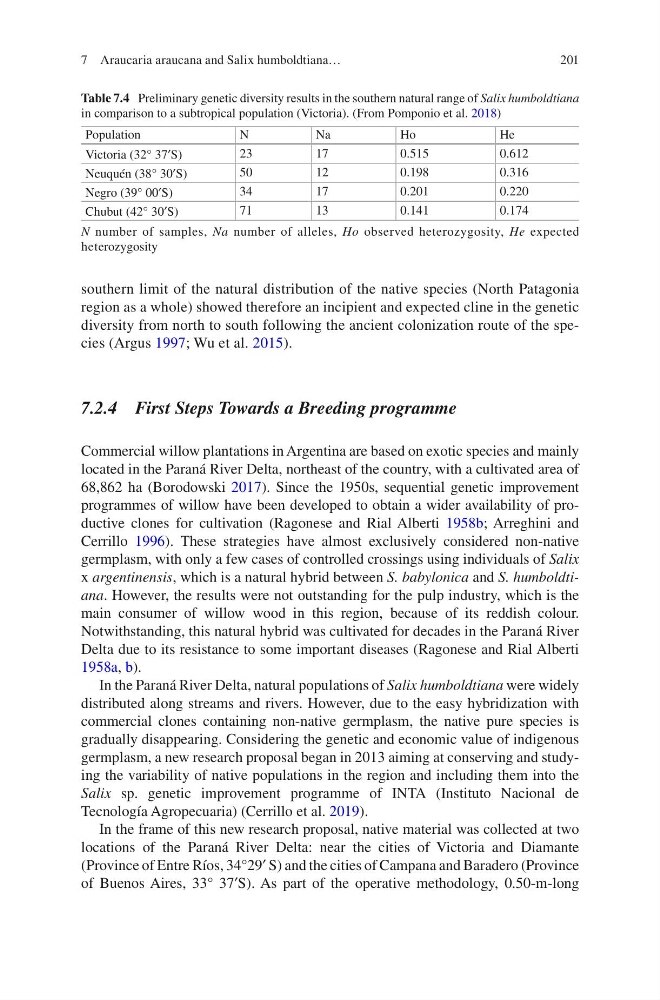
southern limit of the natural distribution of the native species (North Patagonia
region as a whole) showed therefore an incipient and expected cline in the genetic
diversity from north to south following the ancient colonization route of the species (Argus 1997; Wu et al. 2015).
7.2.4 First Steps Towards a Breeding programme
Commercial willow plantations in Argentina are based on exotic species and mainly
located in the Paraná River Delta, northeast of the country, with a cultivated area of
68,862 ha (Borodowski 2017). Since the 1950s, sequential genetic improvement
programmes of willow have been developed to obtain a wider availability of productive clones for cultivation (Ragonese and Rial Alberti 1958b; Arreghini and
Cerrillo 1996). These strategies have almost exclusively considered non-native
germplasm, with only a few cases of controlled crossings using individuals of Salix
x argentinensis, which is a natural hybrid between S. babylonica and S. humboldtiana. However, the results were not outstanding for the pulp industry, which is the
main consumer of willow wood in this region, because of its reddish colour.
Notwithstanding, this natural hybrid was cultivated for decades in the Paraná River
Delta due to its resistance to some important diseases (Ragonese and Rial Alberti
1958a, b).
In the Paraná River Delta, natural populations of Salix humboldtiana were widely
distributed along streams and rivers. However, due to the easy hybridization with
commercial clones containing non-native germplasm, the native pure species is
gradually disappearing. Considering the genetic and economic value of indigenous
germplasm, a new research proposal began in 2013 aiming at conserving and studying the variability of native populations in the region and including them into the
Salix sp. genetic improvement programme of INTA (Instituto Nacional de
Tecnología Agropecuaria) (Cerrillo et al. 2019).
In the frame of this new research proposal, native material was collected at two
locations of the Paraná River Delta: near the cities of Victoria and Diamante
(Province of Entre Ríos, 34°29′ S) and the cities of Campana and Baradero (Province
of Buenos Aires, 33° 37′S). As part of the operative methodology, 0.50-m-long
Table 7.4 Preliminary genetic diversity results in the southern natural range of Salix humboldtiana
in comparison to a subtropical population (Victoria). (From Pomponio et al. 2018)
Population
N
Na
Ho
He
Victoria (32° 37′S)
23
17
0.515
0.612
Neuquén (38° 30′S)
50
12
0.198
0.316
Negro (39° 00′S)
34
17
0.201
0.220
Chubut (42° 30′S)
71
13
0.141
0.174
N number of samples, Na number of alleles, Ho observed heterozygosity, He expected
heterozygosity
7 Araucaria araucana and Salix humboldtiana…
southern limit of the natural distribution of the native species (North Patagonia
region as a whole) showed therefore an incipient and expected cline in the genetic
diversity from north to south following the ancient colonization route of the species (Argus 1997; Wu et al. 2015).
7.2.4 First Steps Towards a Breeding programme
Commercial willow plantations in Argentina are based on exotic species and mainly
located in the Paraná River Delta, northeast of the country, with a cultivated area of
68,862 ha (Borodowski 2017). Since the 1950s, sequential genetic improvement
programmes of willow have been developed to obtain a wider availability of productive clones for cultivation (Ragonese and Rial Alberti 1958b; Arreghini and
Cerrillo 1996). These strategies have almost exclusively considered non-native
germplasm, with only a few cases of controlled crossings using individuals of Salix
x argentinensis, which is a natural hybrid between S. babylonica and S. humboldtiana. However, the results were not outstanding for the pulp industry, which is the
main consumer of willow wood in this region, because of its reddish colour.
Notwithstanding, this natural hybrid was cultivated for decades in the Paraná River
Delta due to its resistance to some important diseases (Ragonese and Rial Alberti
1958a, b).
In the Paraná River Delta, natural populations of Salix humboldtiana were widely
distributed along streams and rivers. However, due to the easy hybridization with
commercial clones containing non-native germplasm, the native pure species is
gradually disappearing. Considering the genetic and economic value of indigenous
germplasm, a new research proposal began in 2013 aiming at conserving and studying the variability of native populations in the region and including them into the
Salix sp. genetic improvement programme of INTA (Instituto Nacional de
Tecnología Agropecuaria) (Cerrillo et al. 2019).
In the frame of this new research proposal, native material was collected at two
locations of the Paraná River Delta: near the cities of Victoria and Diamante
(Province of Entre Ríos, 34°29′ S) and the cities of Campana and Baradero (Province
of Buenos Aires, 33° 37′S). As part of the operative methodology, 0.50-m-long
Table 7.4 Preliminary genetic diversity results in the southern natural range of Salix humboldtiana
in comparison to a subtropical population (Victoria). (From Pomponio et al. 2018)
Population
N
Na
Ho
He
Victoria (32° 37′S)
23
17
0.515
0.612
Neuquén (38° 30′S)
50
12
0.198
0.316
Negro (39° 00′S)
34
17
0.201
0.220
Chubut (42° 30′S)
71
13
0.141
0.174
N number of samples, Na number of alleles, Ho observed heterozygosity, He expected
heterozygosity
7 Araucaria araucana and Salix humboldtiana…