

198
In the arid Patagonian environment, the invasion of Eurasian willows and poplars
was limited to the riverbed and areas below the 1.5 m flood level. Above this level,
a greater diversity of exotic and native species occurred. Beyond the flooding area,
there was a natural limit to the invasion of riparian species and an overall reduction
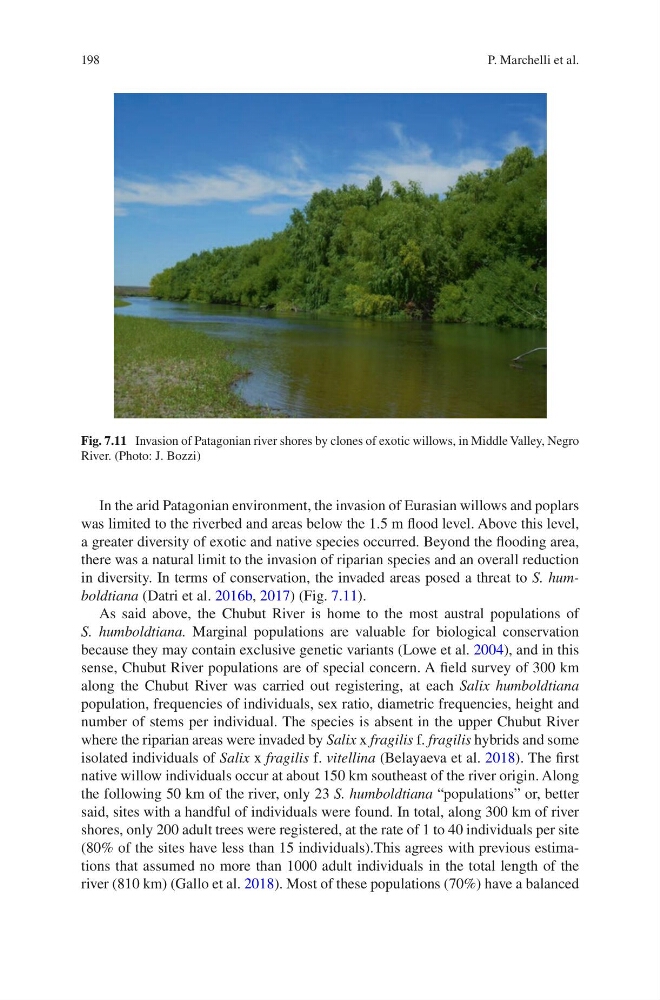
in diversity. In terms of conservation, the invaded areas posed a threat to S. humboldtiana (Datri et al. 2016b, 2017) (Fig. 7.11).
As said above, the Chubut River is home to the most austral populations of
S. humboldtiana. Marginal populations are valuable for biological conservation
because they may contain exclusive genetic variants (Lowe et al. 2004), and in this
sense, Chubut River populations are of special concern. A field survey of 300 km
along the Chubut River was carried out registering, at each Salix humboldtiana
population, frequencies of individuals, sex ratio, diametric frequencies, height and
number of stems per individual. The species is absent in the upper Chubut River
where the riparian areas were invaded by Salix x fragilis f. fragilis hybrids and some
isolated individuals of Salix x fragilis f. vitellina (Belayaeva et al. 2018). The first
native willow individuals occur at about 150 km southeast of the river origin. Along
the following 50 km of the river, only 23 S. humboldtiana “populations” or, better
said, sites with a handful of individuals were found. In total, along 300 km of river
shores, only 200 adult trees were registered, at the rate of 1 to 40 individuals per site
(80% of the sites have less than 15 individuals).This agrees with previous estimations that assumed no more than 1000 adult individuals in the total length of the
river (810 km) (Gallo et al. 2018). Most of these populations (70%) have a balanced
Fig. 7.11 Invasion of Patagonian river shores by clones of exotic willows, in Middle Valley, Negro
River. (Photo: J. Bozzi)
P. Marchelli et al.
In the arid Patagonian environment, the invasion of Eurasian willows and poplars
was limited to the riverbed and areas below the 1.5 m flood level. Above this level,
a greater diversity of exotic and native species occurred. Beyond the flooding area,
there was a natural limit to the invasion of riparian species and an overall reduction
in diversity. In terms of conservation, the invaded areas posed a threat to S. humboldtiana (Datri et al. 2016b, 2017) (Fig. 7.11).
As said above, the Chubut River is home to the most austral populations of
S. humboldtiana. Marginal populations are valuable for biological conservation
because they may contain exclusive genetic variants (Lowe et al. 2004), and in this
sense, Chubut River populations are of special concern. A field survey of 300 km
along the Chubut River was carried out registering, at each Salix humboldtiana
population, frequencies of individuals, sex ratio, diametric frequencies, height and
number of stems per individual. The species is absent in the upper Chubut River
where the riparian areas were invaded by Salix x fragilis f. fragilis hybrids and some
isolated individuals of Salix x fragilis f. vitellina (Belayaeva et al. 2018). The first
native willow individuals occur at about 150 km southeast of the river origin. Along
the following 50 km of the river, only 23 S. humboldtiana “populations” or, better
said, sites with a handful of individuals were found. In total, along 300 km of river
shores, only 200 adult trees were registered, at the rate of 1 to 40 individuals per site
(80% of the sites have less than 15 individuals).This agrees with previous estimations that assumed no more than 1000 adult individuals in the total length of the
river (810 km) (Gallo et al. 2018). Most of these populations (70%) have a balanced
Fig. 7.11 Invasion of Patagonian river shores by clones of exotic willows, in Middle Valley, Negro
River. (Photo: J. Bozzi)
P. Marchelli et al.