

195
Salix humboldtiana has been used since at least 10,000 years ago by original
folks, among others, to make tool handles and arrows during the early and midHolocene (Rodríguez 1999, 2000) in the North of the country and during the
Pleistocene-Holocene transition in the Tandilia Range, Province of Buenos
Aires (Brea et al. 2014). Its wood is reddish and has a basic density (0.35–0.50 g/
cm
3
) higher than most of all other willows introduced in Argentina (Tortorelli
2009; Cerrillo et al. 2016). The settlers prefer its wood, and, therefore, even in its
southernmost range, where few natural specimens of this species remain standing,
trees are being cut clandestinely. Also in the Paraná River Delta, its wood is considered of a better quality compared to other introduced members of the Salicaceae
family, and it has been used as a hard and durable wood for very special uses in that
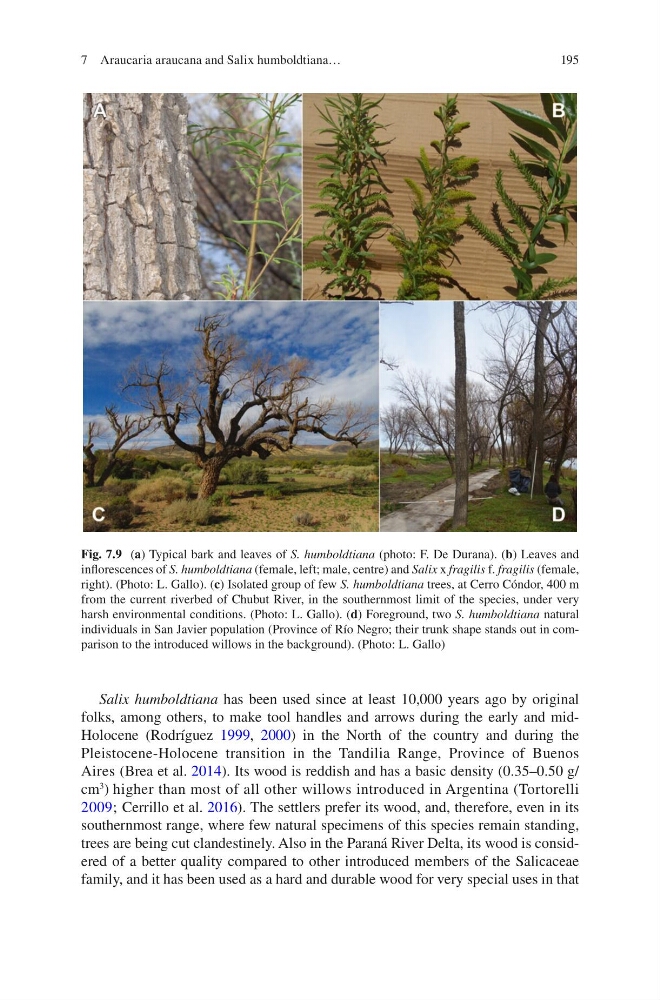
Fig. 7.9 (a) Typical bark and leaves of S. humboldtiana (photo: F. De Durana). (b) Leaves and
inflorescences of S. humboldtiana (female, left; male, centre) and Salix x fragilis f. fragilis (female,
right). (Photo: L. Gallo). (c) Isolated group of few S. humboldtiana trees, at Cerro Cóndor, 400 m
from the current riverbed of Chubut River, in the southernmost limit of the species, under very
harsh environmental conditions. (Photo: L. Gallo). (d) Foreground, two S. humboldtiana natural
individuals in San Javier population (Province of Río Negro; their trunk shape stands out in comparison to the introduced willows in the background). (Photo: L. Gallo)
7 Araucaria araucana and Salix humboldtiana…
Salix humboldtiana has been used since at least 10,000 years ago by original
folks, among others, to make tool handles and arrows during the early and midHolocene (Rodríguez 1999, 2000) in the North of the country and during the
Pleistocene-Holocene transition in the Tandilia Range, Province of Buenos
Aires (Brea et al. 2014). Its wood is reddish and has a basic density (0.35–0.50 g/
cm
3
) higher than most of all other willows introduced in Argentina (Tortorelli
2009; Cerrillo et al. 2016). The settlers prefer its wood, and, therefore, even in its
southernmost range, where few natural specimens of this species remain standing,
trees are being cut clandestinely. Also in the Paraná River Delta, its wood is considered of a better quality compared to other introduced members of the Salicaceae
family, and it has been used as a hard and durable wood for very special uses in that
Fig. 7.9 (a) Typical bark and leaves of S. humboldtiana (photo: F. De Durana). (b) Leaves and
inflorescences of S. humboldtiana (female, left; male, centre) and Salix x fragilis f. fragilis (female,
right). (Photo: L. Gallo). (c) Isolated group of few S. humboldtiana trees, at Cerro Cóndor, 400 m
from the current riverbed of Chubut River, in the southernmost limit of the species, under very
harsh environmental conditions. (Photo: L. Gallo). (d) Foreground, two S. humboldtiana natural
individuals in San Javier population (Province of Río Negro; their trunk shape stands out in comparison to the introduced willows in the background). (Photo: L. Gallo)
7 Araucaria araucana and Salix humboldtiana…