

191
cone production, have been registered in Spain and Portugal for their grafted use in
agroforestry systems or orchards (Guadaño et al. 2016). In this and other breeding
programmes for seed nut production, the variability of seed nut production was high
among individuals within populations, but low among populations (Gordo Alonso
et al. 2007). Heritability values between 45 and 73% were found for seed productivity. Similarly, a large variation in the seed productivity has been registered for
A. araucana among trees of the same population (Sanguinetti and Kitzberger 2009).
“Conservation through use” is essential to maintain the genetic diversity of
Pewen’s forests, as these are forests where communities of native people live. These
native folks use the forest either for the rearing of their livestock, for the collection
of pine nuts or for the use of deadwood to make handcrafts. The complexity of these
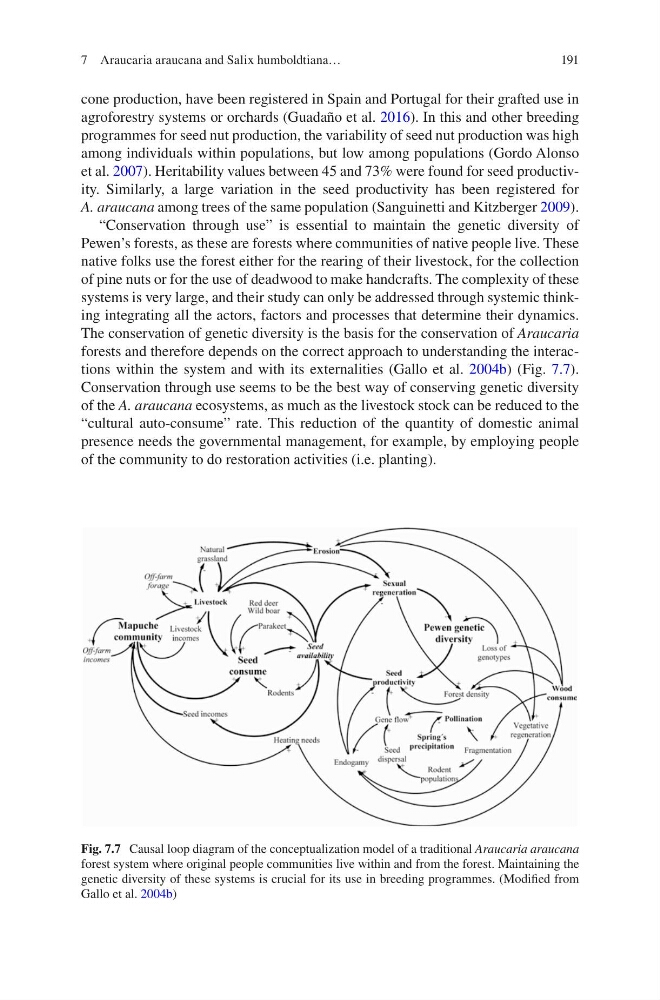
systems is very large, and their study can only be addressed through systemic thinking integrating all the actors, factors and processes that determine their dynamics.
The conservation of genetic diversity is the basis for the conservation of Araucaria
forests and therefore depends on the correct approach to understanding the interactions within the system and with its externalities (Gallo et al. 2004b) (Fig. 7.7).
Conservation through use seems to be the best way of conserving genetic diversity
of the A. araucana ecosystems, as much as the livestock stock can be reduced to the
“cultural auto-consume” rate. This reduction of the quantity of domestic animal
presence needs the governmental management, for example, by employing people
of the community to do restoration activities (i.e. planting).
Fig. 7.7 Causal loop diagram of the conceptualization model of a traditional Araucaria araucana
forest system where original people communities live within and from the forest. Maintaining the
genetic diversity of these systems is crucial for its use in breeding programmes. (Modified from
Gallo et al. 2004b)
7 Araucaria araucana and Salix humboldtiana…
cone production, have been registered in Spain and Portugal for their grafted use in
agroforestry systems or orchards (Guadaño et al. 2016). In this and other breeding
programmes for seed nut production, the variability of seed nut production was high
among individuals within populations, but low among populations (Gordo Alonso
et al. 2007). Heritability values between 45 and 73% were found for seed productivity. Similarly, a large variation in the seed productivity has been registered for
A. araucana among trees of the same population (Sanguinetti and Kitzberger 2009).
“Conservation through use” is essential to maintain the genetic diversity of
Pewen’s forests, as these are forests where communities of native people live. These
native folks use the forest either for the rearing of their livestock, for the collection
of pine nuts or for the use of deadwood to make handcrafts. The complexity of these
systems is very large, and their study can only be addressed through systemic thinking integrating all the actors, factors and processes that determine their dynamics.
The conservation of genetic diversity is the basis for the conservation of Araucaria
forests and therefore depends on the correct approach to understanding the interactions within the system and with its externalities (Gallo et al. 2004b) (Fig. 7.7).
Conservation through use seems to be the best way of conserving genetic diversity
of the A. araucana ecosystems, as much as the livestock stock can be reduced to the
“cultural auto-consume” rate. This reduction of the quantity of domestic animal
presence needs the governmental management, for example, by employing people
of the community to do restoration activities (i.e. planting).
Fig. 7.7 Causal loop diagram of the conceptualization model of a traditional Araucaria araucana
forest system where original people communities live within and from the forest. Maintaining the
genetic diversity of these systems is crucial for its use in breeding programmes. (Modified from
Gallo et al. 2004b)
7 Araucaria araucana and Salix humboldtiana…