

10
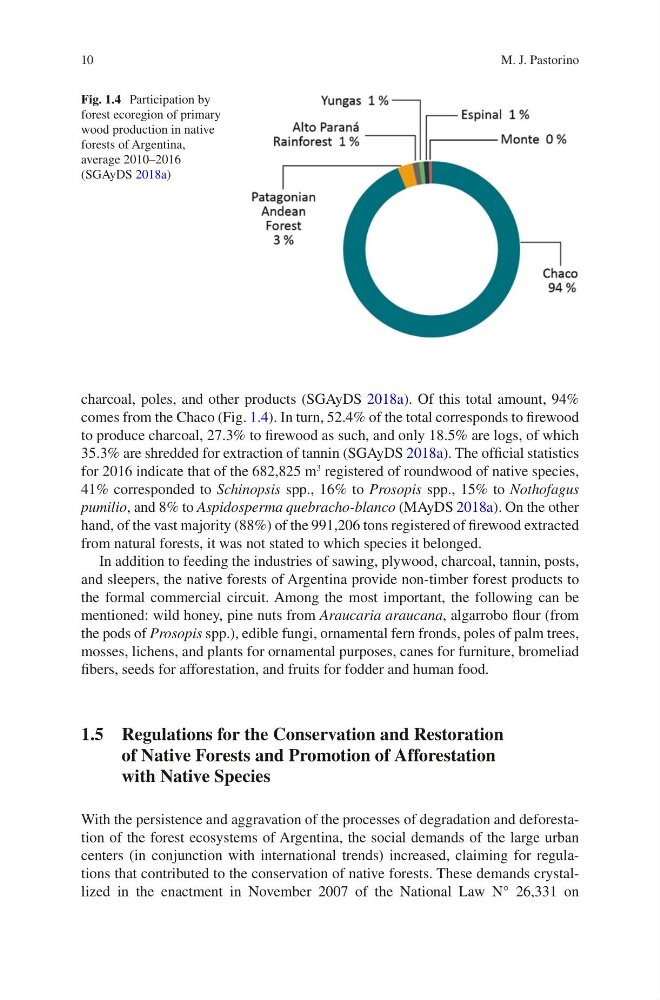
charcoal, poles, and other products (SGAyDS 2018a). Of this total amount, 94%
comes from the Chaco (Fig. 1.4). In turn, 52.4% of the total corresponds to firewood
to produce charcoal, 27.3% to firewood as such, and only 18.5% are logs, of which
35.3% are shredded for extraction of tannin (SGAyDS 2018a). The official statistics
for 2016 indicate that of the 682,825 m
3
registered of roundwood of native species,
41% corresponded to Schinopsis spp., 16% to Prosopis spp., 15% to Nothofagus
pumilio, and 8% to Aspidosperma quebracho-blanco (MAyDS 2018a). On the other
hand, of the vast majority (88%) of the 991,206 tons registered of firewood extracted
from natural forests, it was not stated to which species it belonged.
In addition to feeding the industries of sawing, plywood, charcoal, tannin, posts,
and sleepers, the native forests of Argentina provide non-timber forest products to
the formal commercial circuit. Among the most important, the following can be
mentioned: wild honey, pine nuts from Araucaria araucana, algarrobo flour (from
the pods of Prosopis spp.), edible fungi, ornamental fern fronds, poles of palm trees,
mosses, lichens, and plants for ornamental purposes, canes for furniture, bromeliad
fibers, seeds for afforestation, and fruits for fodder and human food.
1.5 Regulations for the Conservation and Restoration
of Native Forests and Promotion of Afforestation
with Native Species
With the persistence and aggravation of the processes of degradation and deforestation of the forest ecosystems of Argentina, the social demands of the large urban
centers (in conjunction with international trends) increased, claiming for regulations that contributed to the conservation of native forests. These demands crystallized in the enactment in November 2007 of the National Law N° 26,331 on
Fig. 1.4 Participation by
forest ecoregion of primary
wood production in native
forests of Argentina,
average 2010–2016
(SGAyDS 2018a)
M. J. Pastorino
charcoal, poles, and other products (SGAyDS 2018a). Of this total amount, 94%
comes from the Chaco (Fig. 1.4). In turn, 52.4% of the total corresponds to firewood
to produce charcoal, 27.3% to firewood as such, and only 18.5% are logs, of which
35.3% are shredded for extraction of tannin (SGAyDS 2018a). The official statistics
for 2016 indicate that of the 682,825 m
3
registered of roundwood of native species,
41% corresponded to Schinopsis spp., 16% to Prosopis spp., 15% to Nothofagus
pumilio, and 8% to Aspidosperma quebracho-blanco (MAyDS 2018a). On the other
hand, of the vast majority (88%) of the 991,206 tons registered of firewood extracted
from natural forests, it was not stated to which species it belonged.
In addition to feeding the industries of sawing, plywood, charcoal, tannin, posts,
and sleepers, the native forests of Argentina provide non-timber forest products to
the formal commercial circuit. Among the most important, the following can be
mentioned: wild honey, pine nuts from Araucaria araucana, algarrobo flour (from
the pods of Prosopis spp.), edible fungi, ornamental fern fronds, poles of palm trees,
mosses, lichens, and plants for ornamental purposes, canes for furniture, bromeliad
fibers, seeds for afforestation, and fruits for fodder and human food.
1.5 Regulations for the Conservation and Restoration
of Native Forests and Promotion of Afforestation
with Native Species
With the persistence and aggravation of the processes of degradation and deforestation of the forest ecosystems of Argentina, the social demands of the large urban
centers (in conjunction with international trends) increased, claiming for regulations that contributed to the conservation of native forests. These demands crystallized in the enactment in November 2007 of the National Law N° 26,331 on
Fig. 1.4 Participation by
forest ecoregion of primary
wood production in native
forests of Argentina,
average 2010–2016
(SGAyDS 2018a)
M. J. Pastorino