

182
Nuclear genetic markers are a better choice for studies on more recent evolutionary processes and particularly to evaluate genetic patterns on a landscape scale to
recommend best practices for conservation and management. For this purpose, a
subset of stands traditionally used by Mapuche indigenous communities was compared with unmanaged stands using isozyme genetic markers (Gallo et al. 2004a).
The genetic diversity was analysed for the seed generation produced in each adult
stand. This study was concentrated at a local scale in the southern natural distribution area, and samples were taken from a total of 14 populations inside the
Chiuquilihuin community (moderate use of Pewen), in the Aucapan and Rucachoroi
community lands (intensive use of Pewen) and in the Tromen forest (control area
located inside Lanín National Park). This set of 14 populations had a West-East
orientation. One of the tested hypotheses was that eastern isolated and fragmented
populations produced seeds with less genetic diversity than the continuous Araucaria
forests located at the West. We supposed that the isolation and the reduced number
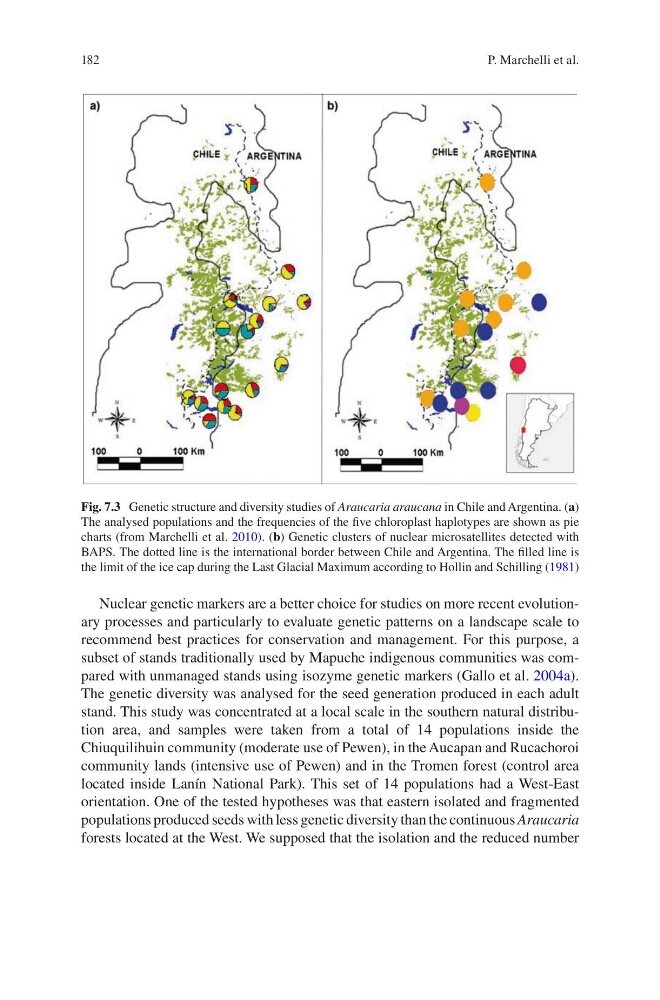
Fig. 7.3 Genetic structure and diversity studies of Araucaria araucana in Chile and Argentina. (a)
The analysed populations and the frequencies of the five chloroplast haplotypes are shown as pie
charts (from Marchelli et al. 2010). (b) Genetic clusters of nuclear microsatellites detected with
BAPS. The dotted line is the international border between Chile and Argentina. The filled line is
the limit of the ice cap during the Last Glacial Maximum according to Hollin and Schilling (1981)
P. Marchelli et al.
Nuclear genetic markers are a better choice for studies on more recent evolutionary processes and particularly to evaluate genetic patterns on a landscape scale to
recommend best practices for conservation and management. For this purpose, a
subset of stands traditionally used by Mapuche indigenous communities was compared with unmanaged stands using isozyme genetic markers (Gallo et al. 2004a).
The genetic diversity was analysed for the seed generation produced in each adult
stand. This study was concentrated at a local scale in the southern natural distribution area, and samples were taken from a total of 14 populations inside the
Chiuquilihuin community (moderate use of Pewen), in the Aucapan and Rucachoroi
community lands (intensive use of Pewen) and in the Tromen forest (control area
located inside Lanín National Park). This set of 14 populations had a West-East
orientation. One of the tested hypotheses was that eastern isolated and fragmented
populations produced seeds with less genetic diversity than the continuous Araucaria
forests located at the West. We supposed that the isolation and the reduced number
Fig. 7.3 Genetic structure and diversity studies of Araucaria araucana in Chile and Argentina. (a)
The analysed populations and the frequencies of the five chloroplast haplotypes are shown as pie
charts (from Marchelli et al. 2010). (b) Genetic clusters of nuclear microsatellites detected with
BAPS. The dotted line is the international border between Chile and Argentina. The filled line is
the limit of the ice cap during the Last Glacial Maximum according to Hollin and Schilling (1981)
P. Marchelli et al.