

8
it totals 64,975,518 ha throughout the country, of which 66% corresponds to the
Monte (all this phytogeographic region corresponds to this category), 20% to the
Chaco, and 9% to the Espinal.
Currently, the Second National Inventory of Native Forest is underway, again in
charge of the Ministry of Environment and Sustainable Development of Argentina,
this time with the establishment of permanent plots in order to create a continuous
system of forest inventories. The inventory categories have also been revised, lowering the minimum height of the trees from 7 m to 3 m for the classification of forestland and the minimum inventory area from 10 ha to 0.5 ha (Peri et al. 2019). Until
results of this second inventory are obtained, it is those of the first inventory that
provide the most reliable information on the natural forest cover of Argentina.
However, deforestation in Argentina has not stopped from 1998 to the present,
maintaining significant fluctuations as throughout the entire history of colonization
of the country’s territory, with long-term trends and conjunctural ups and downs. In
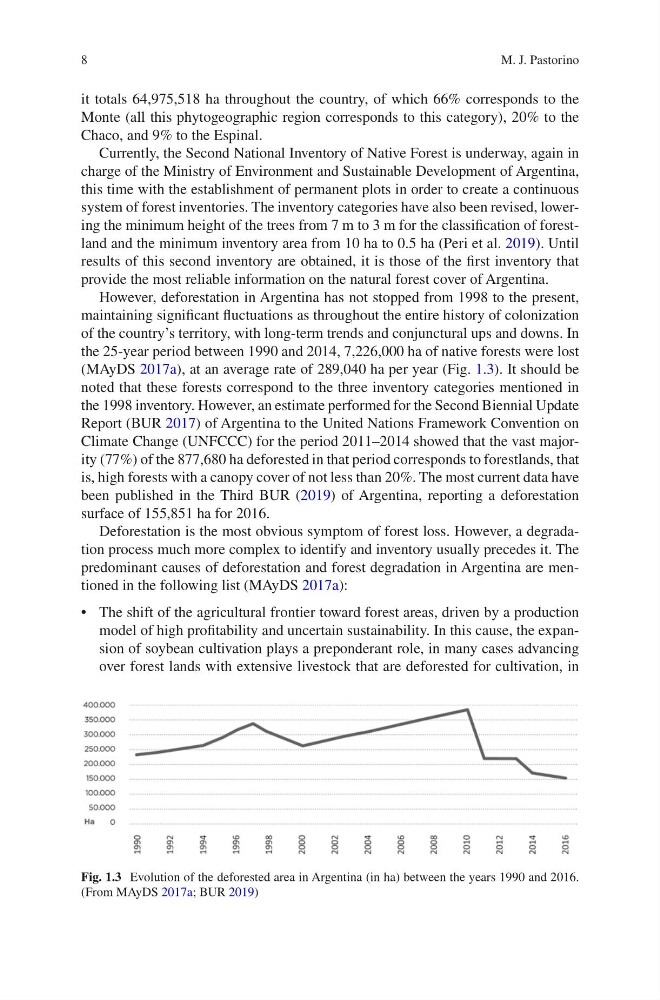
the 25-year period between 1990 and 2014, 7,226,000 ha of native forests were lost
(MAyDS 2017a), at an average rate of 289,040 ha per year (Fig. 1.3). It should be
noted that these forests correspond to the three inventory categories mentioned in
the 1998 inventory. However, an estimate performed for the Second Biennial Update
Report (BUR 2017) of Argentina to the United Nations Framework Convention on
Climate Change (UNFCCC) for the period 2011–2014 showed that the vast majority (77%) of the 877,680 ha deforested in that period corresponds to forestlands, that
is, high forests with a canopy cover of not less than 20%. The most current data have
been published in the Third BUR (2019) of Argentina, reporting a deforestation
surface of 155,851 ha for 2016.
Deforestation is the most obvious symptom of forest loss. However, a degradation process much more complex to identify and inventory usually precedes it. The
predominant causes of deforestation and forest degradation in Argentina are mentioned in the following list (MAyDS 2017a):
• The shift of the agricultural frontier toward forest areas, driven by a production
model of high profitability and uncertain sustainability. In this cause, the expansion of soybean cultivation plays a preponderant role, in many cases advancing
over forest lands with extensive livestock that are deforested for cultivation, in
Fig. 1.3 Evolution of the deforested area in Argentina (in ha) between the years 1990 and 2016.
(From MAyDS 2017a; BUR 2019)
M. J. Pastorino
it totals 64,975,518 ha throughout the country, of which 66% corresponds to the
Monte (all this phytogeographic region corresponds to this category), 20% to the
Chaco, and 9% to the Espinal.
Currently, the Second National Inventory of Native Forest is underway, again in
charge of the Ministry of Environment and Sustainable Development of Argentina,
this time with the establishment of permanent plots in order to create a continuous
system of forest inventories. The inventory categories have also been revised, lowering the minimum height of the trees from 7 m to 3 m for the classification of forestland and the minimum inventory area from 10 ha to 0.5 ha (Peri et al. 2019). Until
results of this second inventory are obtained, it is those of the first inventory that
provide the most reliable information on the natural forest cover of Argentina.
However, deforestation in Argentina has not stopped from 1998 to the present,
maintaining significant fluctuations as throughout the entire history of colonization
of the country’s territory, with long-term trends and conjunctural ups and downs. In
the 25-year period between 1990 and 2014, 7,226,000 ha of native forests were lost
(MAyDS 2017a), at an average rate of 289,040 ha per year (Fig. 1.3). It should be
noted that these forests correspond to the three inventory categories mentioned in
the 1998 inventory. However, an estimate performed for the Second Biennial Update
Report (BUR 2017) of Argentina to the United Nations Framework Convention on
Climate Change (UNFCCC) for the period 2011–2014 showed that the vast majority (77%) of the 877,680 ha deforested in that period corresponds to forestlands, that
is, high forests with a canopy cover of not less than 20%. The most current data have
been published in the Third BUR (2019) of Argentina, reporting a deforestation
surface of 155,851 ha for 2016.
Deforestation is the most obvious symptom of forest loss. However, a degradation process much more complex to identify and inventory usually precedes it. The
predominant causes of deforestation and forest degradation in Argentina are mentioned in the following list (MAyDS 2017a):
• The shift of the agricultural frontier toward forest areas, driven by a production
model of high profitability and uncertain sustainability. In this cause, the expansion of soybean cultivation plays a preponderant role, in many cases advancing
over forest lands with extensive livestock that are deforested for cultivation, in
Fig. 1.3 Evolution of the deforested area in Argentina (in ha) between the years 1990 and 2016.
(From MAyDS 2017a; BUR 2019)
M. J. Pastorino