

160
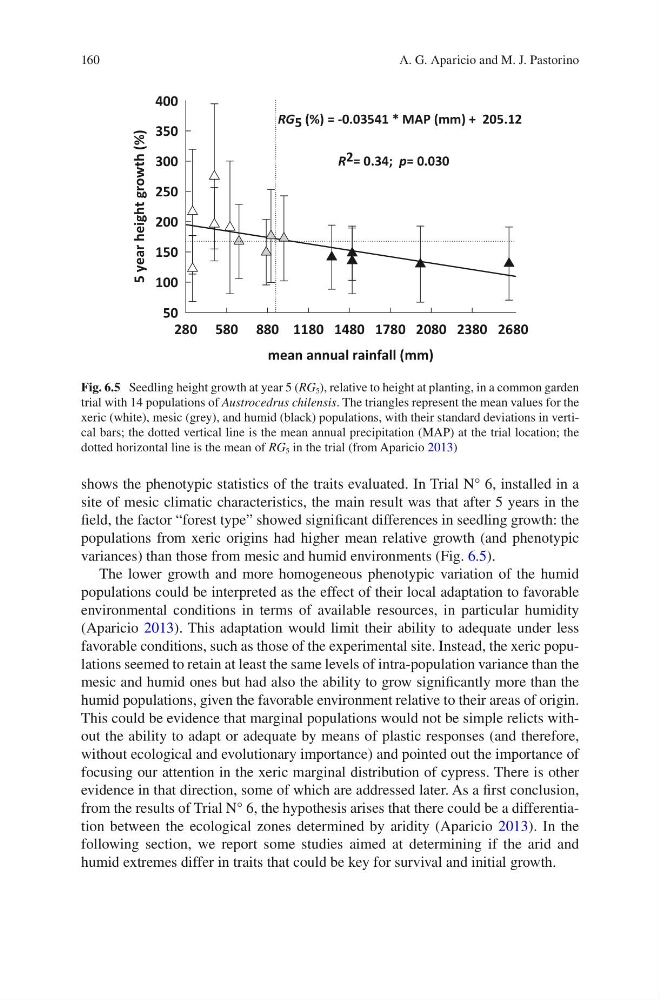
shows the phenotypic statistics of the traits evaluated. In Trial N° 6, installed in a
site of mesic climatic characteristics, the main result was that after 5 years in the
field, the factor “forest type” showed significant differences in seedling growth: the
populations from xeric origins had higher mean relative growth (and phenotypic
variances) than those from mesic and humid environments (Fig. 6.5).
The lower growth and more homogeneous phenotypic variation of the humid
populations could be interpreted as the effect of their local adaptation to favorable
environmental conditions in terms of available resources, in particular humidity
(Aparicio 2013). This adaptation would limit their ability to adequate under less
favorable conditions, such as those of the experimental site. Instead, the xeric populations seemed to retain at least the same levels of intra-population variance than the
mesic and humid ones but had also the ability to grow significantly more than the
humid populations, given the favorable environment relative to their areas of origin.
This could be evidence that marginal populations would not be simple relicts without the ability to adapt or adequate by means of plastic responses (and therefore,
without ecological and evolutionary importance) and pointed out the importance of
focusing our attention in the xeric marginal distribution of cypress. There is other
evidence in that direction, some of which are addressed later. As a first conclusion,
from the results of Trial N° 6, the hypothesis arises that there could be a differentiation between the ecological zones determined by aridity (Aparicio 2013). In the
following section, we report some studies aimed at determining if the arid and
humid extremes differ in traits that could be key for survival and initial growth.
mean annual rainfall (mm)
280 580 880 1180 1480 1780 2080 2380 2680
)
%
(
h
t
w
o
r
g
t
h
g
i
e
h
r
a
e
y
5
50
100
150
200
250
300
350
400
RG 5 (%) = -0.03541 * MAP (mm) + 205.12
R 2 = 0.34; p= 0.030
Fig. 6.5 Seedling height growth at year 5 (RG 5 ), relative to height at planting, in a common garden
trial with 14 populations of Austrocedrus chilensis. The triangles represent the mean values for the
xeric (white), mesic (grey), and humid (black) populations, with their standard deviations in vertical bars; the dotted vertical line is the mean annual precipitation (MAP) at the trial location; the
dotted horizontal line is the mean of RG 5 in the trial (from Aparicio 2013)
A. G. Aparicio and M. J. Pastorino
shows the phenotypic statistics of the traits evaluated. In Trial N° 6, installed in a
site of mesic climatic characteristics, the main result was that after 5 years in the
field, the factor “forest type” showed significant differences in seedling growth: the
populations from xeric origins had higher mean relative growth (and phenotypic
variances) than those from mesic and humid environments (Fig. 6.5).
The lower growth and more homogeneous phenotypic variation of the humid
populations could be interpreted as the effect of their local adaptation to favorable
environmental conditions in terms of available resources, in particular humidity
(Aparicio 2013). This adaptation would limit their ability to adequate under less
favorable conditions, such as those of the experimental site. Instead, the xeric populations seemed to retain at least the same levels of intra-population variance than the
mesic and humid ones but had also the ability to grow significantly more than the
humid populations, given the favorable environment relative to their areas of origin.
This could be evidence that marginal populations would not be simple relicts without the ability to adapt or adequate by means of plastic responses (and therefore,
without ecological and evolutionary importance) and pointed out the importance of
focusing our attention in the xeric marginal distribution of cypress. There is other
evidence in that direction, some of which are addressed later. As a first conclusion,
from the results of Trial N° 6, the hypothesis arises that there could be a differentiation between the ecological zones determined by aridity (Aparicio 2013). In the
following section, we report some studies aimed at determining if the arid and
humid extremes differ in traits that could be key for survival and initial growth.
mean annual rainfall (mm)
280 580 880 1180 1480 1780 2080 2380 2680
)
%
(
h
t
w
o
r
g
t
h
g
i
e
h
r
a
e
y
5
50
100
150
200
250
300
350
400
RG 5 (%) = -0.03541 * MAP (mm) + 205.12
R 2 = 0.34; p= 0.030
Fig. 6.5 Seedling height growth at year 5 (RG 5 ), relative to height at planting, in a common garden
trial with 14 populations of Austrocedrus chilensis. The triangles represent the mean values for the
xeric (white), mesic (grey), and humid (black) populations, with their standard deviations in vertical bars; the dotted vertical line is the mean annual precipitation (MAP) at the trial location; the
dotted horizontal line is the mean of RG 5 in the trial (from Aparicio 2013)
A. G. Aparicio and M. J. Pastorino