

6
floristic districts according to their presence and predominance: (1) District of
Ñandubay (Prosopis affinis), in its northeastern portion (provinces of Corrientes
and Entre Ríos), accompanied by Prosopis nigra and palm groves of Butia yatay;
(2) District of Algarrobo (P. nigra and P. alba) at the center of this formation; and
(3) District of Caldén (Prosopis caldenia), in the southern third of this formation.
Other tree species widely present are Acacia caven, Geoffroea decorticans, and
Celtis spinosa.
1.2.6 Monte Xerophytic Scrubland
It is a scrubland of 1 to 2 m height, which extends over a large arid region of
Argentina, with sandy plains, plateaus, and low mountain slopes. It has a dry climate, somewhat warmer in the northern portion, with average annual temperatures
ranging from 15.5 °C to 13 °C and average rainfall of 80 to 250 mm in the year. It
forms broad ecotones with the dry subtropical forest and the Espinal forest, dominated by several shrubs, such as Larrea sp., Bulnesia retama, and Cercidium praecox. The genus Prosopis is present with species such as P. flexuosa, P. chilensis, and
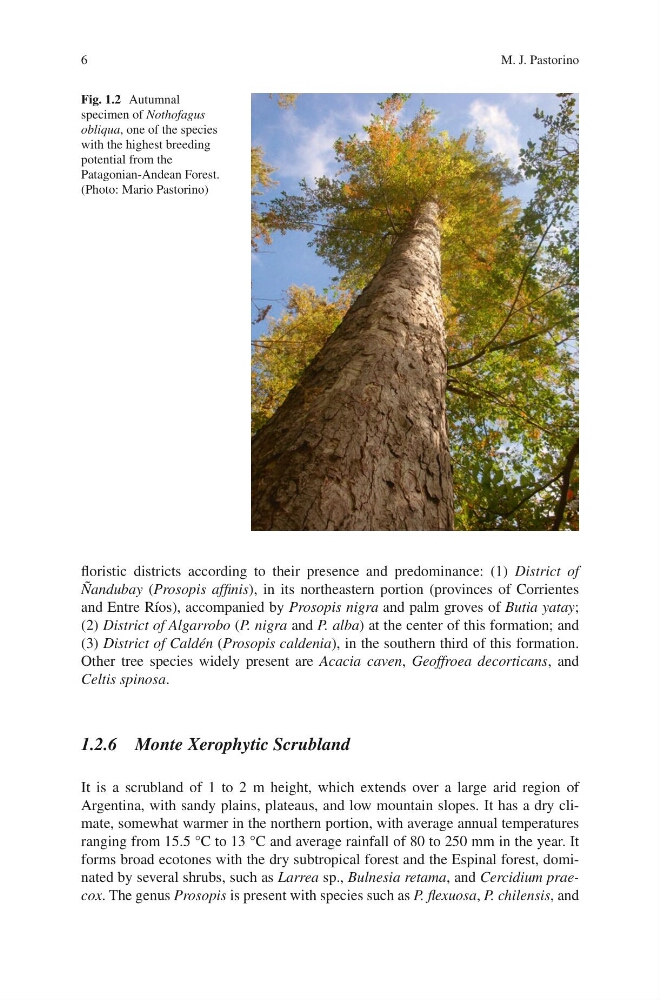
Fig. 1.2 Autumnal
specimen of Nothofagus
obliqua, one of the species
with the highest breeding
potential from the
Patagonian-Andean Forest.
(Photo: Mario Pastorino)
M. J. Pastorino
floristic districts according to their presence and predominance: (1) District of
Ñandubay (Prosopis affinis), in its northeastern portion (provinces of Corrientes
and Entre Ríos), accompanied by Prosopis nigra and palm groves of Butia yatay;
(2) District of Algarrobo (P. nigra and P. alba) at the center of this formation; and
(3) District of Caldén (Prosopis caldenia), in the southern third of this formation.
Other tree species widely present are Acacia caven, Geoffroea decorticans, and
Celtis spinosa.
1.2.6 Monte Xerophytic Scrubland
It is a scrubland of 1 to 2 m height, which extends over a large arid region of
Argentina, with sandy plains, plateaus, and low mountain slopes. It has a dry climate, somewhat warmer in the northern portion, with average annual temperatures
ranging from 15.5 °C to 13 °C and average rainfall of 80 to 250 mm in the year. It
forms broad ecotones with the dry subtropical forest and the Espinal forest, dominated by several shrubs, such as Larrea sp., Bulnesia retama, and Cercidium praecox. The genus Prosopis is present with species such as P. flexuosa, P. chilensis, and
Fig. 1.2 Autumnal
specimen of Nothofagus
obliqua, one of the species
with the highest breeding
potential from the
Patagonian-Andean Forest.
(Photo: Mario Pastorino)
M. J. Pastorino