

137
between plants of high and low altitudes marked a shortening of the growing season
that is perhaps the most relevant constraint for plants at high altitudes (Meloche and
Diggle 2003; Cox 2005). Plants from stand H were shorter, more densely branched
(immediate and delayed), and had a lower proportion of individuals whose main
axes were dominant. At year 6, they presented a higher mean branchiness, and the
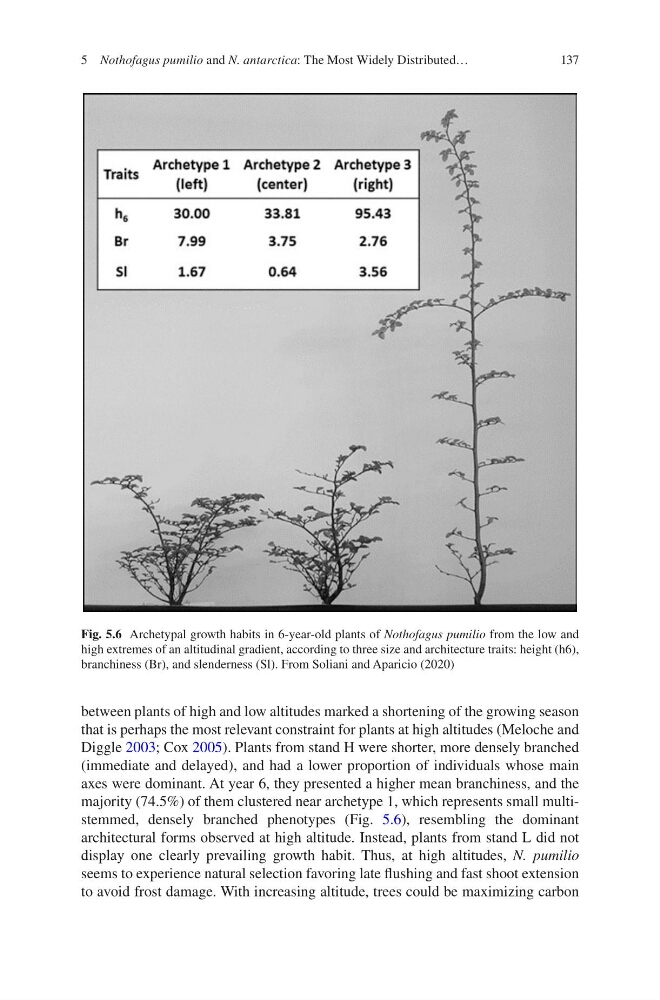
majority (74.5%) of them clustered near archetype 1, which represents small multistemmed, densely branched phenotypes (Fig. 5.6), resembling the dominant
architectural forms observed at high altitude. Instead, plants from stand L did not
display one clearly prevailing growth habit. Thus, at high altitudes, N. pumilio
seems to experience natural selection favoring late flushing and fast shoot extension
to avoid frost damage. With increasing altitude, trees could be maximizing carbon
Fig. 5.6 Archetypal growth habits in 6-year-old plants of Nothofagus pumilio from the low and
high extremes of an altitudinal gradient, according to three size and architecture traits: height (h6),
branchiness (Br), and slenderness (Sl). From Soliani and Aparicio (2020)
5 Nothofagus pumilio and N. antarctica: The Most Widely Distributed…
between plants of high and low altitudes marked a shortening of the growing season
that is perhaps the most relevant constraint for plants at high altitudes (Meloche and
Diggle 2003; Cox 2005). Plants from stand H were shorter, more densely branched
(immediate and delayed), and had a lower proportion of individuals whose main
axes were dominant. At year 6, they presented a higher mean branchiness, and the
majority (74.5%) of them clustered near archetype 1, which represents small multistemmed, densely branched phenotypes (Fig. 5.6), resembling the dominant
architectural forms observed at high altitude. Instead, plants from stand L did not
display one clearly prevailing growth habit. Thus, at high altitudes, N. pumilio
seems to experience natural selection favoring late flushing and fast shoot extension
to avoid frost damage. With increasing altitude, trees could be maximizing carbon
Fig. 5.6 Archetypal growth habits in 6-year-old plants of Nothofagus pumilio from the low and
high extremes of an altitudinal gradient, according to three size and architecture traits: height (h6),
branchiness (Br), and slenderness (Sl). From Soliani and Aparicio (2020)
5 Nothofagus pumilio and N. antarctica: The Most Widely Distributed…