

103
4.3.4 Resilience Against Eventual Damages
Seedling resprouting may have profound effects on population fitness, since it
implies the survival of novel and recombined genotypes and thus may enhance
opportunities for adaptive evolution under climate warming and associated changes
in the frequency and severity of disturbances. With regard to domestication,
resprouting might be an interesting trait to cope with wild and domestic animal
browsing, a limiting factor for the cultivation of roble pellín.
In order to analyse genetic variation and plasticity in seedling resprouting ability,
the previous trial (40 families from 4 populations) and a replica of it installed 400 m
apart in altitude were analysed together after a simulated damage (Aparicio et al.
2015). Just before starting the third growing season (September 2015), all 1920
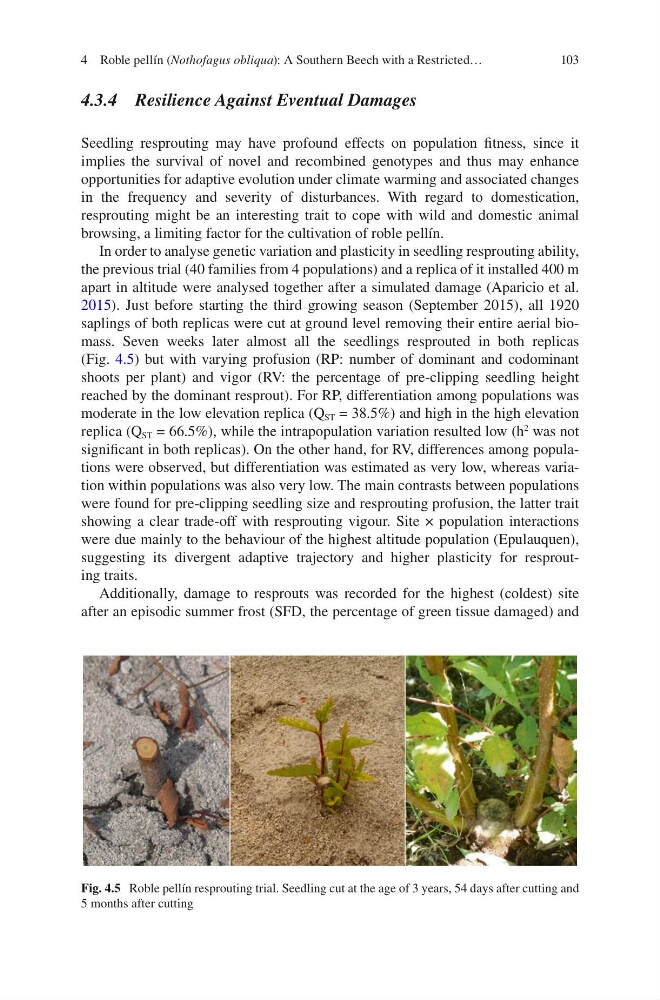
saplings of both replicas were cut at ground level removing their entire aerial biomass. Seven weeks later almost all the seedlings resprouted in both replicas
(Fig. 4.5) but with varying profusion (RP: number of dominant and codominant
shoots per plant) and vigor (RV: the percentage of pre-clipping seedling height
reached by the dominant resprout). For RP, differentiation among populations was
moderate in the low elevation replica (Q ST = 38.5%) and high in the high elevation
replica (Q ST = 66.5%), while the intrapopulation variation resulted low (h
2
was not
significant in both replicas). On the other hand, for RV, differences among populations were observed, but differentiation was estimated as very low, whereas variation within populations was also very low. The main contrasts between populations
were found for pre-clipping seedling size and resprouting profusion, the latter trait
showing a clear trade-off with resprouting vigour. Site × population interactions
were due mainly to the behaviour of the highest altitude population (Epulauquen),
suggesting its divergent adaptive trajectory and higher plasticity for resprouting traits.
Additionally, damage to resprouts was recorded for the highest (coldest) site
after an episodic summer frost (SFD, the percentage of green tissue damaged) and
Fig. 4.5 Roble pellín resprouting trial. Seedling cut at the age of 3 years, 54 days after cutting and
5 months after cutting
4 Roble pellín (Nothofagus obliqua): A Southern Beech with a Restricted…
4.3.4 Resilience Against Eventual Damages
Seedling resprouting may have profound effects on population fitness, since it
implies the survival of novel and recombined genotypes and thus may enhance
opportunities for adaptive evolution under climate warming and associated changes
in the frequency and severity of disturbances. With regard to domestication,
resprouting might be an interesting trait to cope with wild and domestic animal
browsing, a limiting factor for the cultivation of roble pellín.
In order to analyse genetic variation and plasticity in seedling resprouting ability,
the previous trial (40 families from 4 populations) and a replica of it installed 400 m
apart in altitude were analysed together after a simulated damage (Aparicio et al.
2015). Just before starting the third growing season (September 2015), all 1920
saplings of both replicas were cut at ground level removing their entire aerial biomass. Seven weeks later almost all the seedlings resprouted in both replicas
(Fig. 4.5) but with varying profusion (RP: number of dominant and codominant
shoots per plant) and vigor (RV: the percentage of pre-clipping seedling height
reached by the dominant resprout). For RP, differentiation among populations was
moderate in the low elevation replica (Q ST = 38.5%) and high in the high elevation
replica (Q ST = 66.5%), while the intrapopulation variation resulted low (h
2
was not
significant in both replicas). On the other hand, for RV, differences among populations were observed, but differentiation was estimated as very low, whereas variation within populations was also very low. The main contrasts between populations
were found for pre-clipping seedling size and resprouting profusion, the latter trait
showing a clear trade-off with resprouting vigour. Site × population interactions
were due mainly to the behaviour of the highest altitude population (Epulauquen),
suggesting its divergent adaptive trajectory and higher plasticity for resprouting traits.
Additionally, damage to resprouts was recorded for the highest (coldest) site
after an episodic summer frost (SFD, the percentage of green tissue damaged) and
Fig. 4.5 Roble pellín resprouting trial. Seedling cut at the age of 3 years, 54 days after cutting and
5 months after cutting
4 Roble pellín (Nothofagus obliqua): A Southern Beech with a Restricted…