

98
provided by neutral markers, populations exhibiting high genetic diversity and
assumed as probable glacial refuges likely have a higher adaptation capacity, since
within refugial areas, populations have survived for hundreds of generations, facing
different environmental scenarios along which the species evolved.
To face climate change predicted for the Patagonian region – with warming and
decreasing annual precipitation – information concerning genetic diversity at population level should be considered as an additional tool for seed source selection. The
identification of populations with high priority for conservation purposes should
then rely on their genetic diversity level, together with other features such as their
risk of extinction, their general ecological value and the presence of endemisms
harboured by them. For assisted migration programs under progressive climate
change, the identification of genetic zones together with knowledge about hotspots
of genetic diversity should constitute a relevant input for planning the activities.
4.2.3 Genetic Zones as Seed Sources for Breeding
and Restoration
Development of appropriate forest conservation and management measures for a
given tree species includes the identification of distinct genetically homogeneous
zones across its range on the basis of information on molecular and phenotypic
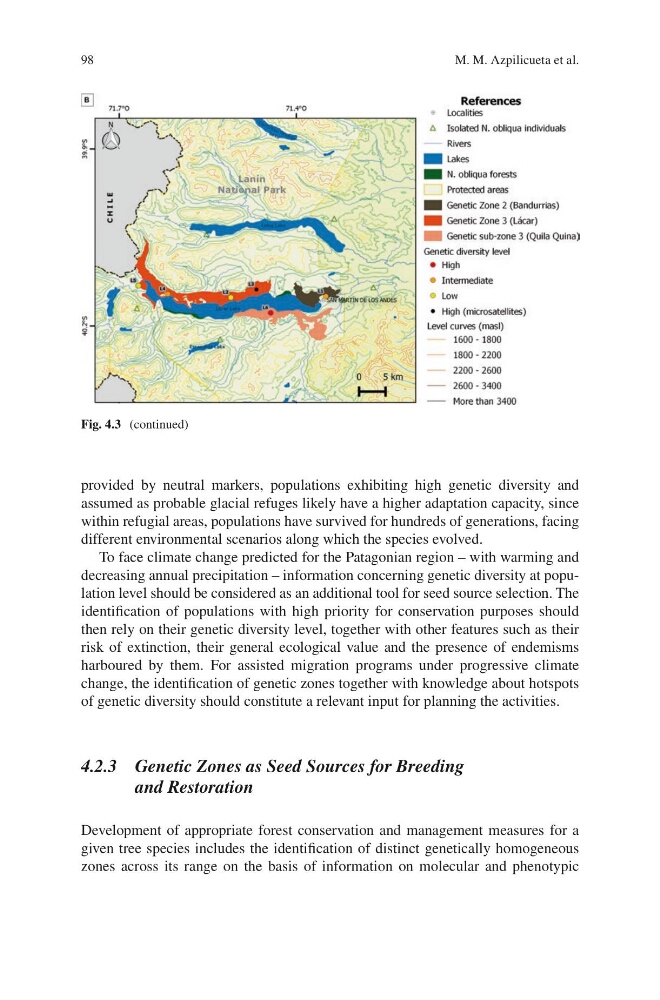
Fig. 4.3 (continued)
M. M. Azpilicueta et al.
provided by neutral markers, populations exhibiting high genetic diversity and
assumed as probable glacial refuges likely have a higher adaptation capacity, since
within refugial areas, populations have survived for hundreds of generations, facing
different environmental scenarios along which the species evolved.
To face climate change predicted for the Patagonian region – with warming and
decreasing annual precipitation – information concerning genetic diversity at population level should be considered as an additional tool for seed source selection. The
identification of populations with high priority for conservation purposes should
then rely on their genetic diversity level, together with other features such as their
risk of extinction, their general ecological value and the presence of endemisms
harboured by them. For assisted migration programs under progressive climate
change, the identification of genetic zones together with knowledge about hotspots
of genetic diversity should constitute a relevant input for planning the activities.
4.2.3 Genetic Zones as Seed Sources for Breeding
and Restoration
Development of appropriate forest conservation and management measures for a
given tree species includes the identification of distinct genetically homogeneous
zones across its range on the basis of information on molecular and phenotypic
Fig. 4.3 (continued)
M. M. Azpilicueta et al.