

76 Ecology and Applied Environmental Science
The subject remains open, but in general, the relationship between ecosystems’ complexity or diversity and stability does not apply. For the time
being, there is no way to pre-estimate the consequences of a species’ extinction from a biocoenosis with satisfactory accuracy. In some cases, such
change has perceptible results but in others it does not. It is reported that in
the case of a marine community with 15 invertebrate species, the removal
of one caused the reduction of the other species to 8.
The relation between diversity and stability has been linked to the
problem of environmental protection against human activities. It is often
suggested that strict measures should be taken for the species’ diversity conservation, based on the argument that otherwise, the general equilibrium
of ecosystems is at risk. This argument does not have strong documentation. However, as a rule, the reduction of biodiversity brings about adverse
consequences to ecosystems and man and it should be avoided, if only for
preventive reasons.
The concept of species diversity in a biocoenosis is related with the richness of its functions. Diversity could firstly be defined as the multitude of
species in the biocoenosis. The richness of functions, though, is related
not only with the multitude of species but with their relative abundance
as well. Let us suppose that there are two communities, A and B, with the
same total number of individuals N = 100 and the same species, 4 for each
community. Let us also suppose that the population sizes in community A
are 25, 25, 25, 25, and in community B they are 94, 2, 2, 2. Although
both communities have the same multitude of species, one can expect that
A will be characterized by a greater richness of functions compared to B.
This is why diversity indices that constitute a measure of the relative species
abundance have been proposed. One of those indices that was proposed by
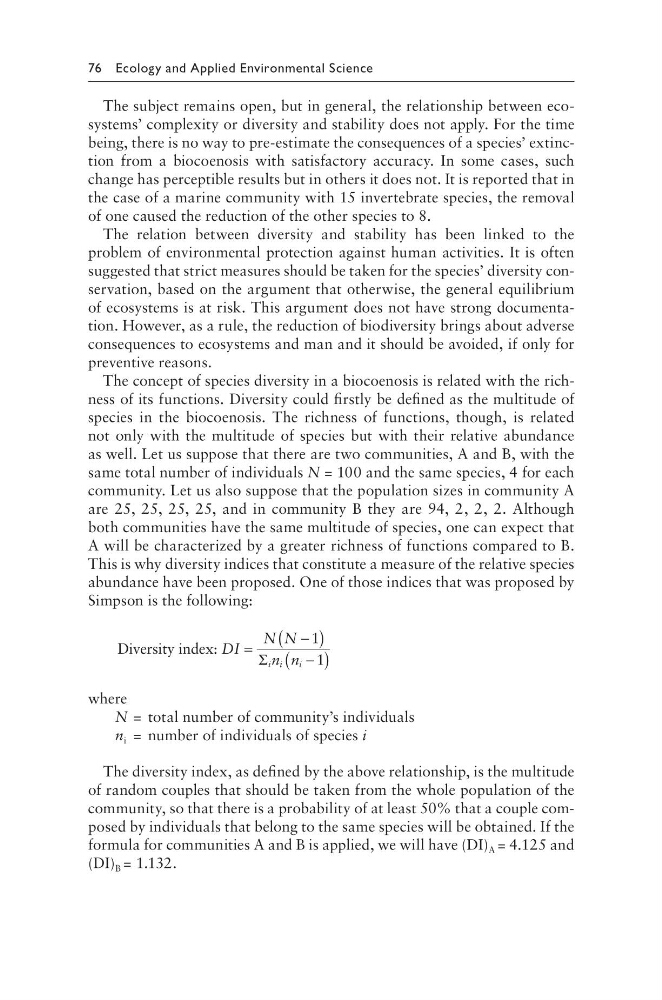
Simpson is the following:
Diversity index: DI
N N
n n
i i
i
=
−
(
)
−
(
)
1
1
Σ
where
N = total number of community’s individuals
n i = number of individuals of species i
The diversity index, as defined by the above relationship, is the multitude
of random couples that should be taken from the whole population of the
community, so that there is a probability of at least 50% that a couple composed by individuals that belong to the same species will be obtained. If the
formula for communities A and B is applied, we will have (DI) A = 4.125 and
(DI) B = 1.132.
The subject remains open, but in general, the relationship between ecosystems’ complexity or diversity and stability does not apply. For the time
being, there is no way to pre-estimate the consequences of a species’ extinction from a biocoenosis with satisfactory accuracy. In some cases, such
change has perceptible results but in others it does not. It is reported that in
the case of a marine community with 15 invertebrate species, the removal
of one caused the reduction of the other species to 8.
The relation between diversity and stability has been linked to the
problem of environmental protection against human activities. It is often
suggested that strict measures should be taken for the species’ diversity conservation, based on the argument that otherwise, the general equilibrium
of ecosystems is at risk. This argument does not have strong documentation. However, as a rule, the reduction of biodiversity brings about adverse
consequences to ecosystems and man and it should be avoided, if only for
preventive reasons.
The concept of species diversity in a biocoenosis is related with the richness of its functions. Diversity could firstly be defined as the multitude of
species in the biocoenosis. The richness of functions, though, is related
not only with the multitude of species but with their relative abundance
as well. Let us suppose that there are two communities, A and B, with the
same total number of individuals N = 100 and the same species, 4 for each
community. Let us also suppose that the population sizes in community A
are 25, 25, 25, 25, and in community B they are 94, 2, 2, 2. Although
both communities have the same multitude of species, one can expect that
A will be characterized by a greater richness of functions compared to B.
This is why diversity indices that constitute a measure of the relative species
abundance have been proposed. One of those indices that was proposed by
Simpson is the following:
Diversity index: DI
N N
n n
i i
i
=
−
(
)
−
(
)
1
1
Σ
where
N = total number of community’s individuals
n i = number of individuals of species i
The diversity index, as defined by the above relationship, is the multitude
of random couples that should be taken from the whole population of the
community, so that there is a probability of at least 50% that a couple composed by individuals that belong to the same species will be obtained. If the
formula for communities A and B is applied, we will have (DI) A = 4.125 and
(DI) B = 1.132.