

68 Ecology and Applied Environmental Science
Producer organisms integrate nitrogen in the prepared proteins. The rest
of the organisms supply themselves with the necessary organic nitrogen
from producer organisms, whereas some specialised decomposers break
down nitrogen compounds of dead organic matter. The greatest part of
nitrogen remains in the ground or water in the form of nitrate or ammonium salts and is reused by plants. A smaller part is released as gaseous N 2
in the atmosphere and completes the cycle. Finally, some N 2 quantities get
out of the cycle, since they end up as deposits in the bottom of the oceans.
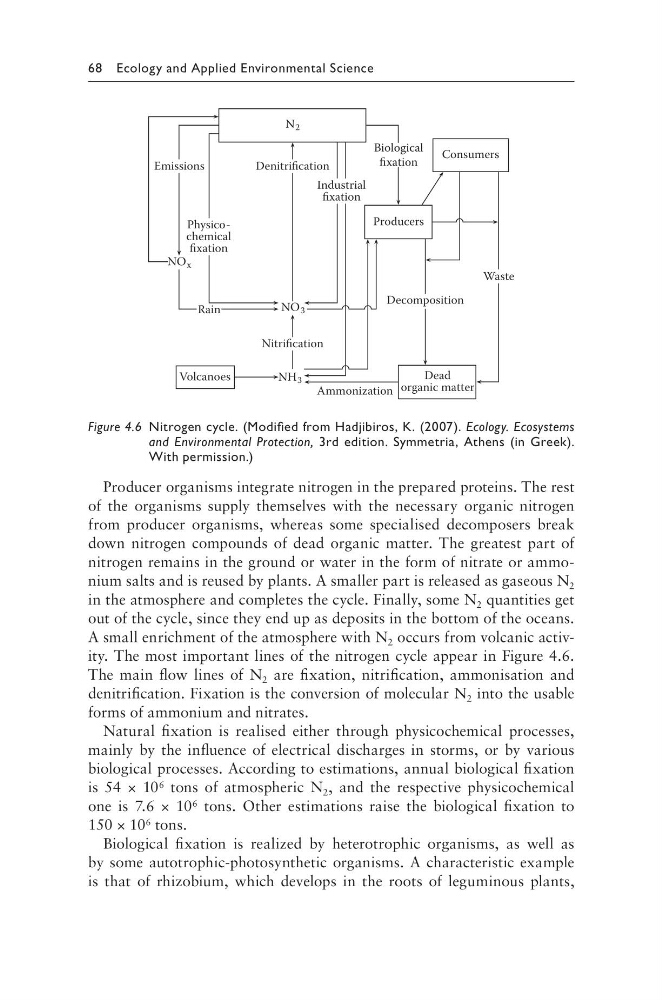
A small enrichment of the atmosphere with N 2 occurs from volcanic activity. The most important lines of the nitrogen cycle appear in Figure 4.6.
The main flow lines of N 2 are fixation, nitrification, ammonisation and
denitrification. Fixation is the conversion of molecular N 2 into the usable
forms of ammonium and nitrates.
Natural fixation is realised either through physicochemical processes,
mainly by the influence of electrical discharges in storms, or by various
biological processes. According to estimations, annual biological fixation
is 54 × 10 6 tons of atmospheric N 2 , and the respective physicochemical
one is 7.6 × 10 6 tons. Other estimations raise the biological fixation to
150 × 10 6 tons.
Biological fixation is realized by heterotrophic organisms, as well as
by some autotrophic-photosynthetic organisms. A characteristic example
is that of rhizobium, which develops in the roots of leguminous plants,
N 2
Consumers
Producers
Dead
organic matter
Volcanoes
NO 3
Denitrification
Industrial
fixation
Physicochemical
fixation
Rain
Emissions
NO x
Nitrification
NH 3
Biological
fixation
Ammonization
Waste
Decomposition
Figure 4.6 Nitrogen cycle. (Modified from Hadjibiros, K. (2007). Ecology. Ecosystems
and Environmental Protection, 3rd edition. Symmetria, Athens (in Greek).
With permission.)
Producer organisms integrate nitrogen in the prepared proteins. The rest
of the organisms supply themselves with the necessary organic nitrogen
from producer organisms, whereas some specialised decomposers break
down nitrogen compounds of dead organic matter. The greatest part of
nitrogen remains in the ground or water in the form of nitrate or ammonium salts and is reused by plants. A smaller part is released as gaseous N 2
in the atmosphere and completes the cycle. Finally, some N 2 quantities get
out of the cycle, since they end up as deposits in the bottom of the oceans.
A small enrichment of the atmosphere with N 2 occurs from volcanic activity. The most important lines of the nitrogen cycle appear in Figure 4.6.
The main flow lines of N 2 are fixation, nitrification, ammonisation and
denitrification. Fixation is the conversion of molecular N 2 into the usable
forms of ammonium and nitrates.
Natural fixation is realised either through physicochemical processes,
mainly by the influence of electrical discharges in storms, or by various
biological processes. According to estimations, annual biological fixation
is 54 × 10 6 tons of atmospheric N 2 , and the respective physicochemical
one is 7.6 × 10 6 tons. Other estimations raise the biological fixation to
150 × 10 6 tons.
Biological fixation is realized by heterotrophic organisms, as well as
by some autotrophic-photosynthetic organisms. A characteristic example
is that of rhizobium, which develops in the roots of leguminous plants,
N 2
Consumers
Producers
Dead
organic matter
Volcanoes
NO 3
Denitrification
Industrial
fixation
Physicochemical
fixation
Rain
Emissions
NO x
Nitrification
NH 3
Biological
fixation
Ammonization
Waste
Decomposition
Figure 4.6 Nitrogen cycle. (Modified from Hadjibiros, K. (2007). Ecology. Ecosystems
and Environmental Protection, 3rd edition. Symmetria, Athens (in Greek).
With permission.)