

Organisation at the Ecosystem Level 65
through the exchanges between living organisms and CO 2 . All land plant
production is realised by CO 2 consumption through photosynthesis. This
gas returns in the atmosphere through organic matter oxidation that takes
place during the process of respiration.
The sea contains an important amount of dissolved CO 2 , about 50 times
greater than the one in the atmosphere. The dissolved gas allows algae and
marine plants to photosynthesize, while at the same time it constitutes a
reservoir which can absorb or render CO 2 to the atmosphere, thus playing a
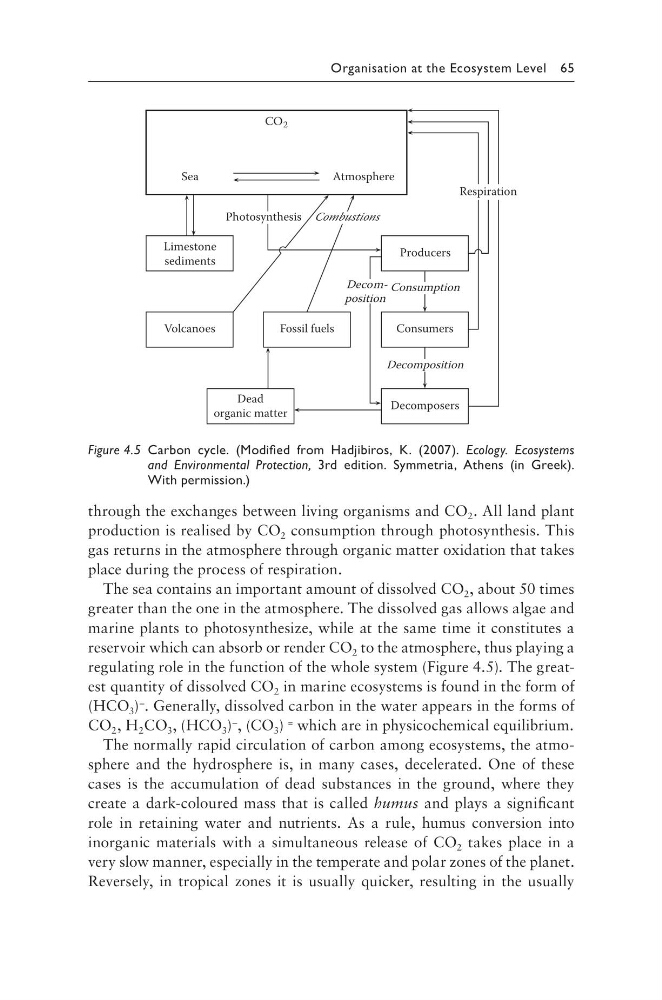
regulating role in the function of the whole system (Figure 4.5). The greatest quantity of dissolved CO 2 in marine ecosystems is found in the form of
(HCO 3 ) – . Generally, dissolved carbon in the water appears in the forms of
CO 2 , H 2 CO 3 , (HCO 3 ) – , (CO 3 ) = which are in physicochemical equilibrium.
The normally rapid circulation of carbon among ecosystems, the atmosphere and the hydrosphere is, in many cases, decelerated. One of these
cases is the accumulation of dead substances in the ground, where they
create a dark-coloured mass that is called humus and plays a significant
role in retaining water and nutrients. As a rule, humus conversion into
inorganic materials with a simultaneous release of CO 2 takes place in a
very slow manner, especially in the temperate and polar zones of the planet.
Reversely, in tropical zones it is usually quicker, resulting in the usually
Sea
Atmosphere
Limestone
sediments
Producers
Fossil fuels
Consumers
Volcanoes
Dead
organic matter
Decomposers
CO 2
Consumption
Photosynthesis
Decomposition
Combustions
Decomposition
Respiration
Figure 4.5 Carbon cycle. (Modified from Hadjibiros, K. (2007). Ecology. Ecosystems
and Environmental Protection, 3rd edition. Symmetria, Athens (in Greek).
With permission.)
through the exchanges between living organisms and CO 2 . All land plant
production is realised by CO 2 consumption through photosynthesis. This
gas returns in the atmosphere through organic matter oxidation that takes
place during the process of respiration.
The sea contains an important amount of dissolved CO 2 , about 50 times
greater than the one in the atmosphere. The dissolved gas allows algae and
marine plants to photosynthesize, while at the same time it constitutes a
reservoir which can absorb or render CO 2 to the atmosphere, thus playing a
regulating role in the function of the whole system (Figure 4.5). The greatest quantity of dissolved CO 2 in marine ecosystems is found in the form of
(HCO 3 ) – . Generally, dissolved carbon in the water appears in the forms of
CO 2 , H 2 CO 3 , (HCO 3 ) – , (CO 3 ) = which are in physicochemical equilibrium.
The normally rapid circulation of carbon among ecosystems, the atmosphere and the hydrosphere is, in many cases, decelerated. One of these
cases is the accumulation of dead substances in the ground, where they
create a dark-coloured mass that is called humus and plays a significant
role in retaining water and nutrients. As a rule, humus conversion into
inorganic materials with a simultaneous release of CO 2 takes place in a
very slow manner, especially in the temperate and polar zones of the planet.
Reversely, in tropical zones it is usually quicker, resulting in the usually
Sea
Atmosphere
Limestone
sediments
Producers
Fossil fuels
Consumers
Volcanoes
Dead
organic matter
Decomposers
CO 2
Consumption
Photosynthesis
Decomposition
Combustions
Decomposition
Respiration
Figure 4.5 Carbon cycle. (Modified from Hadjibiros, K. (2007). Ecology. Ecosystems
and Environmental Protection, 3rd edition. Symmetria, Athens (in Greek).
With permission.)