

62 Ecology and Applied Environmental Science
environment. In this manner, about 35 different chemical elements, essential for the function of living cells, sequentially go through inorganic and
organic forms and reversely. As a rule, these are used primarily by plants
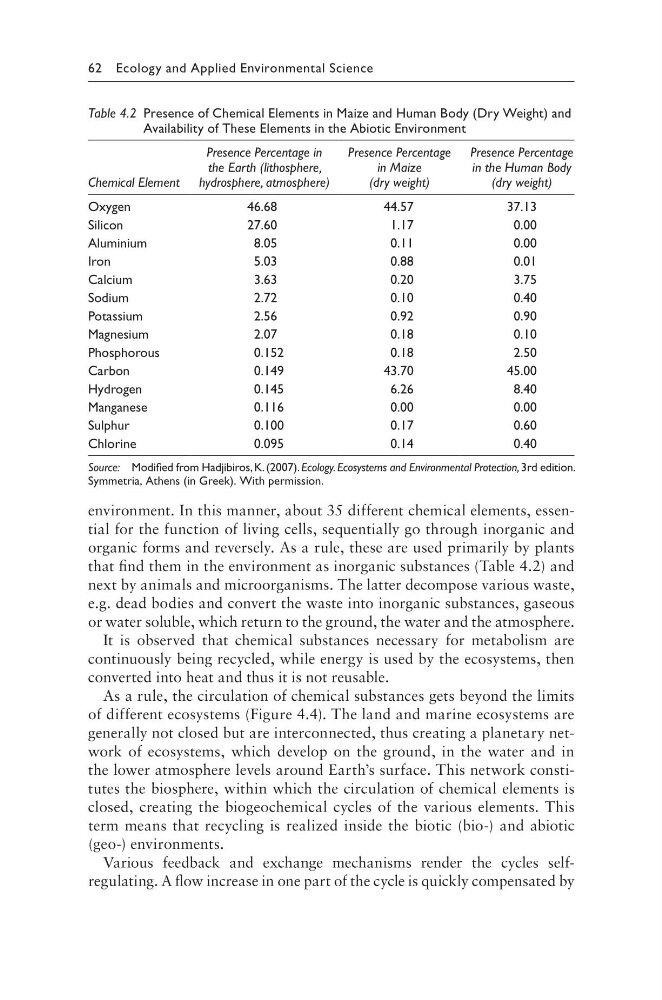
that find them in the environment as inorganic substances (Table 4.2) and
next by animals and microorganisms. The latter decompose various waste,
e.g. dead bodies and convert the waste into inorganic substances, gaseous
or water soluble, which return to the ground, the water and the atmosphere.
It is observed that chemical substances necessary for metabolism are
continuously being recycled, while energy is used by the ecosystems, then
converted into heat and thus it is not reusable.
As a rule, the circulation of chemical substances gets beyond the limits
of different ecosystems (Figure 4.4). The land and marine ecosystems are
generally not closed but are interconnected, thus creating a planetary network of ecosystems, which develop on the ground, in the water and in
the lower atmosphere levels around Earth’s surface. This network constitutes the biosphere, within which the circulation of chemical elements is
closed, creating the biogeochemical cycles of the various elements. This
term means that recycling is realized inside the biotic (bio-) and abiotic
(geo-) environments.
Various feedback and exchange mechanisms render the cycles self-
regulating. A flow increase in one part of the cycle is quickly compensated by
Table 4.2 Presence of Chemical Elements in Maize and Human Body (Dry Weight) and
Availability of These Elements in the Abiotic Environment
Chemical Element
Presence Percentage in
the Earth (lithosphere,
hydrosphere, atmosphere)
Presence Percentage
in Maize
(dry weight)
Presence Percentage
in the Human Body
(dry weight)
Oxygen
46.68
44.57
37.13
Silicon
27.60
1.17
0.00
Aluminium
8.05
0.11
0.00
Iron
5.03
0.88
0.01
Calcium
3.63
0.20
3.75
Sodium
2.72
0.10
0.40
Potassium
2.56
0.92
0.90
Magnesium
2.07
0.18
0.10
Phosphorous
0.152
0.18
2.50
Carbon
0.149
43.70
45.00
Hydrogen
0.145
6.26
8.40
Manganese
0.116
0.00
0.00
Sulphur
0.100
0.17
0.60
Chlorine
0.095
0.14
0.40
Source: Modified from Hadjibiros, K. (2007). Ecology. Ecosystems and Environmental Protection, 3rd edition.
Symmetria, Athens (in Greek). With permission.
environment. In this manner, about 35 different chemical elements, essential for the function of living cells, sequentially go through inorganic and
organic forms and reversely. As a rule, these are used primarily by plants
that find them in the environment as inorganic substances (Table 4.2) and
next by animals and microorganisms. The latter decompose various waste,
e.g. dead bodies and convert the waste into inorganic substances, gaseous
or water soluble, which return to the ground, the water and the atmosphere.
It is observed that chemical substances necessary for metabolism are
continuously being recycled, while energy is used by the ecosystems, then
converted into heat and thus it is not reusable.
As a rule, the circulation of chemical substances gets beyond the limits
of different ecosystems (Figure 4.4). The land and marine ecosystems are
generally not closed but are interconnected, thus creating a planetary network of ecosystems, which develop on the ground, in the water and in
the lower atmosphere levels around Earth’s surface. This network constitutes the biosphere, within which the circulation of chemical elements is
closed, creating the biogeochemical cycles of the various elements. This
term means that recycling is realized inside the biotic (bio-) and abiotic
(geo-) environments.
Various feedback and exchange mechanisms render the cycles self-
regulating. A flow increase in one part of the cycle is quickly compensated by
Table 4.2 Presence of Chemical Elements in Maize and Human Body (Dry Weight) and
Availability of These Elements in the Abiotic Environment
Chemical Element
Presence Percentage in
the Earth (lithosphere,
hydrosphere, atmosphere)
Presence Percentage
in Maize
(dry weight)
Presence Percentage
in the Human Body
(dry weight)
Oxygen
46.68
44.57
37.13
Silicon
27.60
1.17
0.00
Aluminium
8.05
0.11
0.00
Iron
5.03
0.88
0.01
Calcium
3.63
0.20
3.75
Sodium
2.72
0.10
0.40
Potassium
2.56
0.92
0.90
Magnesium
2.07
0.18
0.10
Phosphorous
0.152
0.18
2.50
Carbon
0.149
43.70
45.00
Hydrogen
0.145
6.26
8.40
Manganese
0.116
0.00
0.00
Sulphur
0.100
0.17
0.60
Chlorine
0.095
0.14
0.40
Source: Modified from Hadjibiros, K. (2007). Ecology. Ecosystems and Environmental Protection, 3rd edition.
Symmetria, Athens (in Greek). With permission.