

60 Ecology and Applied Environmental Science
• Soil quality and the presence of nutrient salts and of trace elements
are important. They are also significant for the proper fertilization of
agricultural cultivations.
stitutes the limiting factor that usually determines aquatic ecosystem’s productivity.
• Carbon dioxide concentration in the air or the water is possibly the
main limiting factor for the biosphere in recent geological periods and
in a large time scale.
• Adverse effects of parasites, pollution, grazing or other anthropogenic
interventions may be limiting factors.
An amount of anthropogenic limiting factors is associated with pollution.
Here, one can discern the following:
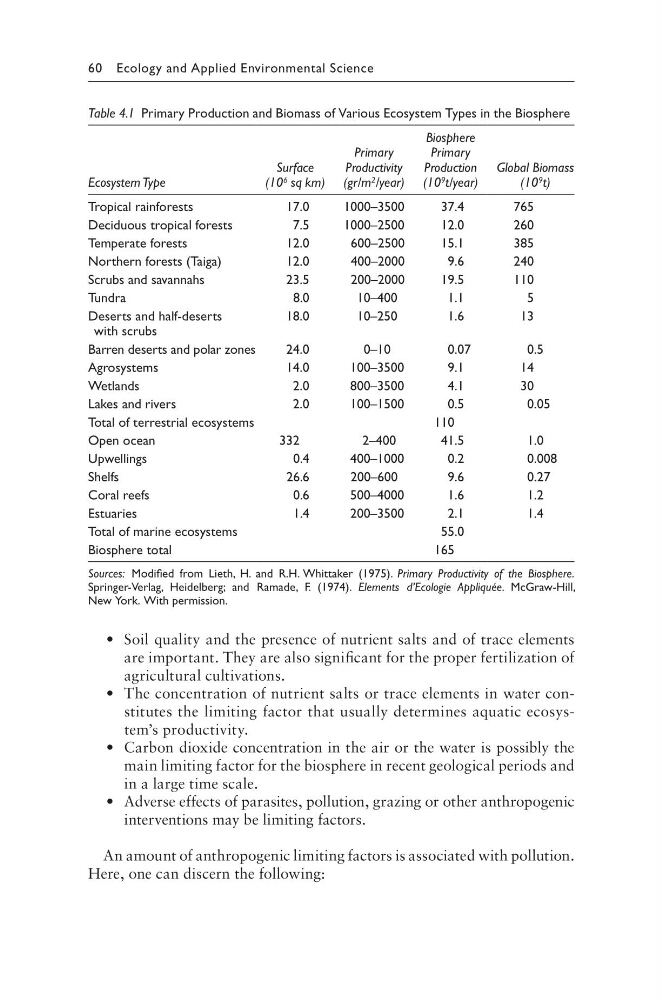
Table 4.1 Primary Production and Biomass of Various Ecosystem Types in the Biosphere
Ecosystem Type
Surface
(10 6 sq km)
Primary
Productivity
(gr/m 2 /year)
Biosphere
Primary
Production
(10 9 t/year)
Global Biomass
(10 9 t)
Tropical rainforests
17.0
1000–3500
37.4
765
Deciduous tropical forests
7.5
1000–2500
12.0
260
Temperate forests
12.0
600–2500
15.1
385
Northern forests (Taiga)
12.0
400–2000
9.6
240
Scrubs and savannahs
23.5
200–2000
19.5
110
Tundra
8.0
10–400
1.1
5
Deserts and half-deserts
with scrubs
18.0
10–250
1.6
13
Barren deserts and polar zones
24.0
0–10
0.07
0.5
Agrosystems
14.0
100–3500
9.1
14
Wetlands
2.0
800–3500
4.1
30
Lakes and rivers
2.0
100–1500
0.5
0.05
Total of terrestrial ecosystems
110
Open ocean
332
2–400
41.5
1.0
Upwellings
0.4
400–1000
0.2
0.008
Shelfs
26.6
200–600
9.6
0.27
Coral reefs
0.6
500–4000
1.6
1.2
Estuaries
1.4
200–3500
2.1
1.4
Total of marine ecosystems
55.0
Biosphere total
165
Sources: Modified from Lieth, H. and R.H. Whittaker (1975). Primary Productivity of the Biosphere.
Springer-Verlag, Heidelberg; and Ramade, F. (1974). Elements d’Ecologie Appliquée. McGraw-Hill,
New York. With permission.
• Soil quality and the presence of nutrient salts and of trace elements
are important. They are also significant for the proper fertilization of
agricultural cultivations.
stitutes the limiting factor that usually determines aquatic ecosystem’s productivity.
• Carbon dioxide concentration in the air or the water is possibly the
main limiting factor for the biosphere in recent geological periods and
in a large time scale.
• Adverse effects of parasites, pollution, grazing or other anthropogenic
interventions may be limiting factors.
An amount of anthropogenic limiting factors is associated with pollution.
Here, one can discern the following:
Table 4.1 Primary Production and Biomass of Various Ecosystem Types in the Biosphere
Ecosystem Type
Surface
(10 6 sq km)
Primary
Productivity
(gr/m 2 /year)
Biosphere
Primary
Production
(10 9 t/year)
Global Biomass
(10 9 t)
Tropical rainforests
17.0
1000–3500
37.4
765
Deciduous tropical forests
7.5
1000–2500
12.0
260
Temperate forests
12.0
600–2500
15.1
385
Northern forests (Taiga)
12.0
400–2000
9.6
240
Scrubs and savannahs
23.5
200–2000
19.5
110
Tundra
8.0
10–400
1.1
5
Deserts and half-deserts
with scrubs
18.0
10–250
1.6
13
Barren deserts and polar zones
24.0
0–10
0.07
0.5
Agrosystems
14.0
100–3500
9.1
14
Wetlands
2.0
800–3500
4.1
30
Lakes and rivers
2.0
100–1500
0.5
0.05
Total of terrestrial ecosystems
110
Open ocean
332
2–400
41.5
1.0
Upwellings
0.4
400–1000
0.2
0.008
Shelfs
26.6
200–600
9.6
0.27
Coral reefs
0.6
500–4000
1.6
1.2
Estuaries
1.4
200–3500
2.1
1.4
Total of marine ecosystems
55.0
Biosphere total
165
Sources: Modified from Lieth, H. and R.H. Whittaker (1975). Primary Productivity of the Biosphere.
Springer-Verlag, Heidelberg; and Ramade, F. (1974). Elements d’Ecologie Appliquée. McGraw-Hill,
New York. With permission.