

44 Ecology and Applied Environmental Science
he has been an accomplished predator of many—and still is a redoubtable competitor of many more—biological species. Human overpopulation constitutes the main factor of degradation of the biosphere and the
environment in general (Chapter 5). As early as 1798, economist Thomas
Malthus suggested that the increasing population will cause depletion of
the resources, which will lead to poverty, hunger and death. Although the
Malthusian predictions have not been confirmed because of technological
and social activities (Chapter 13), the great increase of the global population during the last decades, the generalized expectation of approaching
a high level of consumption and the use of harmful productive methods
(Chapters 7, 8, and 9) lead to an increase of pressures on the environment
and the resources. An observation of human population history reveals the
factors that influence its evolution.
3.7.1 the changes of human Populations
Historical data about the sizes of human populations exist for the period
after AD 1650. Population estimates about previous periods are indirect,
with few circumstantial facts. Before 8000 BC, for example, agriculture
had not developed, man was a wild animals’ hunter and fruit gatherer
and the estimate is based on the observed density of hunters-gatherers’
groups today. For the period from the development of agriculture until the
middle of the 17th century, when population census begun, the estimates
were performed based on observations of contemporary rural societies in
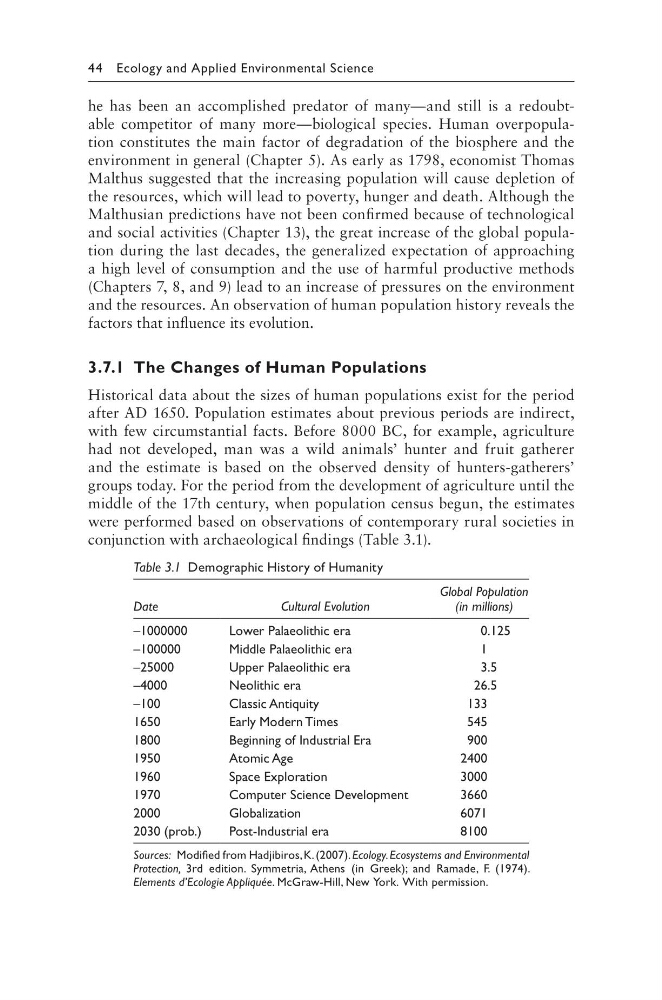
conjunction with archaeological findings (Table 3.1).
Table 3.1 Demographic History of Humanity
Date
Cultural Evolution
Global Population
(in millions)
–1000000
Lower Palaeolithic era
0.125
–100000
Middle Palaeolithic era
1
–25000
Upper Palaeolithic era
3.5
–4000
Neolithic era
26.5
–100
Classic Antiquity
133
1650
Early Modern Times
545
1800
Beginning of Industrial Era
900
1950
Atomic Age
2400
1960
Space Exploration
3000
1970
Computer Science Development
3660
2000
Globalization
6071
2030 (prob.)
Post-Industrial era
8100
Sources: Modified from Hadjibiros, K. (2007). Ecology. Ecosystems and Environmental
Protection, 3rd edition. Symmetria, Athens (in Greek); and Ramade, F. (1974).
Elements d’Ecologie Appliquée. McGraw-Hill, New York. With permission.
he has been an accomplished predator of many—and still is a redoubtable competitor of many more—biological species. Human overpopulation constitutes the main factor of degradation of the biosphere and the
environment in general (Chapter 5). As early as 1798, economist Thomas
Malthus suggested that the increasing population will cause depletion of
the resources, which will lead to poverty, hunger and death. Although the
Malthusian predictions have not been confirmed because of technological
and social activities (Chapter 13), the great increase of the global population during the last decades, the generalized expectation of approaching
a high level of consumption and the use of harmful productive methods
(Chapters 7, 8, and 9) lead to an increase of pressures on the environment
and the resources. An observation of human population history reveals the
factors that influence its evolution.
3.7.1 the changes of human Populations
Historical data about the sizes of human populations exist for the period
after AD 1650. Population estimates about previous periods are indirect,
with few circumstantial facts. Before 8000 BC, for example, agriculture
had not developed, man was a wild animals’ hunter and fruit gatherer
and the estimate is based on the observed density of hunters-gatherers’
groups today. For the period from the development of agriculture until the
middle of the 17th century, when population census begun, the estimates
were performed based on observations of contemporary rural societies in
conjunction with archaeological findings (Table 3.1).
Table 3.1 Demographic History of Humanity
Date
Cultural Evolution
Global Population
(in millions)
–1000000
Lower Palaeolithic era
0.125
–100000
Middle Palaeolithic era
1
–25000
Upper Palaeolithic era
3.5
–4000
Neolithic era
26.5
–100
Classic Antiquity
133
1650
Early Modern Times
545
1800
Beginning of Industrial Era
900
1950
Atomic Age
2400
1960
Space Exploration
3000
1970
Computer Science Development
3660
2000
Globalization
6071
2030 (prob.)
Post-Industrial era
8100
Sources: Modified from Hadjibiros, K. (2007). Ecology. Ecosystems and Environmental
Protection, 3rd edition. Symmetria, Athens (in Greek); and Ramade, F. (1974).
Elements d’Ecologie Appliquée. McGraw-Hill, New York. With permission.