

Organisation at Population Level 39
populations may reach a very small size, and for some random occurrence,
not recover and become eliminated. Then, if the predator is eliminated,
the prey will survive, but if the prey is eradicated, the predator will also be
eliminated. In both cases the system will be altered.
In such circumstances, the concept of refuge can be a stabilising factor,
offering preys the ability to protect themselves against predation while
giving predators the possibility of protection from exhaustion due to lack of
food. Refuges can be spatial, for example a prey’s shelter; temporal, as for
example the existence of some biological stages in the prey’s or predator’s
life span that do not contribute to predation.
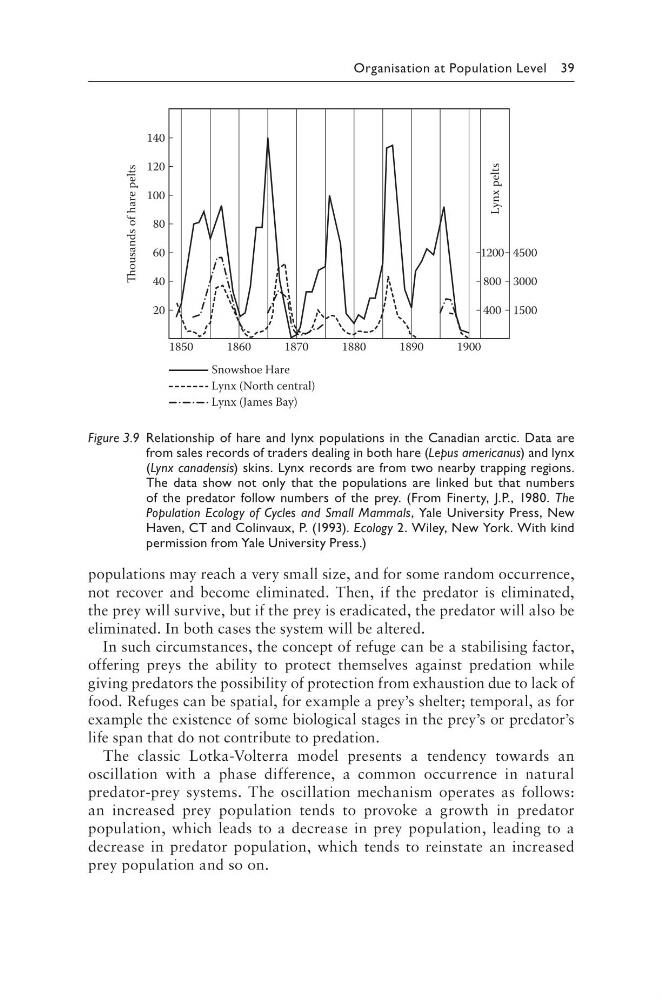
The classic Lotka-Volterra model presents a tendency towards an
oscillation with a phase difference, a common occurrence in natural
predator-prey systems. The oscillation mechanism operates as follows:
an increased prey population tends to provoke a growth in predator
population, which leads to a decrease in prey population, leading to a
decrease in predator population, which tends to reinstate an increased
prey population and so on.
1850
1860
1870
1880
1890
1900
20
40
60
1500
3000
4500
400
800
1200
80
ousands of hare pelts
Lynx pelts
100
120
140
Snowshoe Hare
Lynx (North central)
Lynx (James Bay)
Figure 3.9 Relationship of hare and lynx populations in the Canadian arctic. Data are
from sales records of traders dealing in both hare (Lepus americanus) and lynx
(Lynx canadensis) skins. Lynx records are from two nearby trapping regions.
The data show not only that the populations are linked but that numbers
of the predator follow numbers of the prey. (From Finerty, J.P., 1980. The
Population Ecology of Cycles and Small Mammals, Yale University Press, New
Haven, CT and Colinvaux, P. (1993). Ecology 2. Wiley, New York. With kind
permission from Yale University Press.)
populations may reach a very small size, and for some random occurrence,
not recover and become eliminated. Then, if the predator is eliminated,
the prey will survive, but if the prey is eradicated, the predator will also be
eliminated. In both cases the system will be altered.
In such circumstances, the concept of refuge can be a stabilising factor,
offering preys the ability to protect themselves against predation while
giving predators the possibility of protection from exhaustion due to lack of
food. Refuges can be spatial, for example a prey’s shelter; temporal, as for
example the existence of some biological stages in the prey’s or predator’s
life span that do not contribute to predation.
The classic Lotka-Volterra model presents a tendency towards an
oscillation with a phase difference, a common occurrence in natural
predator-prey systems. The oscillation mechanism operates as follows:
an increased prey population tends to provoke a growth in predator
population, which leads to a decrease in prey population, leading to a
decrease in predator population, which tends to reinstate an increased
prey population and so on.
1850
1860
1870
1880
1890
1900
20
40
60
1500
3000
4500
400
800
1200
80
ousands of hare pelts
Lynx pelts
100
120
140
Snowshoe Hare
Lynx (North central)
Lynx (James Bay)
Figure 3.9 Relationship of hare and lynx populations in the Canadian arctic. Data are
from sales records of traders dealing in both hare (Lepus americanus) and lynx
(Lynx canadensis) skins. Lynx records are from two nearby trapping regions.
The data show not only that the populations are linked but that numbers
of the predator follow numbers of the prey. (From Finerty, J.P., 1980. The
Population Ecology of Cycles and Small Mammals, Yale University Press, New
Haven, CT and Colinvaux, P. (1993). Ecology 2. Wiley, New York. With kind
permission from Yale University Press.)